Wuthering Heights, Part 1 of 3: A Foundling and a Choice
Victorian and Edwardian · Part 1 of 3: A Foundling and a Choice
Wuthering Heights
Emily Brontë (1847) · Chapters 1-9
A visitor to a bleak Yorkshire farmhouse hears how a foundling named Heathcliff grew up there, loved Catherine and lost her to Edgar.
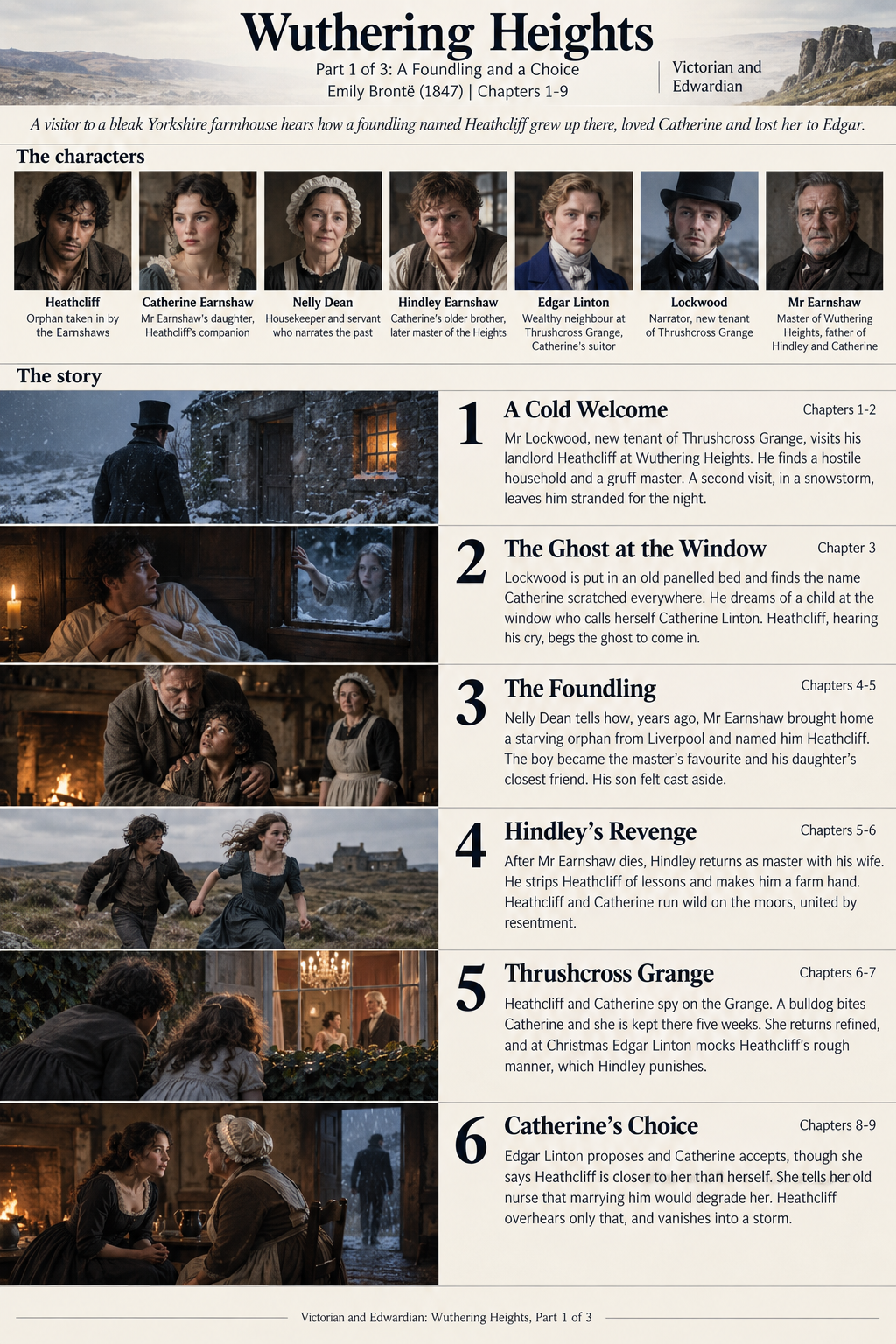
Wuthering Heights opens in 1801 with a stranger's mistake. Mr Lockwood, a refined young man fleeing society, rents Thrushcross Grange in the Yorkshire moors and calls on his landlord, Heathcliff, at a remote farmhouse called Wuthering Heights. He expects a fellow recluse and finds a house where nobody is welcoming and everybody seems at war. The story reaches us through Lockwood's diary and, soon, through a housekeeper's memory.
Heathcliff is dark, curt and watchful. His household includes a sullen young woman, a rough young man and a fanatical old servant, Joseph. Snowed in on a second visit, Lockwood is put in an old panelled bed. He finds the name Catherine scratched on the ledge in three versions: Earnshaw, Heathcliff, Linton. He dreams of a child at the window who says she is Catherine Linton, a waif for twenty years. When he cries out, Heathcliff flings open the casement and begs her to come in.
Back at the Grange, ill, Lockwood draws the story from Nelly Dean. Years earlier, Mr Earnshaw walked home from Liverpool with a ragged, dark orphan and named him Heathcliff. His son Hindley hated the newcomer; his daughter Catherine became his inseparable companion. When Mr Earnshaw died, Hindley returned as master with a wife, Frances, and turned Heathcliff into a farm labourer. The two young people escaped to Thrushcross Grange to spy on the Lintons. A bulldog seized Catherine, and she stayed there five weeks. She came home a young lady, and Heathcliff was mocked by Edgar Linton. After Frances died giving birth to a son, Hareton, Hindley sank into drink. Edgar proposed and Catherine accepted. She told Nelly that marrying Heathcliff would now degrade her, though she also said, "I am Heathcliff." Heathcliff heard only the first part, left in a storm and vanished. Catherine, soaked and feverish, was nursed at the Grange and later married Edgar.
Motives here are tangled. Hindley's cruelty grows from wounded pride, since he feels his father's love was stolen. Heathcliff's devotion to Catherine hardens into bitterness as he is pushed down the social ladder. Catherine is torn between a bond she feels as part of her own nature and the comfort and status Edgar offers. She half persuades herself that Edgar's wealth might one day help Heathcliff.
The part develops the book's central contrasts: the wild Heights against the polished Grange, passion against propriety, and love as identity against love as social advancement. It also shows how class, ownership and humiliation shape character. Scholars disagree about Heathcliff's origins and what they signify, and about whether Catherine's choice is a betrayal or the act of a woman with few options. Nelly, a partial narrator, adds to the uncertainty.
A reader can take away several lessons. Cruelty and humiliation in childhood have long consequences. Pride and half-heard words can wreck lives. Choosing security over deep attachment may carry a cost that no one can foresee. And when a story is told through one witness, it is worth asking what that witness might leave out.
Further reading
- Emily Brontë (ed. Pauline Nestor), Wuthering Heights (Penguin Classics) (2003)
- Juliet Barker, The Brontës (1994)
- Terry Eagleton, Myths of Power: A Marxist Study of the Brontës (1975)