Wuthering Heights, Part 2 of 3: Return, Revenge and Death
Victorian and Edwardian · Part 2 of 3: Return, Revenge and Death
Wuthering Heights
Emily Brontë (1847) · Chapters 10-17
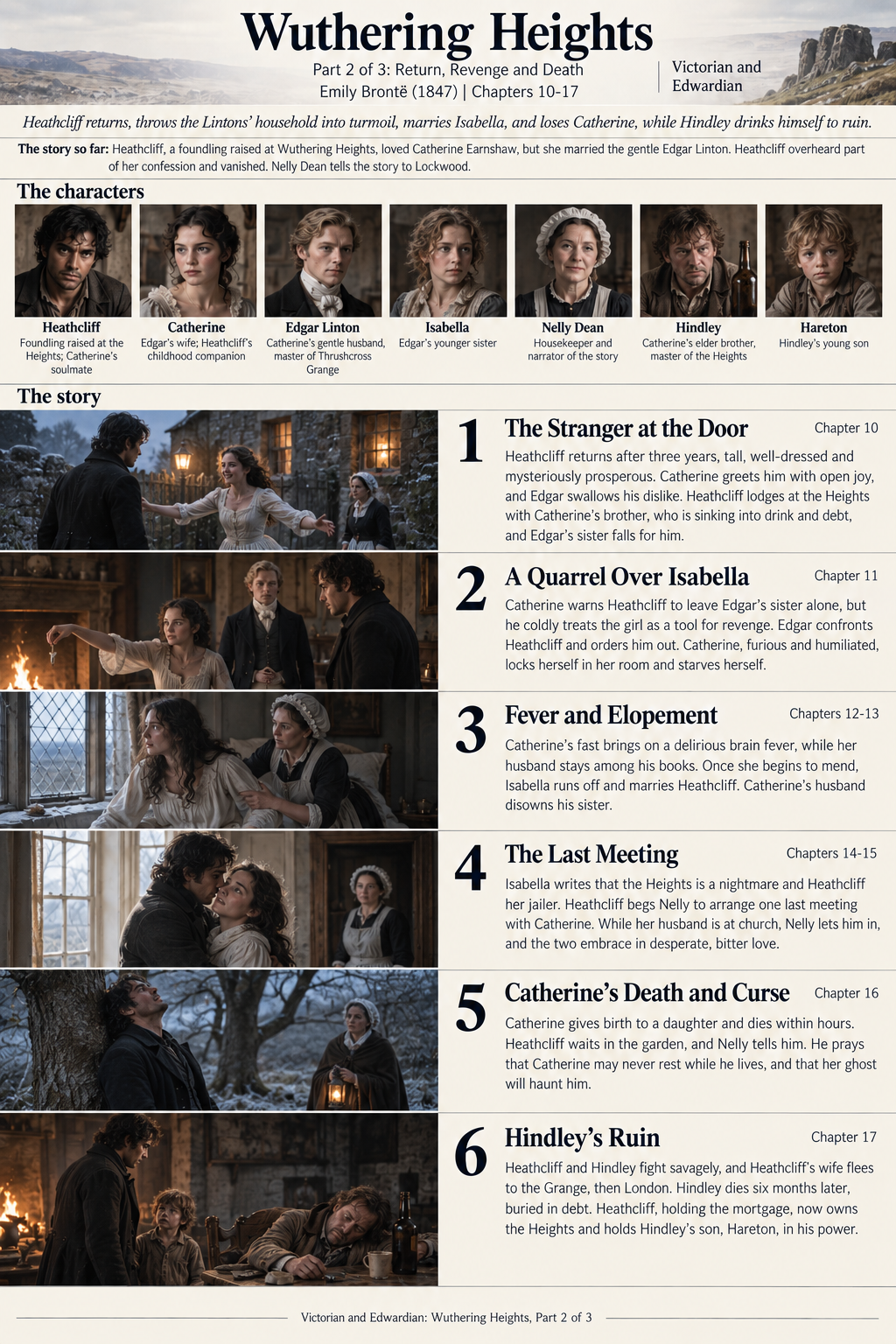
Heathcliff returns, throws the Lintons' household into turmoil, marries Isabella, and loses Catherine, while Hindley drinks himself to ruin.
The story so far: Heathcliff, a foundling raised at Wuthering Heights, loved Catherine Earnshaw, but she married the gentle Edgar Linton. Heathcliff overheard part of her confession and vanished. Nelly Dean tells the story to Lockwood.
Part one ended with Catherine Earnshaw married to Edgar Linton of Thrushcross Grange. Heathcliff, the foundling raised beside her at Wuthering Heights and degraded by her brother Hindley, had overheard half of her confession and vanished. Nelly Dean, the housekeeper, has been telling the tale to the tenant Lockwood.
This part opens with Heathcliff's return after three years, tall, well-dressed and unreadable. Catherine is overjoyed; Edgar is stiff and uneasy. Heathcliff lodges at the Heights, where Hindley is gambling and drinking himself into debt, while Edgar's sister Isabella falls romantically for him. Catherine warns Heathcliff off, but he treats the girl as a weapon against Edgar. When Edgar orders him from the house, Catherine, caught between two men, locks herself in her room and starves herself into a brain fever.
While Catherine lies delirious and her husband buries himself in books, Isabella elopes with Heathcliff. Edgar disowns her. At the Heights she discovers a cruel, loveless household and writes a letter saying so. Heathcliff persuades Nelly to arrange one last meeting with Catherine while Edgar is at church. They embrace in anguish, each blaming the other for the ruin. That night Catherine gives birth to a daughter and dies within hours. Heathcliff's grief becomes a curse: he prays that she may never rest while he lives and that she will haunt him. Isabella soon escapes from the Heights and goes south. Hindley dies six months later, leaving his debts to Heathcliff, who now owns the Heights and holds Hindley's son Hareton in his power.
The characters are driven by wounded pride and thwarted love. Catherine wants both men and cannot bear to lose either; her illness is half rage and half self-punishment. Heathcliff's love hardens into a vengeance that spares no one, not even Isabella. Edgar is decent but passive, and his inability to grasp Catherine's danger helps hasten her end. Nelly, who both helps and hinders, shows how little a narrator, or a bystander, can truly control.
The part develops the book's central themes: love as a destructive, almost physical bond, the clash between wild moorland passion and genteel Grange civility, and revenge as a form of inheritance. Property and marriage are weapons: Heathcliff gains the Heights and Hareton by exploiting debt and an elopement. Critics disagree whether Heathcliff is a Byronic hero, a victim of class cruelty, or a figure of pure destructiveness. Probably he is all three.
Readers can take away several lessons. Cruelty is learned and passed on; the abuse of Heathcliff in childhood comes back as abuse of others. Trying to please everyone, as Catherine does, can destroy a person. Silence and passivity, like Edgar's, are not innocence. And treating other people as instruments of a grudge will ruin the avenger too.
Further reading
- Emily Brontë, ed. Pauline Nestor, Wuthering Heights (Penguin Classics) (2003)
- Juliet Barker, The Brontës (1994)
- Winifred Gérin, Emily Brontë: A Biography (1971)