Sense and Sensibility, Part 3 of 3: Fever, Confession and Freedom
Austen · Part 3 of 3: Fever, Confession and Freedom
Sense and Sensibility
Jane Austen (1811) · Volume 3, Chapters 37-50
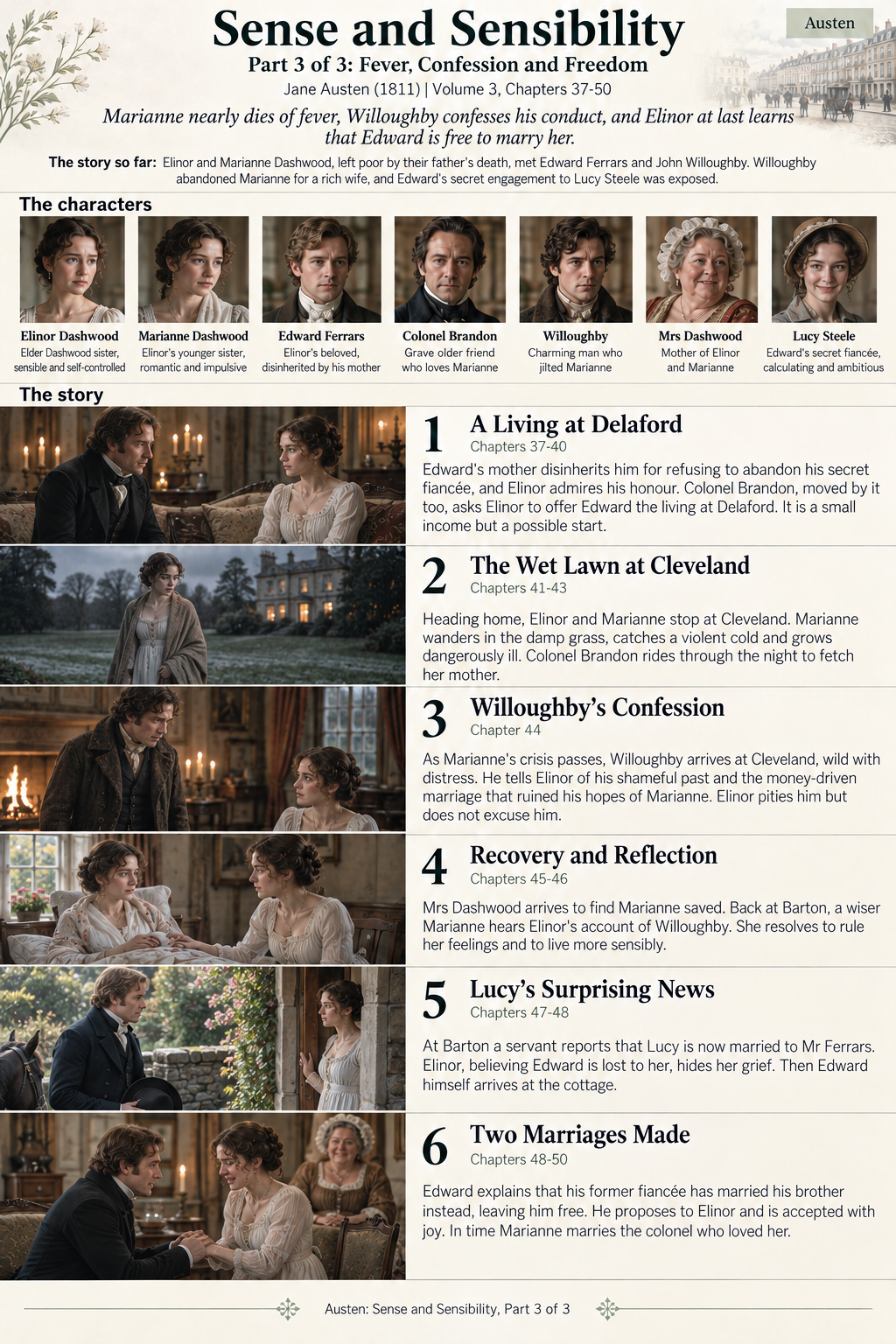
Marianne nearly dies of fever, Willoughby confesses his conduct, and Elinor at last learns that Edward is free to marry her.
The story so far: Elinor and Marianne Dashwood, left poor by their father's death, met Edward Ferrars and John Willoughby. Willoughby abandoned Marianne for a rich wife, and Edward's secret engagement to Lucy Steele was exposed.
By the start of this final part, the Dashwood sisters have each suffered a blow. Willoughby, who courted Marianne so ardently, has abandoned her for a wealthy heiress. Elinor, who loves Edward Ferrars, has learned that he has been secretly engaged to Lucy Steele for four years.
Edward's engagement is now public, and his mother, Mrs Ferrars, demands that he break it. He refuses, keeping his word even though he no longer loves Lucy, and she disinherits him in favour of his brother Robert. Colonel Brandon admires this honour and, through Elinor, offers Edward the living of Delaford. Edward is overwhelmed, and Elinor sees that the post may let him marry only the woman he is bound to. Soon afterwards she and Marianne leave London with Mrs Jennings and break their journey at Cleveland, the Palmers' house in Somerset. There Marianne, still heartsick, walks in the wet grass, catches a violent cold and develops a dangerous fever. Brandon rides off to bring Mrs Dashwood from Barton.
At the height of the danger Willoughby arrives, having heard that Marianne is dying. He tells Elinor of his seduction of Brandon's young ward, of his disgrace, and of how he married Miss Grey for money though he loved Marianne. Elinor's pity is mixed with disapproval, and she sends him away. Marianne recovers, Mrs Dashwood arrives, and at Barton Marianne reflects on her own excesses. She resolves to master her feelings. Then a servant brings news that Lucy is now Mrs Ferrars. Elinor believes Edward is lost, until Edward arrives and explains that Lucy has married Robert. He is free, and he proposes to Elinor.
The motives are simple but telling. Willoughby is not purely wicked, but he is weak and loves comfort more than truth. Edward's loyalty costs him dearly, and Brandon's constancy shows love as steady service rather than display. Marianne's change is the most striking. She begins to see that feeling needs the discipline of judgement, while Elinor discovers that restraint does not mean she feels less.
The themes are the cost of money, the gap between show and substance, and the way sense and sensibility need each other. Many readers see a rebuke to cultish sensibility, while others point out that Austen treats Marianne's passion with sympathy, so that Marianne is chastened rather than simply condemned.
The lessons are practical. Keeping a promise can be costly but gives a person worth. Intense feeling is not proof of truth, and neither is charm. Generosity and patience, like Brandon's, deserve more trust than glamour. Happiness comes when feeling and judgement are brought into balance.
Further reading
- Jane Austen, ed. Ros Ballaster, Sense and Sensibility (Penguin Classics) (2003)
- Claire Tomalin, Jane Austen: A Life (1997)
- Claudia L. Johnson, Jane Austen: Women, Politics, and the Novel (1988)