War and Peace, Part 2 of 3: Hope and Its Undoing
Russian · Part 2 of 3: Hope and Its Undoing
War and Peace
Leo Tolstoy (1869) · Volume 2
Pierre seeks a better way to live, while Prince Andrei and Natasha find happiness that proves difficult to protect.
The story so far: In 1805, Pierre unexpectedly inherited a fortune and married Hélène. Prince Andrei went to war seeking glory, but the battle of Austerlitz left him questioning what glory was worth.
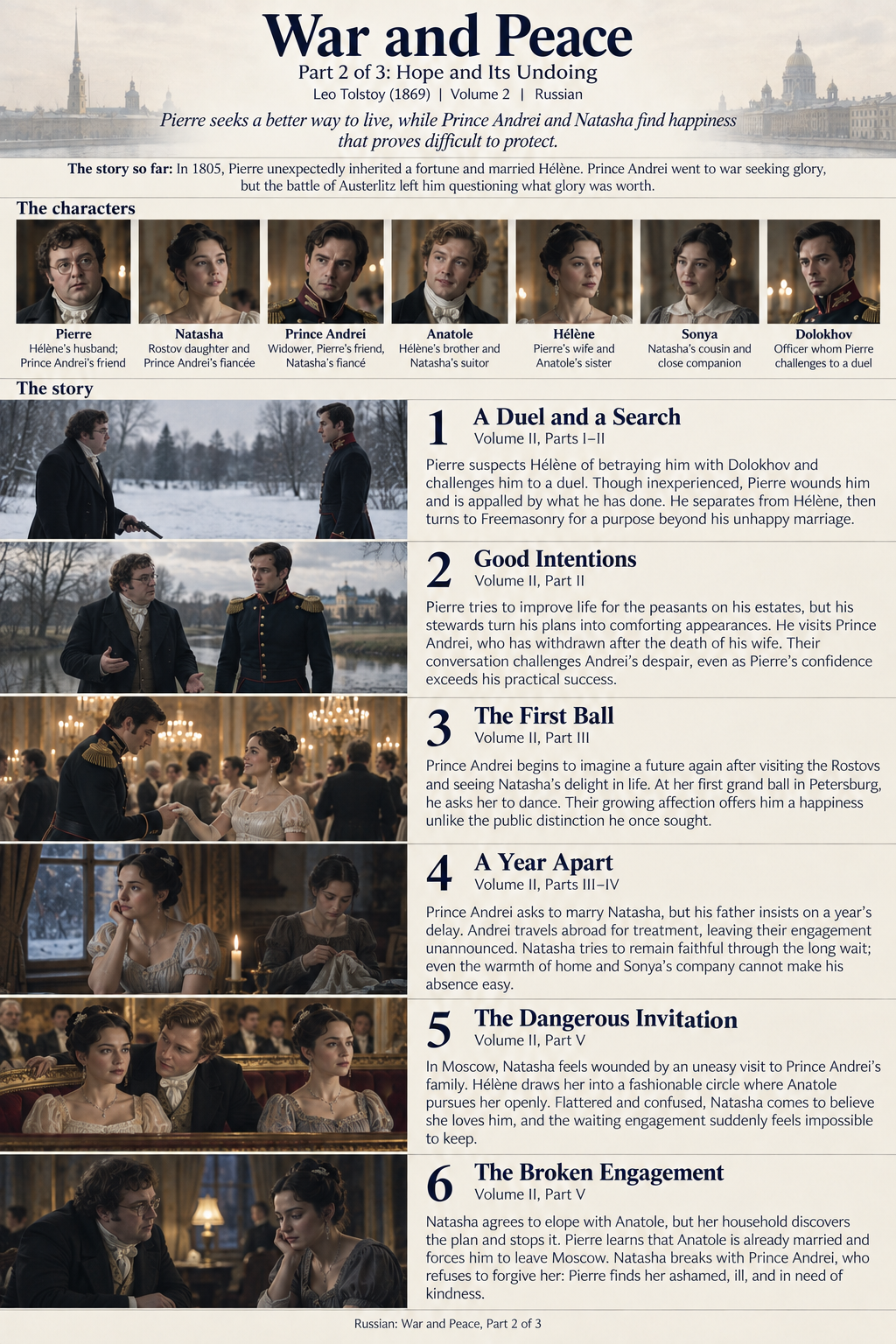
Pierre Bezukhov entered society as an awkward outsider, inherited an enormous fortune, and married the beautiful Hélène. Prince Andrei Bolkonsky went to war hoping for glory, only to find that the battlefield offered no answer to his deeper dissatisfaction. As Volume 2 begins, both men are trying to live with the choices they made.
Pierre suspects Hélène of betraying him with Dolokhov. At a dinner, resentment erupts into a challenge, and Pierre, who has no experience of duelling, wounds Dolokhov. Shaken by the violence and by his marriage, Pierre separates from Hélène. A chance meeting with a Freemason at Torzhok gives him a new hope: that he can become a better man by serving others. He joins the Masons and sets out to ease the lives of the peasants on his estates. Yet his stewards show him improvements more readily than they carry them out. His wish to do good is sincere, but he has not learned how to see through reassuring appearances.
Prince Andrei has returned from war to find his wife dying after the birth of their son. Grief has narrowed his world to family and the management of his estates. When Pierre visits him, their disagreement about goodness, duty, and the peasants brings both men’s convictions into focus. Later, while visiting the Rostov family at Otradnoe, Andrei hears Natasha Rostov’s unguarded delight in a spring night. He begins to feel that life need not be over for him. In Petersburg he takes an interest in public work, but his hopes increasingly centre on Natasha. At her first grand ball, he invites her to dance; affection grows, and he asks to marry her.
Andrei’s father insists that they wait a year. Andrei goes abroad for treatment, leaving Natasha with a promise but no publicly announced engagement. At home she has the pleasures of family life, including a winter visit to the country with her cousin Sonya, but the delay wears on her. In Moscow, an uncomfortable visit to Andrei’s father and sister leaves her feeling unwelcome. Hélène then draws Natasha into her fashionable circle. At the opera, Natasha meets Hélène’s brother Anatole Kuragin, whose determined attention makes her question what she thought she knew about love.
Natasha agrees to elope with Anatole. Sonya discovers the plan and warns their guardian, Marya Dmitrievna, who prevents the escape. Pierre learns that Anatole is already married and compels him to leave Moscow. Natasha breaks her promise to Andrei, then falls ill after taking poison. Andrei refuses to forgive her. Pierre, however, responds to her shame with compassion; after visiting her, he sees the great comet of 1812 in the night sky. This volume asks how people tell lasting love from immediate desire, and moral action from the feeling of being moral. It offers no easy safeguard against error. Pierre’s imperfect kindness suggests that seeing another person clearly can matter more than judging them quickly.
Further reading
- Leo Tolstoy; translated by Richard Pevear and Larissa Volokhonsky, War and Peace (2007)
- Donna Tussing Orwin, editor, The Cambridge Companion to Tolstoy (2002)
- A. N. Wilson, Tolstoy (1988)