War and Peace, Part 1 of 3: Drawing Rooms and Open Skies
Russian · Part 1 of 3: Drawing Rooms and Open Skies
War and Peace
Leo Tolstoy (1869) · Volume 1
In 1805, Pierre inherits a fortune, Nikolai goes to war, and Prince Andrei seeks glory far from the drawing rooms of St. Petersburg.
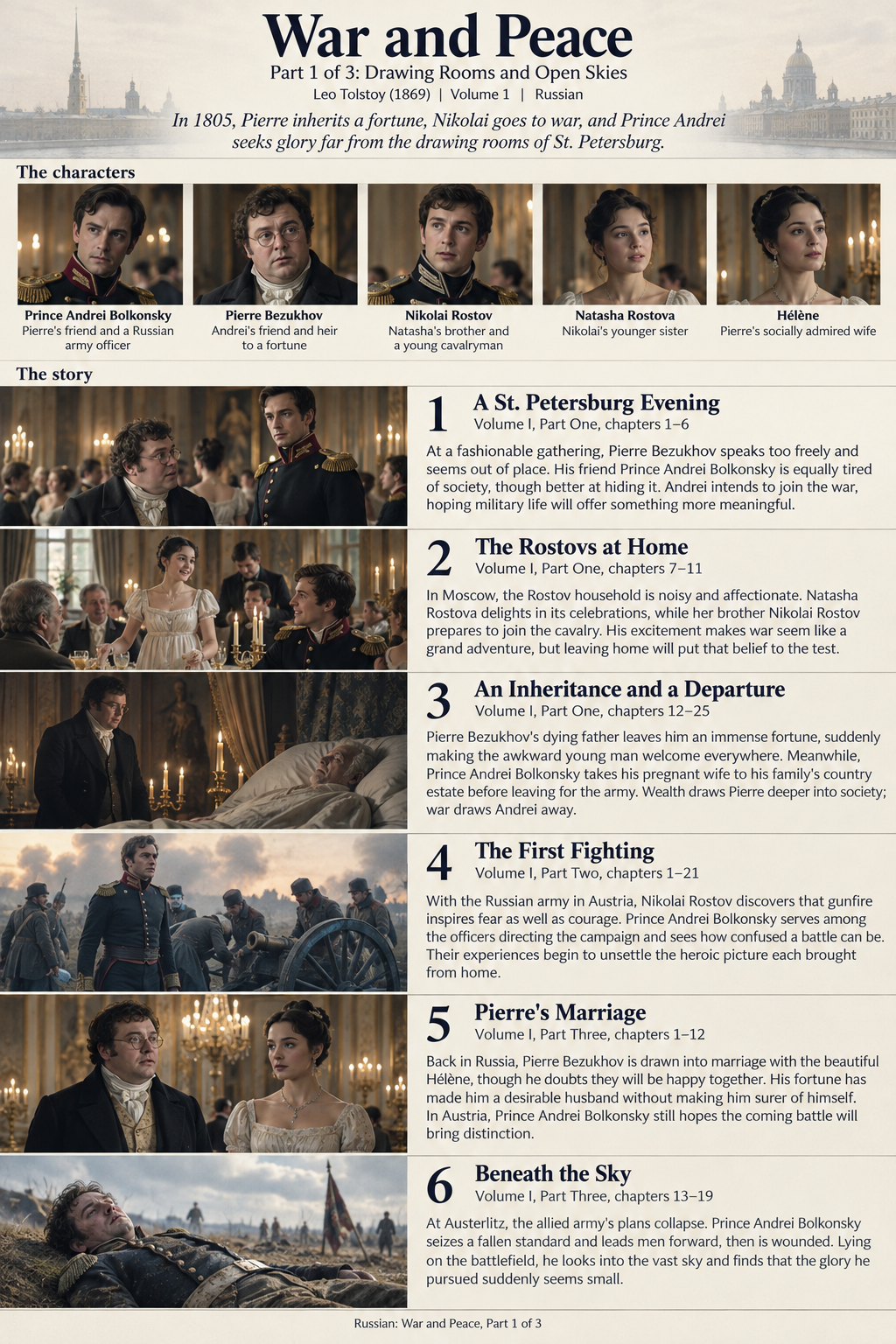
The novel opens in 1805, with Russia's upper classes discussing Napoleon and the approaching war in St. Petersburg drawing rooms. At Anna Pavlovna Scherer's gathering, Pierre Bezukhov speaks with an unguarded enthusiasm that unsettles his hosts. His friend Prince Andrei Bolkonsky knows how to behave there but is bored by it. Andrei hopes that service with the army will give his life a purpose that society has not supplied. In Moscow, the Rostov family offers a warmer, less restrained world. Young Natasha Rostova throws herself into its celebrations, while her brother Nikolai prepares eagerly to join the cavalry.
Pierre's position changes when his father, Count Bezukhov, dies and leaves him a vast fortune. Formerly an awkward outsider, Pierre becomes an important man in the eyes of people who once paid him little attention. He has money and a title but little practice in judging those who seek his company. Andrei, meanwhile, takes his pregnant wife, Lise, to his family's estate at Bald Hills before departing for the army. There he leaves her with his stern father and his sister, Princess Marya. Lise fears their separation; Andrei is impatient to go, though their leave-taking is painful.
In Austria, the war looks different from a drawing-room conversation. Russian forces retreat before the French, and Nikolai's first encounters with danger expose the gap between eagerness to fight and fear of being killed. He is wounded during the fighting near Schöngrabern. Andrei, serving on the army staff, also sees how little a battle resembles a clear plan: orders, confusion, endurance, and individual action all matter. The soldiers at a hard-pressed artillery battery impress him more than the confident accounts of events offered afterward.
Back in Russia, Pierre is steered toward Hélène, a beautiful woman much admired in society. He feels attracted to her but doubts that marriage will make either of them happy. Unable to act on those doubts, he marries her. His inheritance has given him the power to choose almost anything, yet he struggles to make this choice freely. Andrei's uncertainty takes another form. As the armies prepare for Austerlitz, he longs for a chance to distinguish himself in a decisive battle, even as he understands that the fighting may cost him his life.
At Austerlitz, the allied army's confident plans fail amid battlefield confusion. Andrei picks up a fallen standard and urges men forward, imagining at last the action he has desired. A wound brings him down. Lying still, he notices the immense, quiet sky above him, and his hopes of glory seem suddenly slight beside it. Tolstoy does not make Pierre's wealth, Nikolai's courage, or Andrei's ambition meaningless; he asks what happens when each meets a reality it cannot control. This part invites readers to notice how readily applause can be mistaken for affection, confidence for understanding, and public triumph for a satisfying life.
Further reading
- Leo Tolstoy, translated by Richard Pevear and Larissa Volokhonsky, War and Peace (2007)
- Isaiah Berlin, The Hedgehog and the Fox (1953)
- Orlando Figes, Natasha's Dance: A Cultural History of Russia (2002)