Beowulf, Part 3 of 3: The Last Fight
Early English · Part 3 of 3: The Last Fight
Beowulf
Anonymous (c. 700-1000) · Lines 2200-3182
After fifty years as king, Beowulf faces a dragon whose fire threatens his people.
The story so far: Beowulf saved the Danish hall Heorot from Grendel and Grendel’s mother. He returned to his own people, the Geats, with honor and treasure.
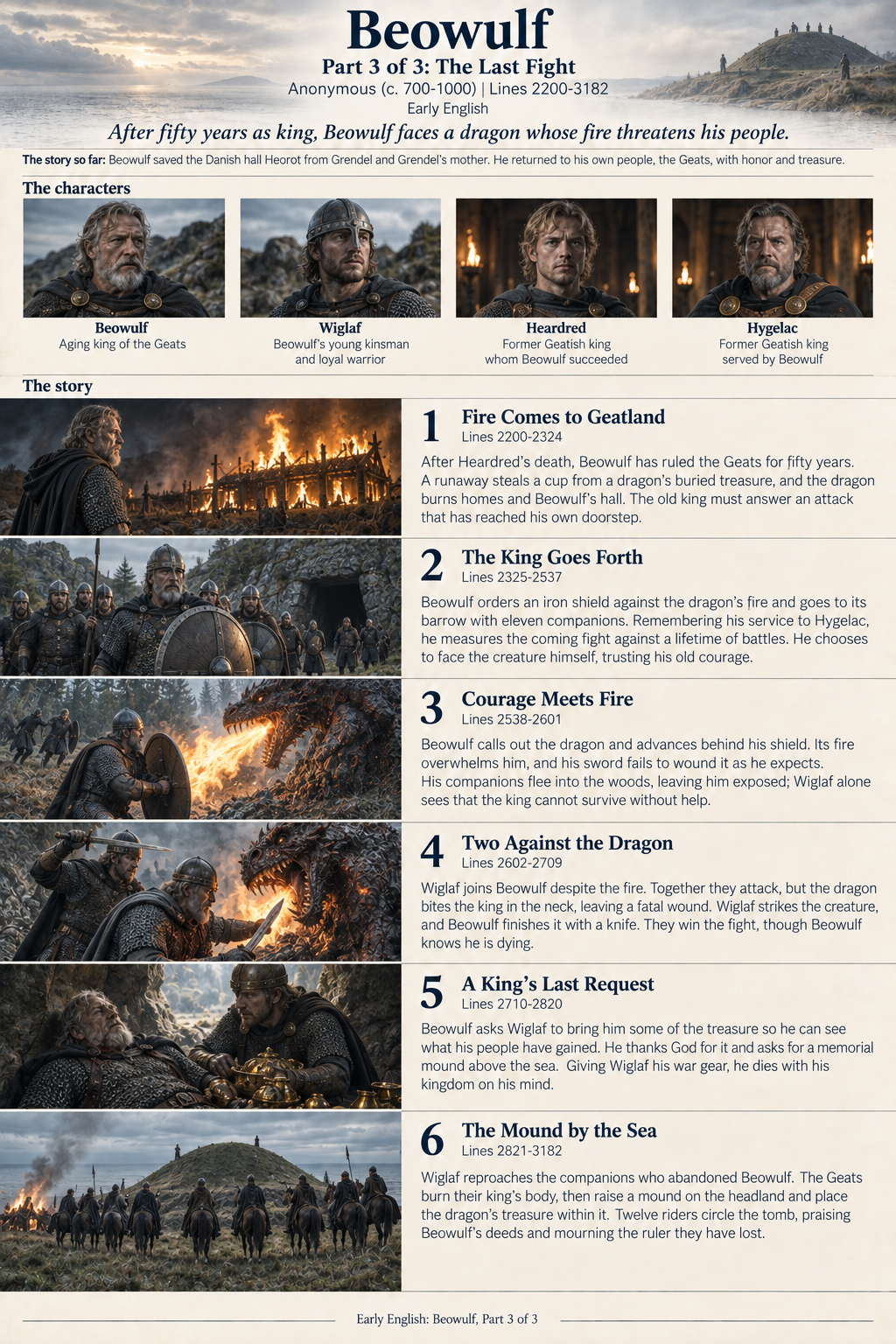
Years earlier, Beowulf defeated Grendel and Grendel’s mother for the Danes, then returned to his own people, the Geats. Now fifty years have passed. After the deaths of Hygelac and Heardred, Beowulf became king, and his long rule is ending in a danger unlike those he faced as a young warrior. A runaway seeking refuge enters a barrow and takes a cup from a hidden hoard. Its guardian, a dragon, wakes in fury. Flying out at night, it burns Geatish homes and Beowulf’s own hall.
Beowulf orders a shield made of iron to withstand the fire. He takes eleven companions toward the barrow, guided by the man who took the cup. As he prepares to fight, he looks back over his life: his upbringing, service to Hygelac and hard-won place among the Geats. These memories make clear how much has changed. He is still determined to defend his people, but he is no longer the young man who fought Grendel without a weapon. He tells his companions to wait while he faces the dragon himself.
At the entrance, Beowulf calls out, and the dragon answers with fire. His shield protects him only briefly; his sword does not serve him as he hoped. The companions retreat into the woods. Wiglaf, a young kinsman, cannot bear to leave the king who gave him arms and a place at his side. He urges the others to remember their promises, then runs to Beowulf alone. Their joint attack turns the fight, but the dragon bites Beowulf in the neck. Wiglaf wounds it, and Beowulf kills it with a knife. The victory has come too late to save him: the bite is fatal.
Beowulf sends Wiglaf into the barrow to bring out some of the treasure. Seeing it, he thanks God that he has won these riches for his people. He asks for his body to be burned and for a mound to be raised on a headland, where sailors will see it. He gives Wiglaf his war gear and dies. Wiglaf rebukes the companions who fled, warning that their failure has cost the Geats dearly. The people burn Beowulf’s body, build his mound beside the sea, and place the dragon’s treasure inside it. Twelve riders circle the tomb and speak of their king with grief and praise.
The treasure cannot bring Beowulf back, and buried in the mound, it cannot protect the living. The ending holds two truths together: his courage saved his people from the dragon, yet his death leaves them vulnerable. Readers differ over whether his decision to fight alone is chiefly heroic or also dangerously proud. The poem invites us to value loyalty not merely as a promise but as help given when it is costly. It also asks what a leader can leave behind when even strength and generosity cannot make a life last.
Further reading
- Seamus Heaney, Beowulf: A New Verse Translation (1999)
- R. W. Chambers, Beowulf: An Introduction to the Study of the Poem (1921)
- J. R. R. Tolkien, Beowulf: The Monsters and the Critics (1936)