Beowulf, Part 2 of 3: Beneath the Mere
Early English · Part 2 of 3: Beneath the Mere
Beowulf
Anonymous (c. 700-1000) · Lines 1251-2199
A new attack draws Beowulf beneath a haunted mere before he returns to his own people.
The story so far: Beowulf has come from Geatland to help Hrothgar, whose hall, Heorot, has suffered years of attacks by Grendel. Beowulf has defeated the monster, and the Danes have celebrated.
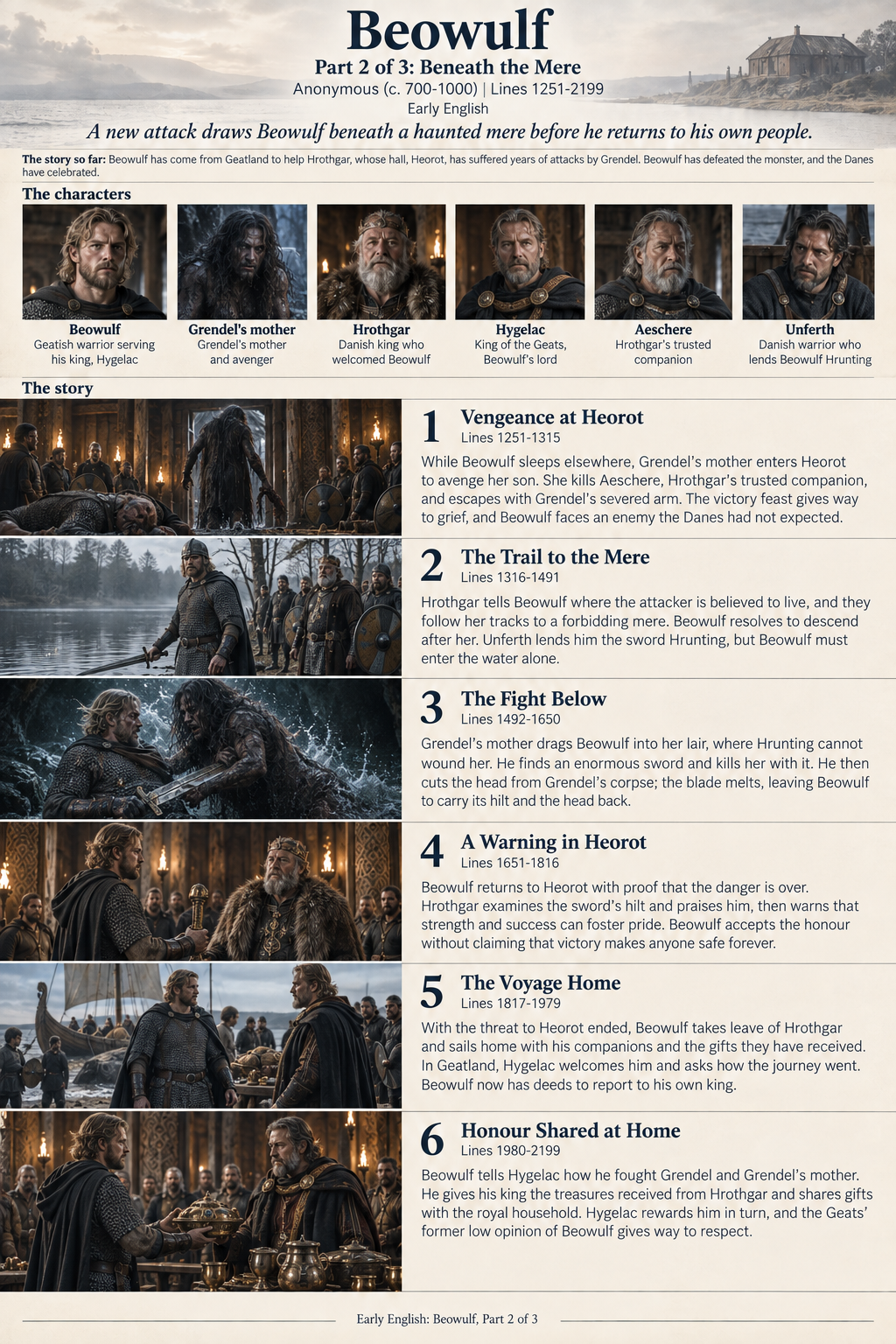
Beowulf has freed the Danish king Hrothgar’s hall, Heorot, from Grendel, the creature that attacked it for years. The Danes celebrate, but their relief does not last. That night Grendel’s mother enters the hall to avenge her son. She kills Aeschere, one of Hrothgar’s closest companions, and takes away Grendel’s severed arm, which had been displayed there. Beowulf has slept elsewhere and could not stop her. The new death makes clear that Grendel’s defeat has not ended the danger.
Grieving for Aeschere, Hrothgar tells Beowulf about the fearful place where the two creatures were believed to live. Beowulf urges action rather than surrender to sorrow, and a party follows the attacker’s tracks to a mere surrounded by forbidding woods. The signs at its edge confirm Aeschere’s fate. Beowulf prepares to go into the water alone. Unferth lends him Hrunting, a sword with a formidable reputation, and Beowulf entrusts his companions’ welfare to Hrothgar should he fail to return.
The descent is long. Grendel’s mother seizes Beowulf beneath the water and pulls him into a chamber where he can fight. Hrunting fails to cut her, and their struggle brings Beowulf close to death. Then he sees an enormous sword in the lair. With it he kills her and finds Grendel’s lifeless body, from which he cuts the head. The monster’s blood melts the great sword’s blade, so Beowulf takes its hilt and Grendel’s head as proof of what happened. His companions, who have waited above in fear, see him emerge alive.
Back at Heorot, Beowulf reports the fight and presents the hilt to Hrothgar. The king’s gratitude becomes a warning: a person may possess extraordinary strength and still forget that prosperity is temporary. Beowulf has won a second victory, but Hrothgar asks him to resist the pride that victory can invite. After more honours and gifts, Beowulf leaves Denmark. Hrothgar parts from him with affection, and the Geats sail home.
In Geatland, Hygelac welcomes Beowulf and asks about the expedition. Beowulf recounts his encounters with Grendel and Grendel’s mother. He also describes Hrothgar’s household and doubts that a planned marriage there will settle an old feud. Beowulf gives Hygelac treasures received in Denmark and presents gifts to Hygelac’s wife, Hygd; Hygelac rewards him in return. The Geats had once thought little of Beowulf, but his conduct has changed their judgment. Across this part, revenge answers one killing with another, while generosity turns hard-won honour into something shared. Readers may differ on how far the poem endorses Beowulf’s pursuit of vengeance; it also makes room for Hrothgar’s counsel about humility. Courage matters here, but so do loyalty, restraint and the knowledge that no success removes human limits.
Further reading
- Seamus Heaney, Beowulf: A New Verse Translation (1999)
- John D. Niles, Beowulf: The Poem and Its Tradition (1983)
- Andy Orchard, A Critical Companion to Beowulf (2003)