Beowulf, Part 1 of 3: The Hall and the Hero
Early English · Part 1 of 3: The Hall and the Hero
Beowulf
Anonymous (c. 700-1000) · Lines 1-1250
Beowulf crosses the sea to free Hrothgar's hall from the murderous Grendel.
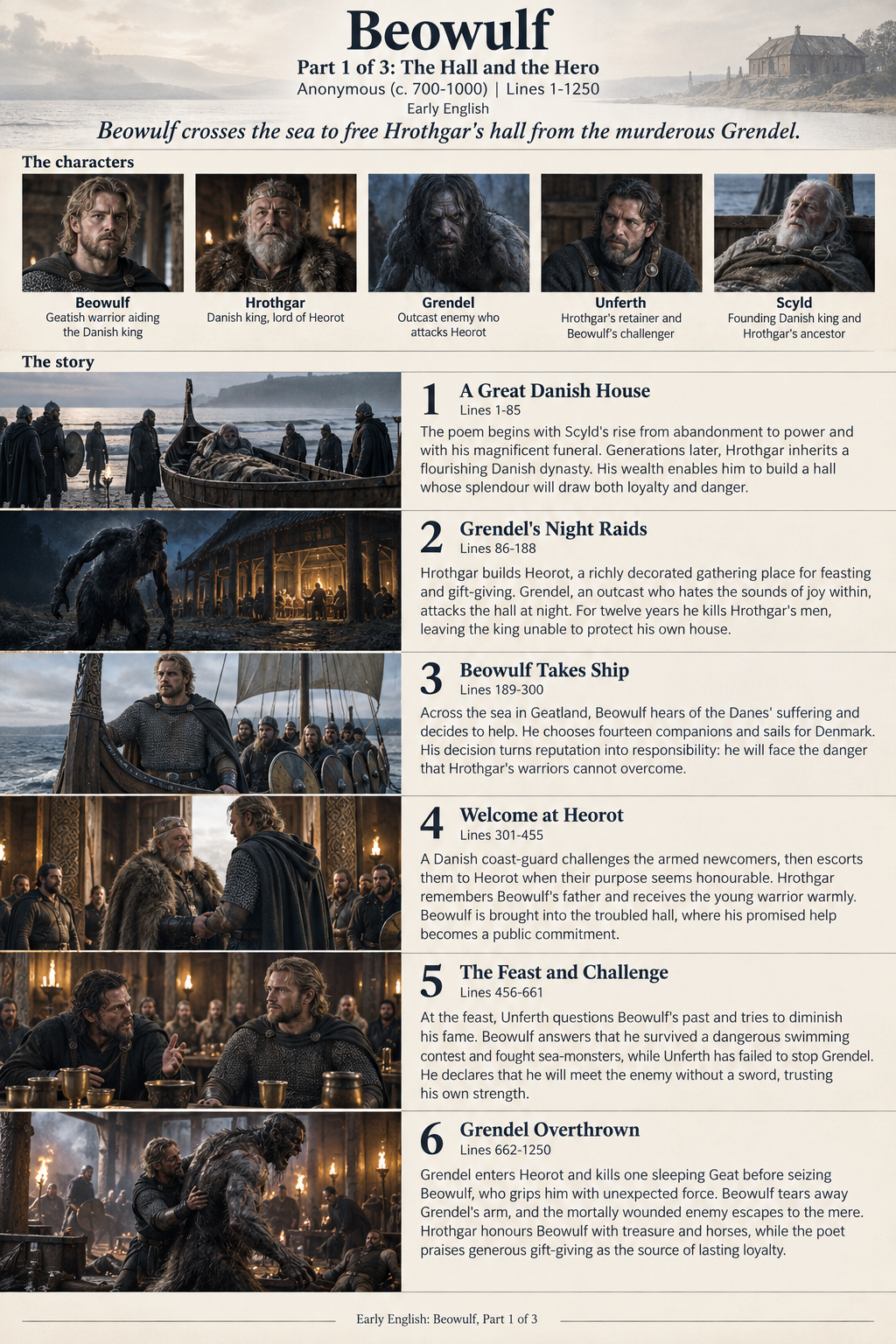
The poem opens not with Beowulf but with the Danish royal line. Scyld rises from humble beginnings to become a feared and honoured king, and his followers send his body out to sea in a richly furnished ship. In later generations Hrothgar, a Danish king, builds the great hall called Heorot, where he gives treasures to his retainers and they celebrate together.
Heorot's joy provokes Grendel, a hostile outcast associated by the poet with Cain's accursed kin. Hearing music and happiness in the hall, Grendel comes by night. He kills and carries off Hrothgar's men, and his attacks continue for twelve years. The Danes cannot use Heorot safely, and neither weapons nor counsel free them. The hall, meant to bind a king to his people through shared feasting and generosity, becomes a sign of their helplessness.
Beowulf, a young Geatish warrior, hears of this suffering across the sea. He chooses fourteen companions and sails to Denmark. After a coast-guard questions the armed visitors, they are escorted to Heorot. Hrothgar remembers Beowulf's father and welcomes him. At the feast, Beowulf openly promises to fight Grendel. Unferth challenges him by recalling a swimming contest, but Beowulf replies that he endured the contest, fought sea-monsters, and will do what Unferth has not done: confront Grendel.
That night Beowulf waits in Heorot without a sword, trusting that Grendel fights without weapons and that the contest should be equal. Grendel enters the hall and devours one of the sleeping Geats. When he reaches for Beowulf, however, he finds himself held in a grip he cannot escape. Their struggle shakes the hall. Beowulf refuses to let go, and tears Grendel's arm and shoulder from his body. Fatally wounded, Grendel flees toward his mere; Beowulf's companions cannot harm him with their swords, but they stand by their leader as best they can.
At dawn the Danes see Grendel's severed arm hanging high in Heorot. Relief turns into celebration. A poet sings of Sigemund, a hero who won lasting fame by killing a dragon, and the narrator contrasts that generous figure with the destructive Heremod. Hrothgar calls Beowulf dear to him and rewards him with weapons, armour, treasure, and eight horses, one equipped with a splendid saddle. He also pays compensation in gold for the Geat whom Grendel killed.
This first movement of the poem examines what makes leadership secure. Hrothgar's hall depends on hospitality, loyalty, and gifts, yet material splendour alone cannot protect it. Beowulf's courage is real, but it is joined to a willingness to act for people outside his own kingdom. The poem also tests public reputation: Unferth's challenge shows how easily fame can be disputed, while Beowulf must prove his words through action. Its practical lesson is not that strength solves every problem, but that communities need brave service, faithful support, and leaders who repay loyalty with generosity.
Further reading
- Seamus Heaney, Beowulf: A New Translation (1999)
- J. R. R. Tolkien, Beowulf: The Monsters and the Critics (1936)
- Andy Orchard, A Critical Companion to Beowulf (2003)