Jane Eyre, Part 3 of 3: The Return to Ferndean
Victorian and Edwardian · Part 3 of 3: The Return to Ferndean
Jane Eyre
Charlotte Brontë (1847) · Volume 3, Chapters 27-38
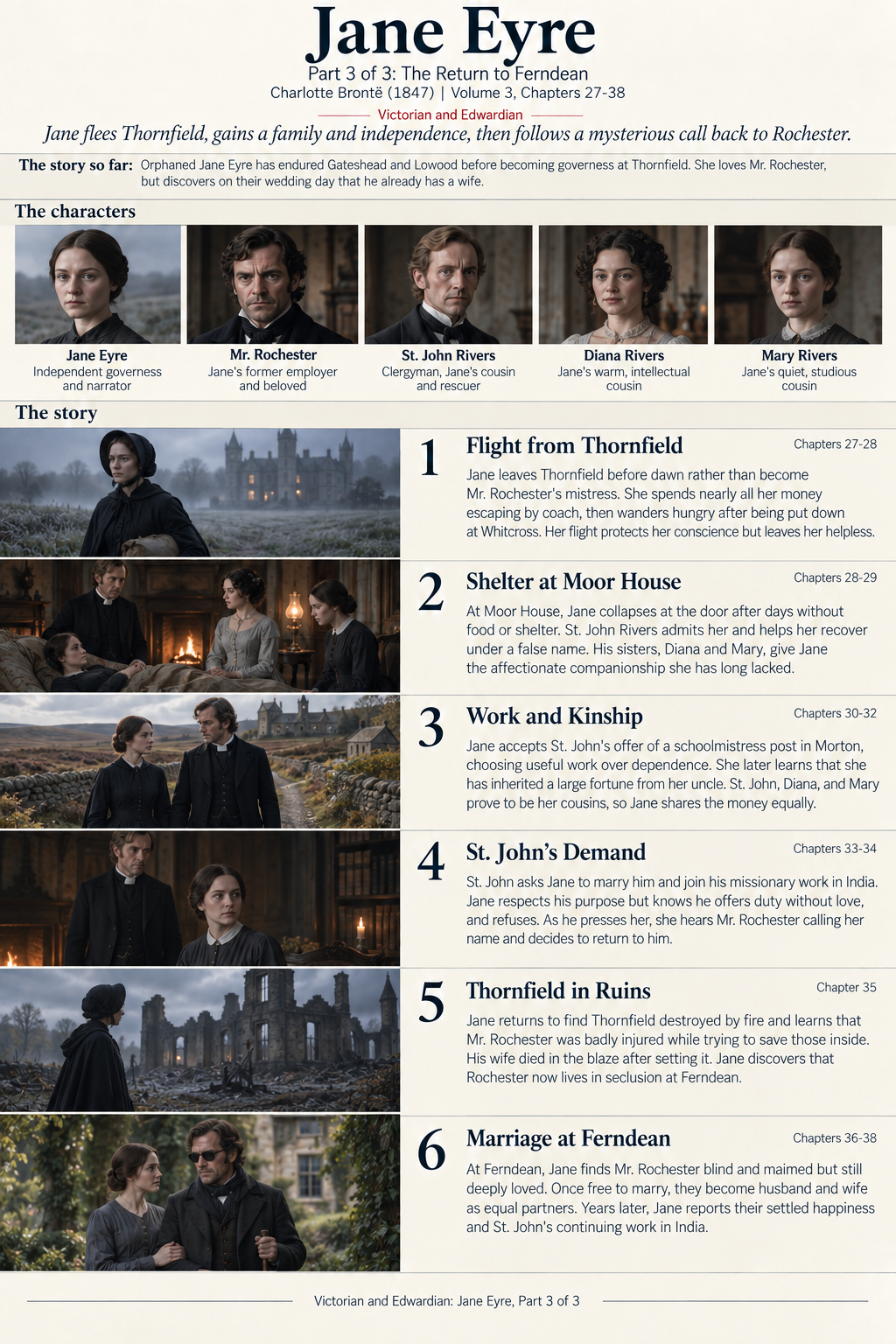
Jane flees Thornfield, gains a family and independence, then follows a mysterious call back to Rochester.
The story so far: Orphaned Jane Eyre has endured Gateshead and Lowood before becoming governess at Thornfield. She loves Mr. Rochester, but discovers on their wedding day that he already has a wife.
Jane Eyre has escaped a harsh childhood at Gateshead and Lowood School to become governess at Thornfield Hall. There she has fallen in love with her employer, Mr. Rochester. Their marriage has been stopped because Rochester is already married to Bertha Mason, who is confined in the house. Rochester asks Jane to remain with him, but she cannot accept a life that violates her moral convictions.
In this final part, Jane leaves Thornfield before dawn and travels as far as her small supply of money allows. She is eventually abandoned at Whitcross, exhausted and unable to buy food or lodging. After days of hunger, she reaches Moor House, also called Marsh End, where St. John Rivers, a clergyman, and his sisters Diana and Mary take her in. Jane conceals her history and calls herself Jane Elliott. Their care restores her strength, and the affection of Diana and Mary gives her a sense of domestic belonging unlike anything she has known.
St. John finds Jane a post teaching poor village girls at a school in Morton. At first the work seems limited beside the passionate life she has left behind, but Jane learns to value its usefulness and the independence it gives her. Then she receives extraordinary news: her uncle John Eyre has died and left her a fortune of twenty thousand pounds. St. John reveals that he, Diana, and Mary are Jane's cousins. Jane refuses to keep the inheritance alone. She divides it equally among the four cousins, gaining not merely money but family and a secure place in the world.
St. John, whose ambitions are religious and missionary, asks Jane to marry him and accompany him to India. He values her courage and practical ability, but not in the way she needs to be loved. Jane respects him and is tempted by the grandeur of sacrifice, yet she sees that marriage without love would destroy her inward life. When he continues to exert pressure through appeals to duty, she hears Rochester's voice calling her across the distance. The novel treats the moment as mysterious; later events suggest that Rochester called to her at the same hour. Jane takes this as a summons to discover his fate.
She returns to Thornfield and finds only a burned ruin. Bertha Mason set the fire and died after climbing onto the roof; Rochester was injured while rescuing others, losing a hand and his sight. Jane finds him living in secluded Ferndean. Their reunion matters because the old imbalance has changed: Jane now has money, family, and freedom, while Rochester is dependent and humbled. Yet Brontë does not make pity Jane's motive. She returns because she loves him and can now marry him without surrendering either conscience or self-respect.
Jane and Rochester marry, and she describes ten years of companionship in which his sight partly returns and they have a son. The closing pages also remember St. John in India, still committed to his demanding vocation. This ending brings together the novel's central claims: love needs moral freedom, economic independence strengthens rather than cancels affection, and religious duty without sympathy can become oppressive. Jane's example is practical as well as romantic: endure hardship, seek work and friendship, and refuse choices that require the loss of one's deepest integrity.
Further reading
- Charlotte Brontë, Jane Eyre, edited by Stevie Davies (2006)
- Sandra M. Gilbert and Susan Gubar, The Madwoman in the Attic (1979)
- Juliet Barker, The Brontës (1994)