Jane Eyre, Part 2 of 3: The Broken Wedding
Victorian and Edwardian · Part 2 of 3: The Broken Wedding
Jane Eyre
Charlotte Brontë (1847) · Volume 2, Chapters 16-26
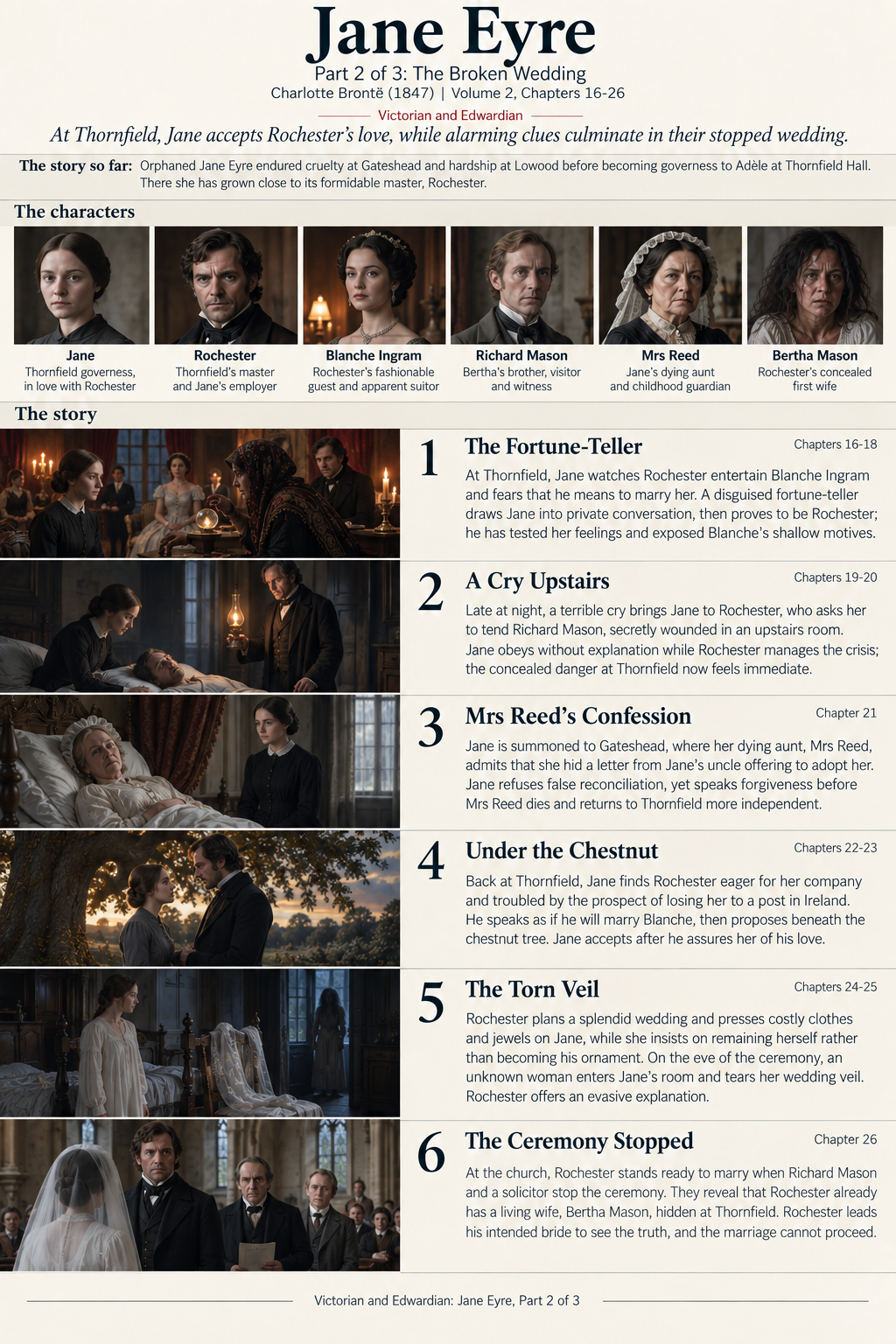
At Thornfield, Jane accepts Rochester’s love, while alarming clues culminate in their stopped wedding.
The story so far: Orphaned Jane Eyre endured cruelty at Gateshead and hardship at Lowood before becoming governess to Adèle at Thornfield Hall. There she has grown close to its formidable master, Rochester.
Jane Eyre has escaped the loveless Reed household and the harsh discipline of Lowood School to become governess to Adèle at Thornfield Hall. There she has formed an increasingly intimate bond with the Hall’s master, Edward Rochester, though she remains conscious of the great difference in their wealth and social position.
The arrival of fashionable visitors, including Blanche Ingram, unsettles Jane. Blanche seems perfectly suited to be Rochester’s bride: rich, beautiful, and socially assured. Jane tries to master her jealousy, even making plain sketches that contrast her own appearance with Blanche’s. A fortune-teller then visits Thornfield and speaks privately with the women. When Jane meets her, she discovers that the supposed old gypsy is Rochester in disguise. His performance has allowed him to observe his guests, and it sharpens Jane’s painful uncertainty about his intentions.
Thornfield’s earlier mystery grows darker when a midnight cry summons Jane. Rochester takes her to Richard Mason, a visitor who has been violently injured in a locked upper room, and tells Jane to care for him without asking questions. Jane does so through the night, showing both courage and loyalty. Soon afterward, she is called to Gateshead because Mrs Reed is dying. Mrs Reed admits that she concealed a letter from Jane’s uncle, who had wanted to adopt Jane and make her his heir. Jane cannot pretend affection she does not feel, but she offers forgiveness before her aunt dies.
On returning to Thornfield, Jane finds Rochester openly seeking her company. He leads her to believe that he will marry Blanche and that Jane must leave for a distant governess post. When Jane finally says that separation will hurt because they are equals in spirit, Rochester proposes beneath the old chestnut tree. Jane accepts when he assures her that he loves her. Their happiness is immediately shadowed by a violent storm that splits the tree, an image that gives the scene its Gothic unease.
Jane resists Rochester’s attempts to cover her in expensive dresses and jewellery, fearing that such adornment would turn her into somebody unreal. The night before the wedding, she wakes to find a strange, frightening woman in her room who tears her bridal veil. Rochester claims that Grace Poole is responsible, but his explanation does not remove Jane’s alarm. At the church, a solicitor and Richard Mason stop the marriage. They establish that Rochester is already married to Mason’s sister, Bertha Mason, who is alive and kept at Thornfield. Rochester takes Jane to see her, and the ceremony ends.
This section tests whether love can exist without truth and equality. Jane’s refusal to be bought by luxury shows her moral independence, while Rochester’s secrecy makes his passionate courtship profoundly compromised. The lesson is not that feeling is unimportant, but that affection needs honesty, freedom, and respect if it is to be trusted.
Further reading
- Charlotte Brontë, Jane Eyre (2006)
- Juliet Barker, The Brontës (1994)
- Sandra M. Gilbert and Susan Gubar, The Madwoman in the Attic (1979)