Jane Eyre, Part 1 of 3: From Red Room to Thornfield
Victorian and Edwardian · Part 1 of 3: From Red Room to Thornfield
Jane Eyre
Charlotte Brontë (1847) · Volume 1, Chapters 1-15
Jane Eyre escapes a cruel childhood and harsh school to become a governess at the mysterious Thornfield Hall.
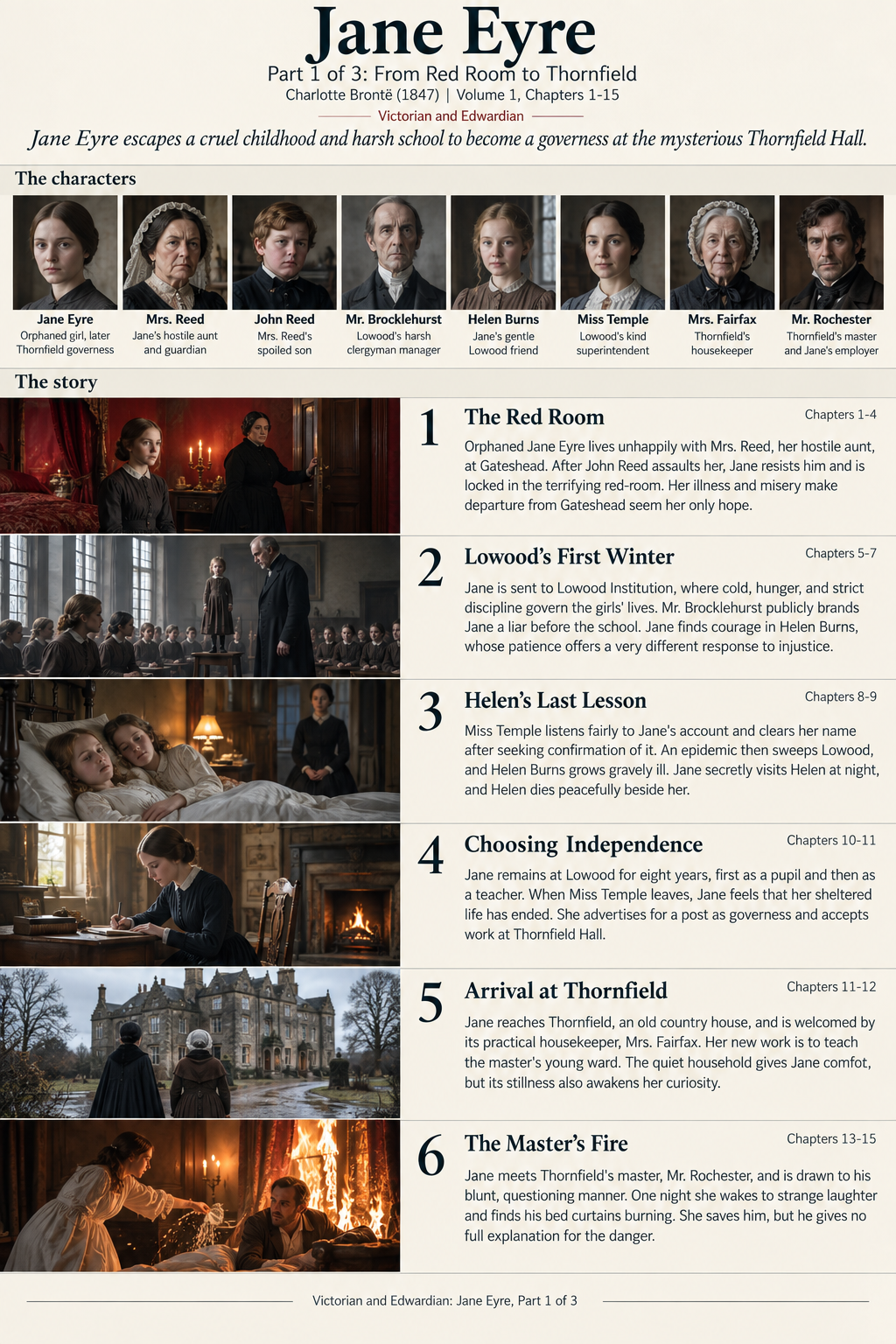
Jane Eyre opens as an orphaned child dependent on her aunt, Mrs. Reed, at Gateshead Hall. Mrs. Reed's children treat Jane as an inferior, especially the violent John Reed. When John attacks her, Jane fights back instead of silently accepting the blow. The adults punish Jane by shutting her in the red-room where her uncle died, a place she fears intensely. Her terror leaves her ill, but it also sharpens her wish to escape Gateshead.
Mrs. Reed agrees to send Jane to Lowood Institution, a charity school recommended by the clergyman Mr. Brocklehurst. Lowood initially seems to offer a fresh start, yet it is cold, underfed, and ruled by harsh public discipline. Brocklehurst warns the school that Jane is deceitful and makes her stand exposed before the other pupils. Jane's pain comes not only from deprivation but from being denied the ordinary respect she longs for.
At Lowood, Jane befriends Helen Burns, a gifted and gentle girl who bears punishment with an almost religious patience. Helen's response troubles Jane, who believes cruelty should be resisted. Miss Temple, the school superintendent, gives Jane the fairness she has lacked: she investigates Mrs. Reed's accusation and publicly clears Jane's name. When disease spreads through the school, Helen becomes ill with consumption. Jane steals into the sickroom to be with her, and Helen dies during the night.
After an inquiry improves conditions at Lowood, Jane spends six years there as a pupil and two as a teacher. The departure of Miss Temple, who has been a moral refuge for her, makes Jane recognize that she wants a wider life. She advertises for work and takes a position as governess at Thornfield Hall. There she is received kindly by Mrs. Fairfax, the housekeeper, and begins teaching the master's young ward. The old house feels peaceful, but its secluded grandeur and occasional strange sounds give it an unsettled air.
Jane soon meets the master, Mr. Rochester, after encountering him on a wintry road and later speaking with him at Thornfield. He is abrupt, probing, and unlike the pious authority figures Jane has known. Their conversations allow Jane to speak plainly and to feel her intelligence taken seriously. One night, awakened by an uncanny laugh and the smell of smoke, she discovers that Rochester's bed curtains are on fire. She puts out the flames and saves him. Rochester thanks her warmly but refuses to explain the event fully.
This opening movement sets dependence against independence. Jane learns that endurance can preserve dignity, as Helen teaches, but she also retains her own conviction that injustice should be named and resisted. Lowood exposes the damage done when charity lacks compassion, while Thornfield offers Jane paid work and a measure of self-direction. The practical lesson is not that courage removes danger, but that self-respect, honest speech, and useful work can give a person room to choose a life beyond mistreatment.
Further reading
- Charlotte Brontë, Jane Eyre: A Norton Critical Edition (2001)
- Sandra M. Gilbert and Susan Gubar, The Madwoman in the Attic (1979)
- Terry Eagleton, Myths of Power: A Marxist Study of the Brontës (1975)