War and Peace, Part 3 of 3: Moscow and the Long Retreat
Russian · Part 3 of 3: Moscow and the Long Retreat
War and Peace
Leo Tolstoy (1869) · Volumes 3-4 and the Epilogues
The invasion of Russia drives Pierre, Natasha, Andrei and their families through battle, flight and captivity toward an uncertain peace.
The story so far: Pierre has inherited a fortune but still seeks a purpose. Andrei and Natasha were engaged, but her involvement with another man broke their engagement.
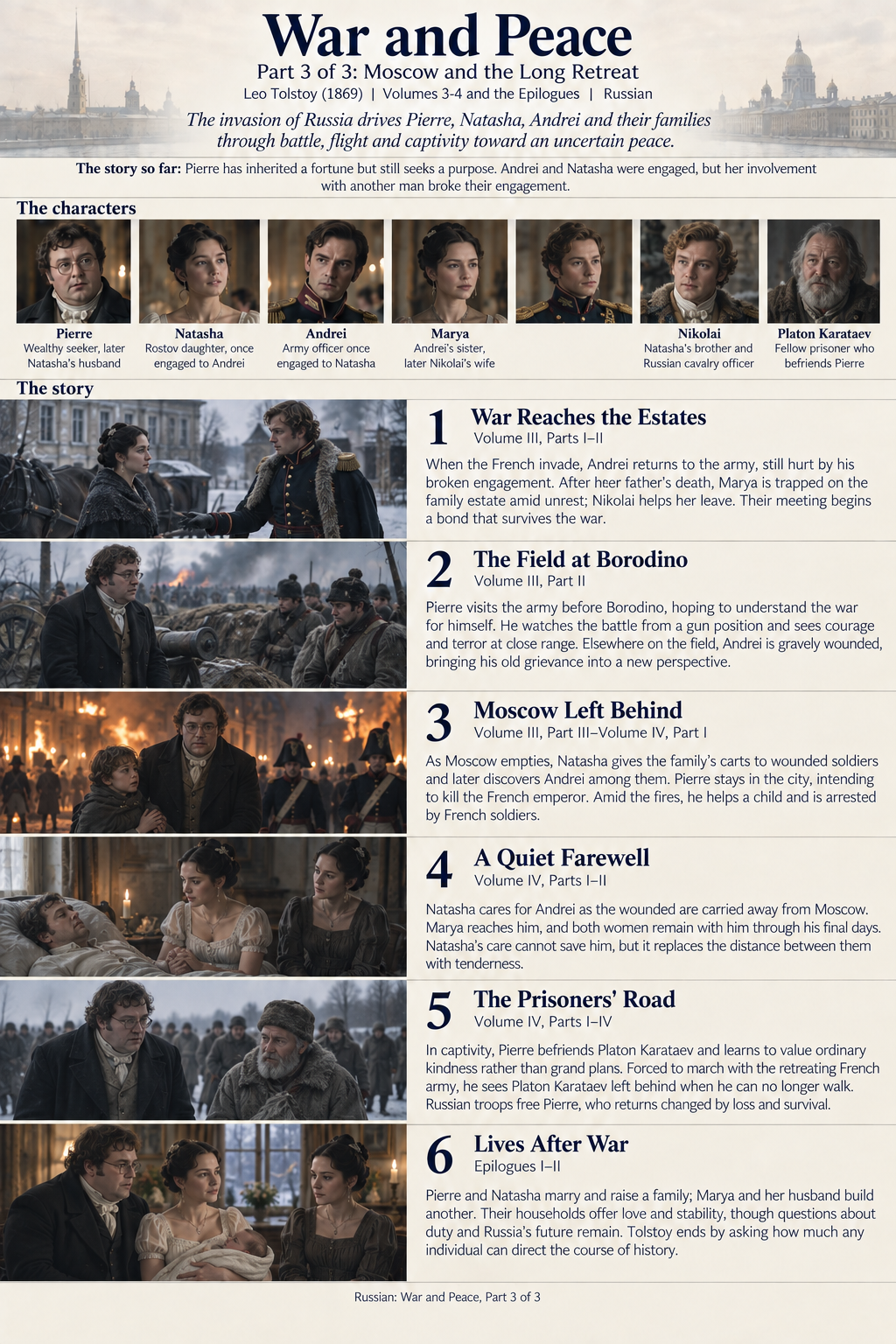
Pierre, rich but unsure what to do with his life, has sought answers in society and Freemasonry. Andrei's engagement to Natasha ended after she became involved with another man. As Napoleon invades Russia in 1812, private troubles are overtaken by war. Andrei returns to the army, still wounded by the broken engagement. At Bogucharovo, his sister Marya is stranded after their father's death. Nikolai Rostov, Natasha's brother and a cavalry officer, helps her leave, beginning an attachment neither can yet pursue.
Pierre travels to the Russian army before the battle of Borodino. From an artillery position he witnesses men enduring fear, injury and exhaustion, a reality unlike the commanding view of war he had imagined. Andrei, serving with his regiment, is gravely wounded without the chance for a heroic charge. His suffering begins to loosen his anger toward Natasha. The Russian army withdraws after the battle, and Moscow is evacuated. Natasha persuades her family to give up carts loaded with possessions so wounded soldiers can be carried away. Only after they leave does she discover that Andrei is among them.
Pierre remains in Moscow with an impractical plan to assassinate Napoleon. As fires spread through the largely deserted city, he helps a child and is arrested by French soldiers. He witnesses prisoners being executed, narrowly escaping death himself. In captivity he meets Platon Karataev, whose unassuming companionship gives him a kind of peace that his earlier schemes for improving himself could not provide. Meanwhile, Natasha reaches Andrei and cares for him. Marya joins them, and the two women stay with him until he dies. Their shared grief draws them close.
The French retreat, taking Pierre and other prisoners on a punishing march. Platon Karataev grows too weak to continue and is shot after falling behind. Pierre survives until Russian troops free him. Liberation does not erase what he has seen, but captivity has changed what he values: he is more receptive to daily life and to other people. Natasha, devastated by Andrei's death, also helps care for her mother after the family learns that her younger brother Petya has been killed. When Pierre and Natasha meet again, each recognizes a possibility of happiness without forgetting those they have lost.
The epilogue follows the families into the years after the war. Pierre and Natasha marry and have children; Nikolai marries Marya, and they make a life at Bald Hills. Domestic peace is neither effortless nor an escape from public questions: Pierre's interest in political reform troubles Nikolai, who places great weight on duty. Tolstoy then examines how history is written, challenging accounts that credit rulers or generals with directing events made by countless people. Readers disagree about how much freedom his argument allows individuals. Yet these lives show choices that matter at a human scale: Natasha yields the carts, Pierre helps a stranger, and survivors care for one another. The novel asks readers to notice that kind of responsibility without mistaking it for control over history.
Further reading
- Leo Tolstoy, translated by Richard Pevear and Larissa Volokhonsky, War and Peace (2007)
- Isaiah Berlin, The Hedgehog and the Fox: An Essay on Tolstoy's View of History (1953)
- Gary Saul Morson, Hidden in Plain View: Narrative and Creative Potentials in War and Peace (1987)