The Iliad, Part 3 of 3: Rage, Revenge and Ransom
Ancient and Classical · Part 3 of 3: Rage, Revenge and Ransom
The Iliad
Homer (c. 8th century BC) · Books 17-24
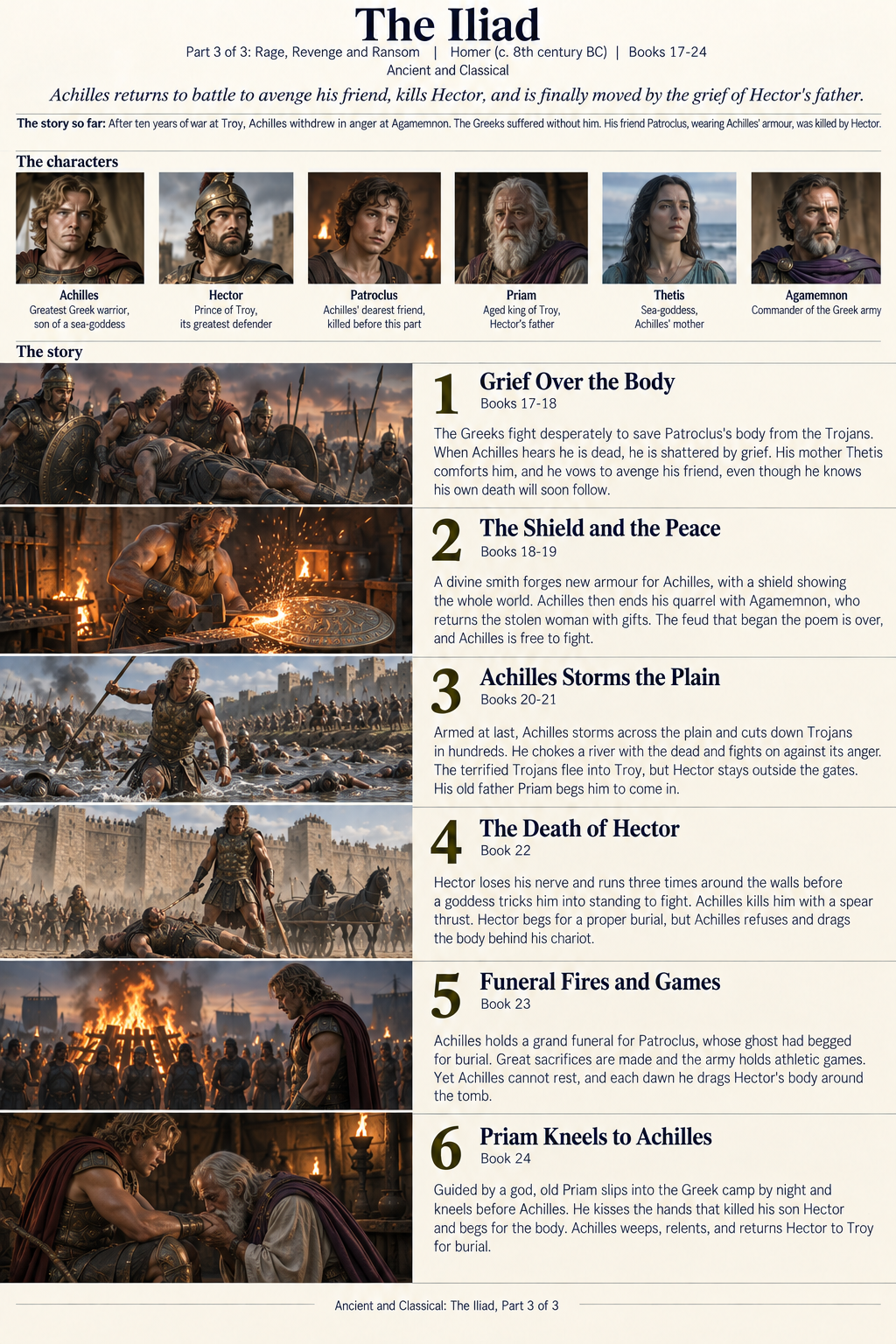
Achilles returns to battle to avenge his friend, kills Hector, and is finally moved by the grief of Hector's father.
The story so far: After ten years of war at Troy, Achilles withdrew in anger at Agamemnon. The Greeks suffered without him. His friend Patroclus, wearing Achilles' armour, was killed by Hector.
By this point the Greeks have besieged Troy for ten years. Agamemnon's seizure of Briseis made Achilles, the greatest Greek warrior, withdraw from the fighting, and without him the Greeks were driven back to their ships. Achilles rejected an embassy of appeals, but he let his beloved friend Patroclus go into battle wearing his armour. Patroclus turned the tide, then was killed by Hector, with help from the god Apollo.
The final part opens with a savage struggle over Patroclus's body, which the Greeks at last carry back to their camp. When Achilles hears the news, he is overwhelmed by grief. His mother, the sea-goddess Thetis, rises from the water to comfort him. She warns that his own death will follow Hector's, yet he chooses vengeance anyway. She obtains new armour from the smith-god Hephaestus, including a great shield that shows the whole world: cities at peace and at war, harvest, dancing and the encircling ocean. Achilles then ends his quarrel with Agamemnon, who returns Briseis with gifts, and he arms for battle.
With the gods now free to join in, Achilles tears through the Trojan ranks. He fills the river Scamander with corpses until the river itself rises against him. The Trojans pour back into the city, but Hector stays outside the gates, ashamed to retreat, although his father Priam and his mother Hecabe beg him to come in. When Achilles appears, Hector panics and runs three times around the walls. The goddess Athena then tricks him into turning to fight. Hector throws his spear and misses, and finds himself without another. Achilles kills him with a thrust to the throat. The dying Hector asks that his body be returned for ransom, but Achilles refuses and drags it behind his chariot.
Patroclus's ghost had appeared to Achilles asking for burial, and Achilles now holds a huge funeral with sacrifices and athletic games. In the games he behaves with generosity and fairness. Yet each dawn he drags Hector's body around the tomb, and Apollo keeps it unmarred. The gods pity the dead man. Zeus sends Thetis to Achilles and a messenger to Priam. Guided by the god Hermes, Priam crosses the plain at night with a wagon of ransom and enters Achilles' hut. He kneels, kisses the hands that killed his sons and asks Achilles to remember his own father. They weep together, Achilles for Patroclus and his father, Priam for Hector. Achilles shares a meal with him and grants a truce for the funeral. The poem ends with Hector's burial and the laments of Andromache, Hecabe and Helen.
Achilles begins this part driven by rage and guilt, since his quarrel led to his friend's death. His revenge does not heal him, and his cruelty to Hector's body shows grief turning into something monstrous. Only Priam's appeal, one father to another, breaks that cycle. The poem's themes are the cost of anger, the shortness of life and the shared suffering of enemies. Homer treats both sides with respect.
The reader can take several lessons from this. Pride and wounded honour can destroy what we love, and revenge brings no peace. Compassion can survive even in the midst of hatred and war. Recognising our common mortality is the beginning of mercy.
Further reading
- Emily Wilson (translator), The Iliad (2023)
- Caroline Alexander, The War That Killed Achilles (2009)
- Jasper Griffin, Homer: A Very Short Introduction (1980)