Animal Farm, Part 1 of 3: A Dream of Freedom
Twentieth Century · Part 1 of 3: A Dream of Freedom
Animal Farm
George Orwell (1945) · Chapters 1-3
An old boar's dream inspires the animals of Manor Farm to overthrow their drunken farmer and begin running the farm themselves.
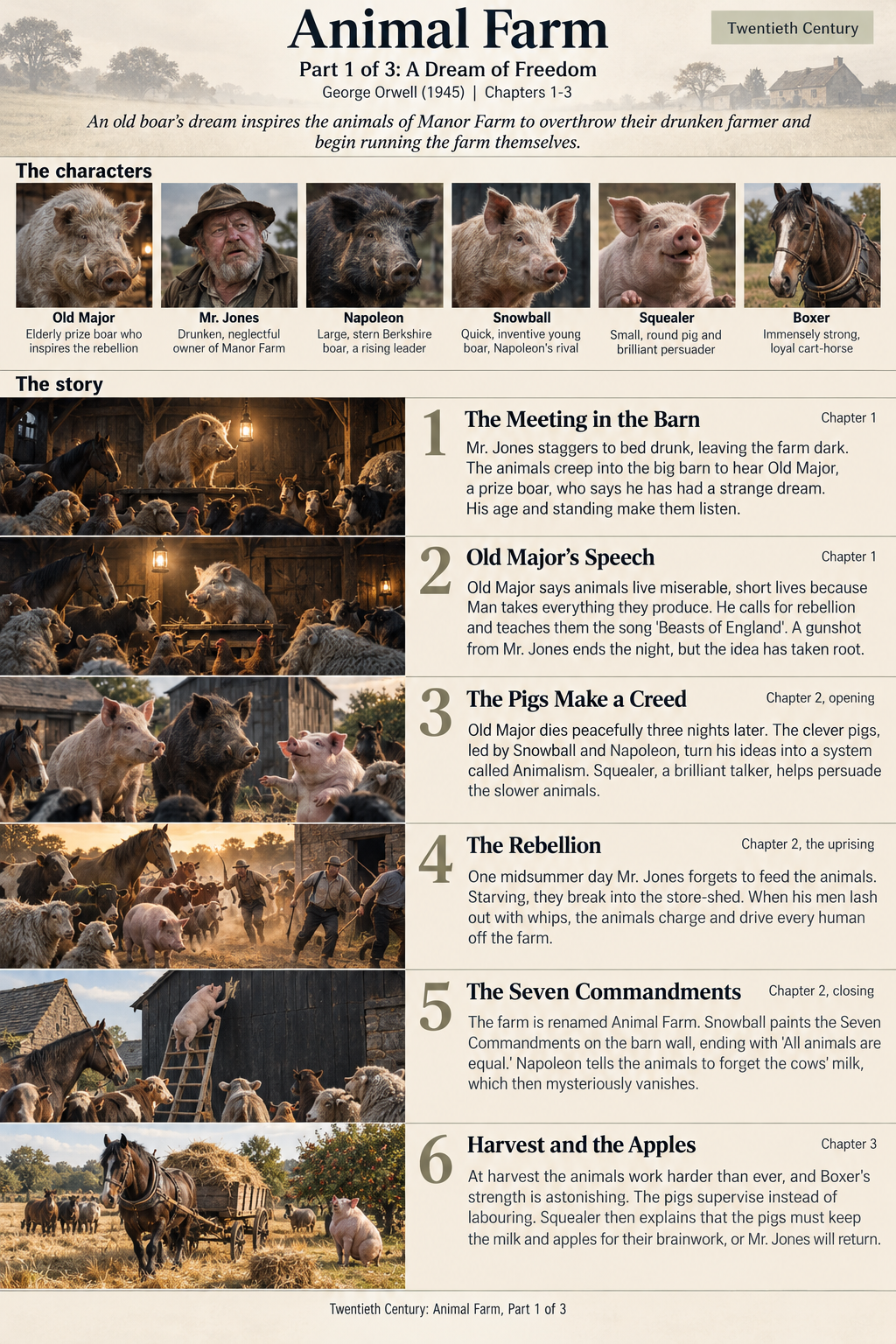
George Orwell's fable opens on Manor Farm, a run-down English farm owned by Mr. Jones, a man more devoted to drink than to his animals. One night, after Jones has staggered to bed and blown out his lantern, the animals slip into the big barn. They have been summoned by Old Major, a prize boar so respected that none dares ignore him.
Old Major tells them he has had a dream of a world without humans. He lays out their situation plainly: the animals toil, are underfed, and are slaughtered when they are no longer useful, while Man consumes without producing. The remedy is rebellion, and the animals must never copy Man's habits. He teaches them 'Beasts of England', and their singing wakes Jones, who fires his gun into the dark. Three nights later Old Major dies, but his message lives on.
The pigs, as the cleverest animals, take up the teaching. Snowball is inventive and lively, Napoleon forceful and silent, and Squealer a gifted talker. They shape the dream into Animalism. The rebellion arrives sooner than anyone expects. On Midsummer's Eve Jones drinks away the day and the animals go unfed. Starving, they break into the store-shed, and when Jones and his men arrive with whips, the animals drive them out. Mrs. Jones flees, and the farm is theirs.
They rename it Animal Farm. Snowball paints the Seven Commandments on the barn wall, which include 'Four legs good, two legs bad' in spirit and end with 'All animals are equal.' The first signs of trouble come quickly: the milk from the cows vanishes into the pigs' mash. In Chapter 3 the harvest succeeds beyond hope. Boxer works tirelessly, with his motto 'I will work harder'. The pigs supervise, Snowball founds committees, and Napoleon takes the puppies away to educate them. When the apples are reserved for the pigs, Squealer argues that they need them for brainwork, and that Jones would return otherwise. The animals accept this.
The motives are already visible. The ordinary animals want a fair and safe life, and Boxer's loyalty is total. The pigs begin as idealists but quickly give themselves privileges, and Napoleon in particular holds back and watches. Most of the animals are too ignorant, trusting or frightened to question.
The themes are set out early: how revolutions begin in real injustice, how ideals are written down and simplified, and how language can bend the truth. Squealer's threat of Jones's return shows fear used as an argument. The 'equal' commandment already sits beside a quiet inequality.
The lessons are practical. Be wary of explanations that conveniently benefit those who give them. Notice who controls education and information. Remember that good intentions need checks, and that people who work hardest are often the least heard.
Further reading
- George Orwell, Animal Farm: A Fairy Story (Penguin Modern Classics) (2000)
- Bernard Crick, George Orwell: A Life (1980)
- D. J. Taylor, Orwell: The Life (2003)