Animal Farm, Part 2 of 3: Snowball's Fall, Napoleon's Rise
Twentieth Century · Part 2 of 3: Snowball's Fall, Napoleon's Rise
Animal Farm
George Orwell (1945) · Chapters 4-7
The animals defeat Jones's attack, but Napoleon drives out Snowball, forces them to build a windmill and begins to rule through fear.
The story so far: Old Major's dream inspires the animals of Manor Farm to overthrow the drunken farmer Mr Jones. They rename it Animal Farm and adopt seven commandments, with the clever pigs Snowball and Napoleon leading.
Old Major, the prize boar, dreamed of a world without human masters and died soon after teaching the animals the song 'Beasts of England'. Within months the animals of Manor Farm had driven out the careless farmer Mr Jones, renamed the place Animal Farm, and painted seven commandments on the barn wall, with the pigs Snowball and Napoleon taking the lead.
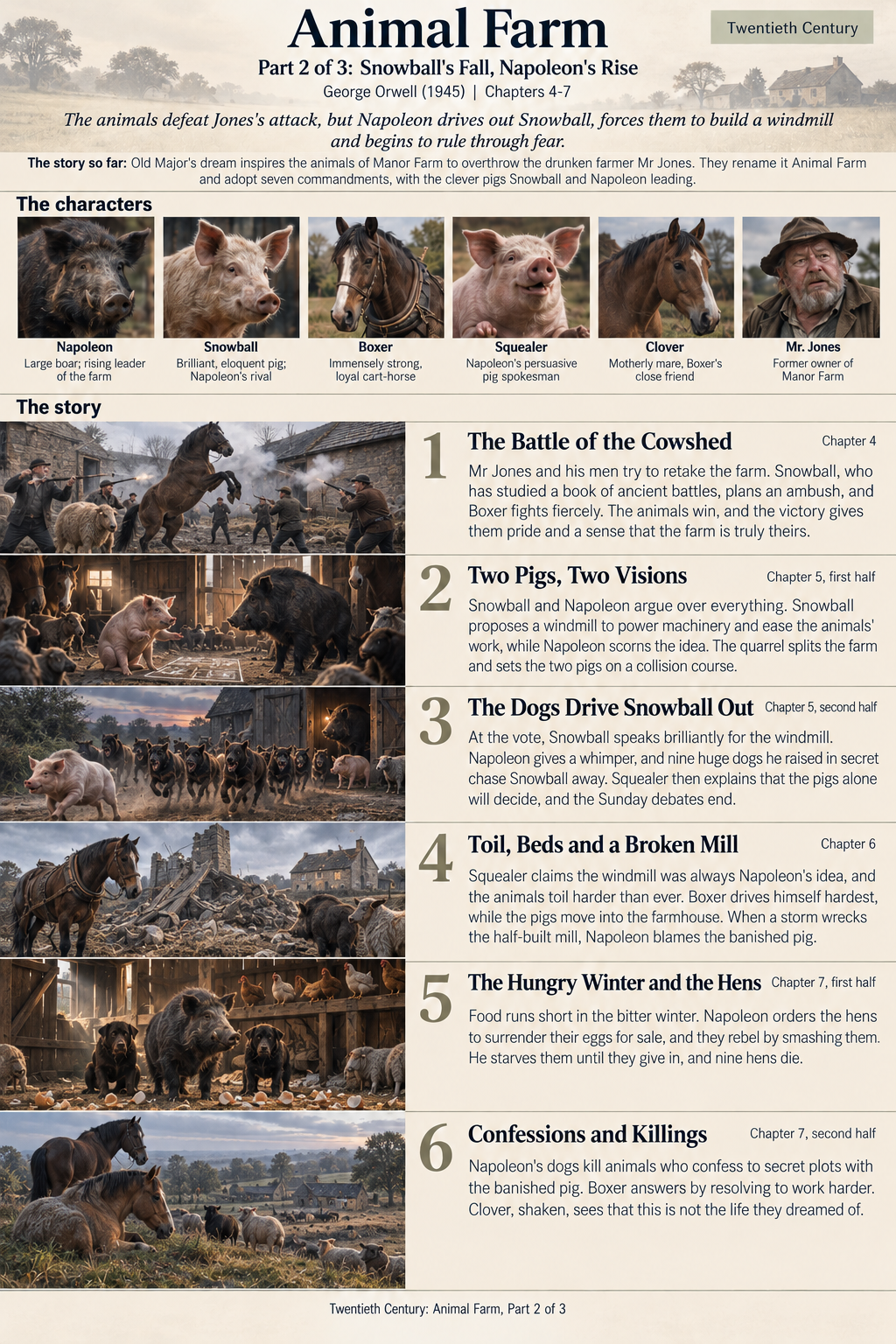
This part opens with the animals' first test. Mr Jones and his men march on the farm to take it back, but Snowball, who has studied an old book of ancient battles, has prepared an ambush. Geese, pigeons and sheep harry the men, then Boxer, the huge cart-horse, rears up and strikes with his hooves. The humans flee, and Snowball and Boxer are given medals as Animal Heroes. Jones's gun is kept as a trophy and fired twice a year.
Victory does not bring unity. Snowball and Napoleon disagree over everything. Snowball dreams of a windmill that would generate electricity and shorten the working week; Napoleon calls it a fantasy and says the priority is food. On the day of the vote, Snowball speaks so well that the animals seem won over. Then Napoleon gives a whimper, and nine huge dogs, secretly raised from puppies he took from their mothers, burst in and chase Snowball off the farm for good. Napoleon abolishes the Sunday debates, and Squealer, his smooth-tongued spokesman, assures everyone that the pigs alone will decide. Soon afterwards the windmill is declared to be Napoleon's own idea, stolen by Snowball.
Life grows harder. The animals work sixty hours a week and then volunteer on Sundays to build the mill, with Boxer toiling hardest. The pigs, meanwhile, move into the farmhouse and sleep in beds, and the commandment against beds is quietly amended. When a storm destroys the half-built windmill, Napoleon blames Snowball and orders work to start again. Winter brings near-starvation, hidden by lies to visitors. Napoleon demands the hens' eggs for sale; they rebel, and he cuts their food until nine have died. Then comes the horror of the confessions: animals admit to secret dealings with Snowball and are killed by the dogs on the spot. The commandment against killing now carries the words 'without cause', and 'Beasts of England' is abolished.
Napoleon's motives are plain: he wants power, and he uses fear, rewritten history and Squealer's arguments to keep it. The ordinary animals are driven by loyalty and hope. Boxer answers every crisis with 'I will work harder', and Clover sees that this is not the future they imagined, yet cannot find words to protest. The part develops the theme of a revolution betrayed from within, the way propaganda rewrites memory, and how force and rhetoric work together. Most readers see Snowball and Napoleon as echoes of Trotsky and Stalin, though the fable works without that key.
The lessons are practical. Be wary of leaders who cannot tolerate debate, and of explanations that change the past to fit the present. Rights lost quietly are hard to regain. Loyalty without questions leaves people helpless, and a community that stops checking its own founding promises invites those who would break them.
Further reading
- George Orwell, Animal Farm: A Fairy Story (Penguin Modern Classics) (2000)
- Bernard Crick, George Orwell: A Life (1980)
- Michael Shelden, Orwell: The Authorised Biography (1991)