Animal Farm, Part 3 of 3: From Comrades to Masters
Twentieth Century · Part 3 of 3: From Comrades to Masters
Animal Farm
George Orwell (1945) · Chapters 8-10
Napoleon's pigs tighten their grip as the windmill falls, Boxer is sold to the knacker, and the pigs finally stand and walk like men.
The story so far: The animals drove out farmer Jones and ran the farm by Seven Commandments. Napoleon, a pig, then exiled his rival Snowball, took sole power, had 'traitors' killed, and drove the animals to build a windmill.
By now the Rebellion has soured. The animals drove out Mr Jones and promised each other equality under Seven Commandments. Then Napoleon, a pig, used his savage dogs to expel his rival Snowball and rule alone. After a bloody round of forced confessions and executions, the rules had already been quietly bent: beds were allowed 'with sheets', and killing was forbidden only 'without cause'.
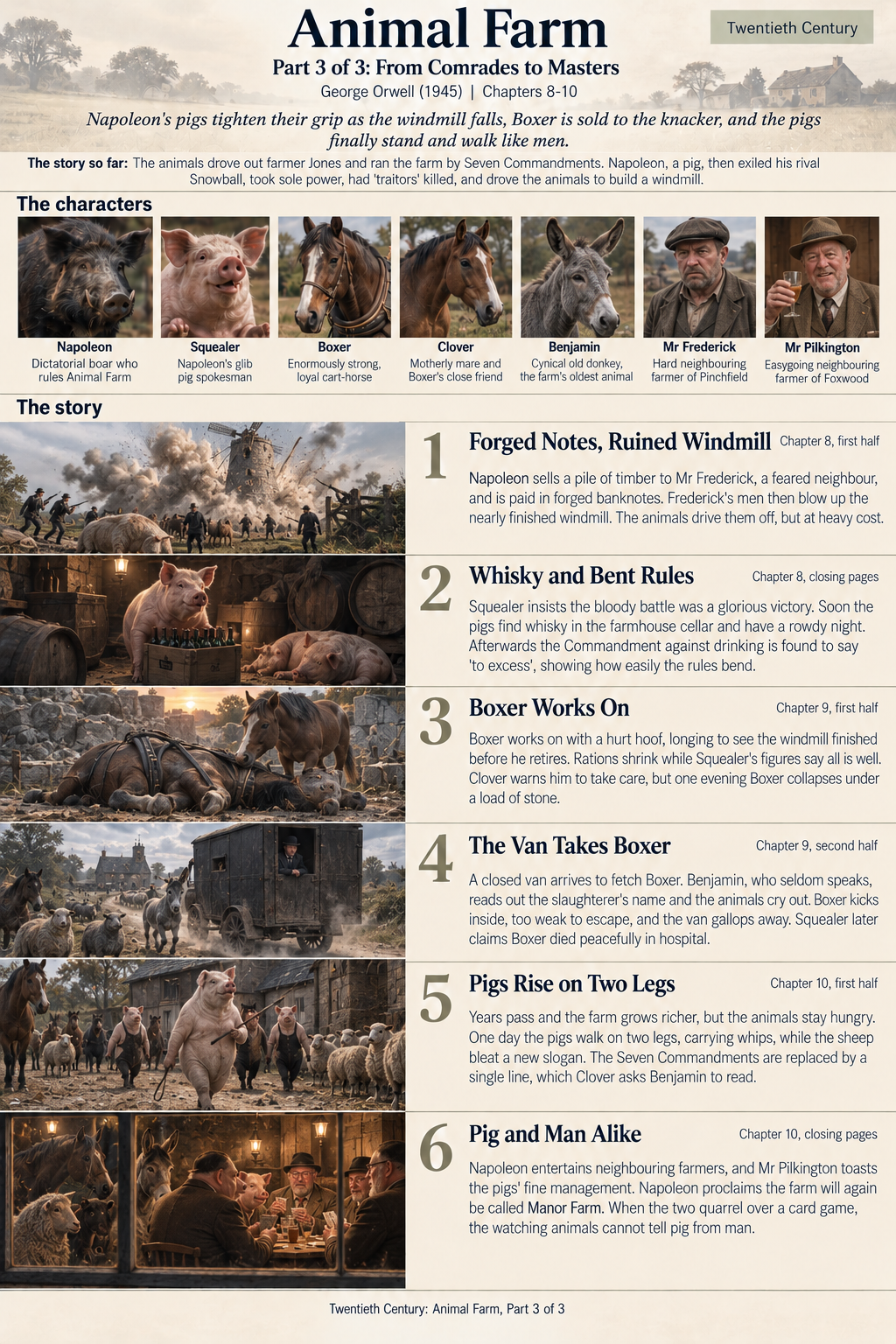
Chapter 8 opens with the animals uneasy about that rule on killing. Squealer, Napoleon's smooth spokesman, persuades them they are misremembering. Napoleon now appears rarely, guarded by dogs and hailed as 'Father of All Animals'. Having seemed to favour Mr Pilkington, he sells a pile of timber to Mr Frederick, a neighbour rumoured to be cruel. Frederick pays in forged banknotes, then he and his men attack and blow up the almost finished windmill. The animals drive them off, but many are wounded. Squealer calls it a glorious victory. Soon the pigs find whisky in the farmhouse cellar, and after a rowdy night Napoleon is ill. The Commandment on drink is later found to read 'to excess'.
Chapter 9 turns to Boxer, the great cart-horse whose motto is 'I will work harder'. His hoof is slow to heal, but he refuses to rest, hoping to see the windmill finished before he retires. Rations are cut while Squealer reads out figures proving everyone is better off. One evening Boxer collapses under a load of stone. Squealer says he will be treated at a hospital. When a closed van arrives, Benjamin, the cynical donkey, reads out the name of a horse slaughterer on its side. The animals cry out, and Boxer kicks weakly at the van as it speeds away. Squealer insists the van now belongs to a hospital and that Boxer died peacefully. A few days later the pigs have a noisy night after a crate of whisky arrives.
Chapter 10 leaps ahead many years. Few remember Jones, and Snowball and Boxer are barely mentioned. The farm is richer and the windmill grinds corn, yet the ordinary animals remain hungry and overworked. Then the pigs walk out on their hind legs with whips, while the sheep bleat 'Four legs good, two legs better!' The Commandments are replaced by one line: 'All animals are equal, but some animals are more equal than others.' Napoleon dines with neighbouring farmers, and the old name Manor Farm is restored. When he and Mr Pilkington quarrel over cards, the watching animals cannot tell pig from man.
Napoleon and the pigs are driven by appetite for comfort and power, and each small concession makes the next easier. The animals, by contrast, are weakened by exhaustion, poor memory and trust in Squealer. The part develops the corruption of language, the rewriting of history, and the exploitation of loyalty. Readers still debate whether Orwell blames the leaders, the passive masses or both.
The lessons are practical. Keep records of what was promised, because rulers who control the past control the argument. Be wary of statistics offered in place of lived experience. Loyalty without questions can be fatal, as Boxer's was. And those who fight tyranny can become what they fought if no one holds them to account.
Further reading
- George Orwell, Animal Farm: A Fairy Story (Penguin Modern Classics) (2000)
- Bernard Crick, George Orwell: A Life (1980)
- Gordon Bowker, Inside George Orwell: A Biography (2003)