King Lear, Part 1 of 3: Nothing Will Come of Nothing
Shakespeare · Part 1 of 3: Nothing Will Come of Nothing
King Lear
William Shakespeare (c. 1606) · Acts 1-2
An aged king tests his daughters' love, banishes the honest one, and is then humiliated and shut out by the other two.
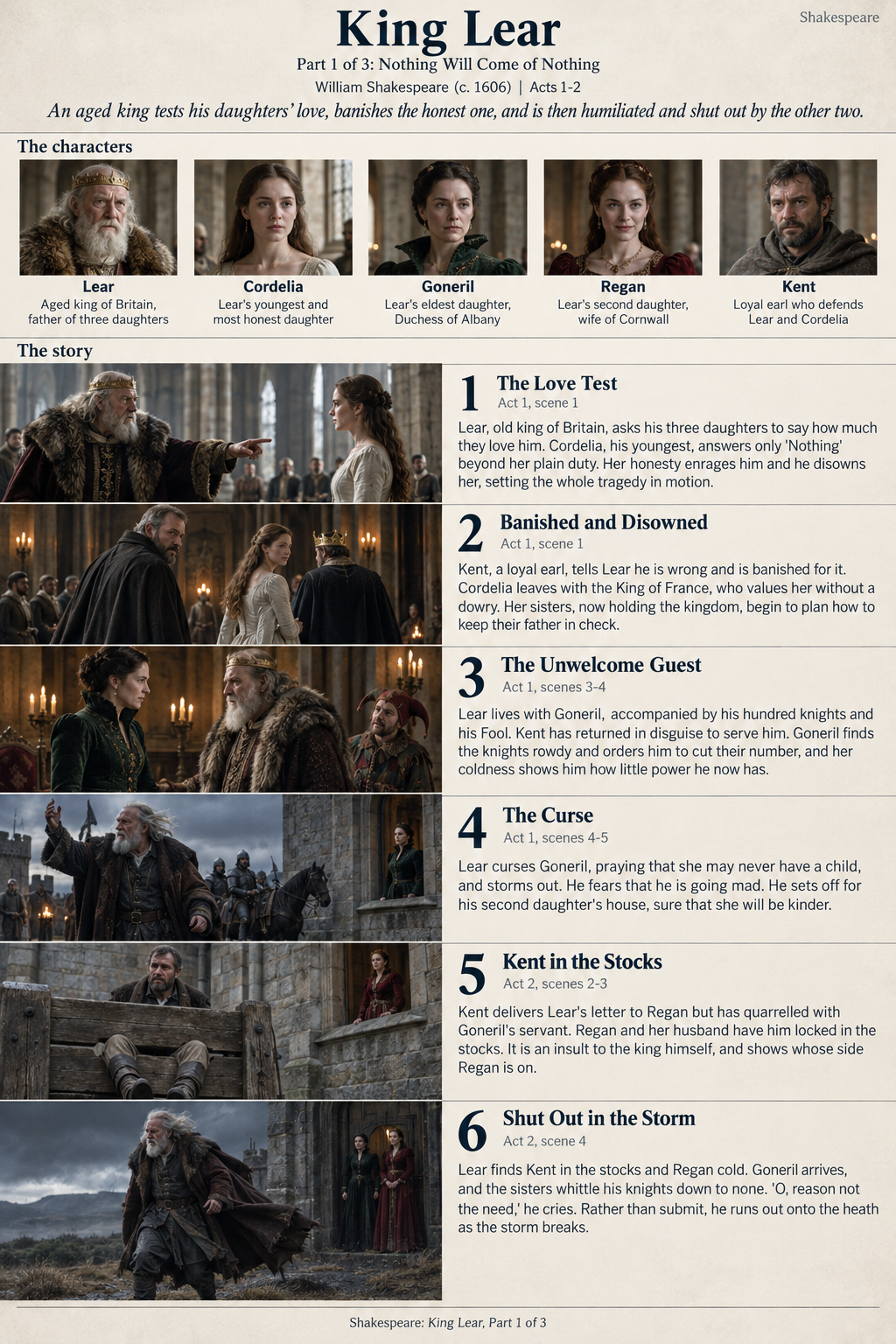
King Lear opens in an ancient Britain where an old king has decided to retire from power without giving up its pleasures. Lear plans to divide his kingdom among his three daughters, Goneril, Regan and Cordelia, rewarding each according to how much she professes to love him. He means to keep the title of king and a retinue of a hundred knights.
In Act 1, scene 1, Goneril and Regan answer with extravagant speeches. Cordelia, the youngest and his favourite, refuses to inflate her feelings. 'Nothing, my lord,' she says, and explains that she loves him as a daughter should, but will not give him all her love if she marries. Furious, Lear disowns her and shares her portion between her sisters. The Earl of Kent protests and is banished. The Duke of Burgundy withdraws his suit, but the King of France takes Cordelia without a dowry. Left alone, Goneril and Regan agree that their father has always been rash, and that age has made him worse.
A second story runs beside this one. The Earl of Gloucester's illegitimate son Edmund forges a letter to persuade his father that his legitimate brother Edgar plots against him, and in Act 2 Edgar is forced to flee and hide. Meanwhile Lear goes to live with Goneril, and Kent returns in disguise to serve him. Goneril complains of the knights' behaviour and the Fool's mockery, and orders him to reduce his train. Lear curses her, praying that she may never bear a child, and heads for Regan's house. Kent, sent ahead, quarrels with Goneril's servant and is put in the stocks by Regan and her husband Cornwall, a direct insult to the king. When Lear arrives, Regan sides with her sister. Goneril comes too, and the two bargain his knights down to twenty-five, ten, five, and finally one: what need has he of any? 'O, reason not the need,' Lear pleads. As a storm gathers, he rushes out onto the open heath, and the doors are bolted behind him.
The motives are plain but painful. Lear is proud and hungry for public proof of love, and he confuses ceremony with feeling. Cordelia is honest to the point of stubbornness, and her refusal to perform costs her everything. Goneril and Regan are calculating, and once they hold power they have no wish to share it. Kent shows loyalty that accepts punishment. Lear himself moves quickly from command to fury to helplessness, and he begins to fear for his own sanity.
The themes gather early. The play sets true love against flattery, and asks what authority is worth once its trappings are gone. It sets the family bond against selfish ambition, and 'nature' against the ruthless uses people make of it. It also shows how age makes a parent dependent on his children. Critics differ on how far Lear is simply foolish and how far Cordelia is also at fault, but most agree that the opening scene is a catastrophe of his own making.
A reader can take away several lessons. Beware those who tell you only what you want to hear, and value those who tell you hard truths. Handing over power is easy, but keeping dignity afterwards is harder. Generosity given in order to be praised often turns to bitterness. And a person's worth, as Lear's plea about need suggests, cannot be measured by the show that surrounds them.
Further reading
- R. A. Foakes (ed.), King Lear (Arden Shakespeare, Third Series) (1997)
- A. C. Bradley, Shakespearean Tragedy (1904)
- Stephen Greenblatt, Will in the World: How Shakespeare Became Shakespeare (2004)