King Lear, Part 2 of 3: Storm, Madness and Blindness
Shakespeare · Part 2 of 3: Storm, Madness and Blindness
King Lear
William Shakespeare (c. 1606) · Act 3
Cast out by his daughters, Lear is broken by a storm and by madness, while his loyal friend Gloucester is cruelly blinded.
The story so far: Lear divided his kingdom between Goneril and Regan after their flattery and banished honest Cordelia. His two daughters then stripped him of his knights and shut him out, while Edmund schemed against his brother Edgar.
At the start of the play, Lear, an aged king of Britain, divided his kingdom between his daughters Goneril and Regan after they flattered him, and banished the honest Cordelia and his loyal follower Kent. Goneril and Regan then stripped him of his knights and shut their doors against him. Meanwhile Edmund, the illegitimate son of the Earl of Gloucester, tricked his father into rejecting his legitimate brother Edgar, who fled.
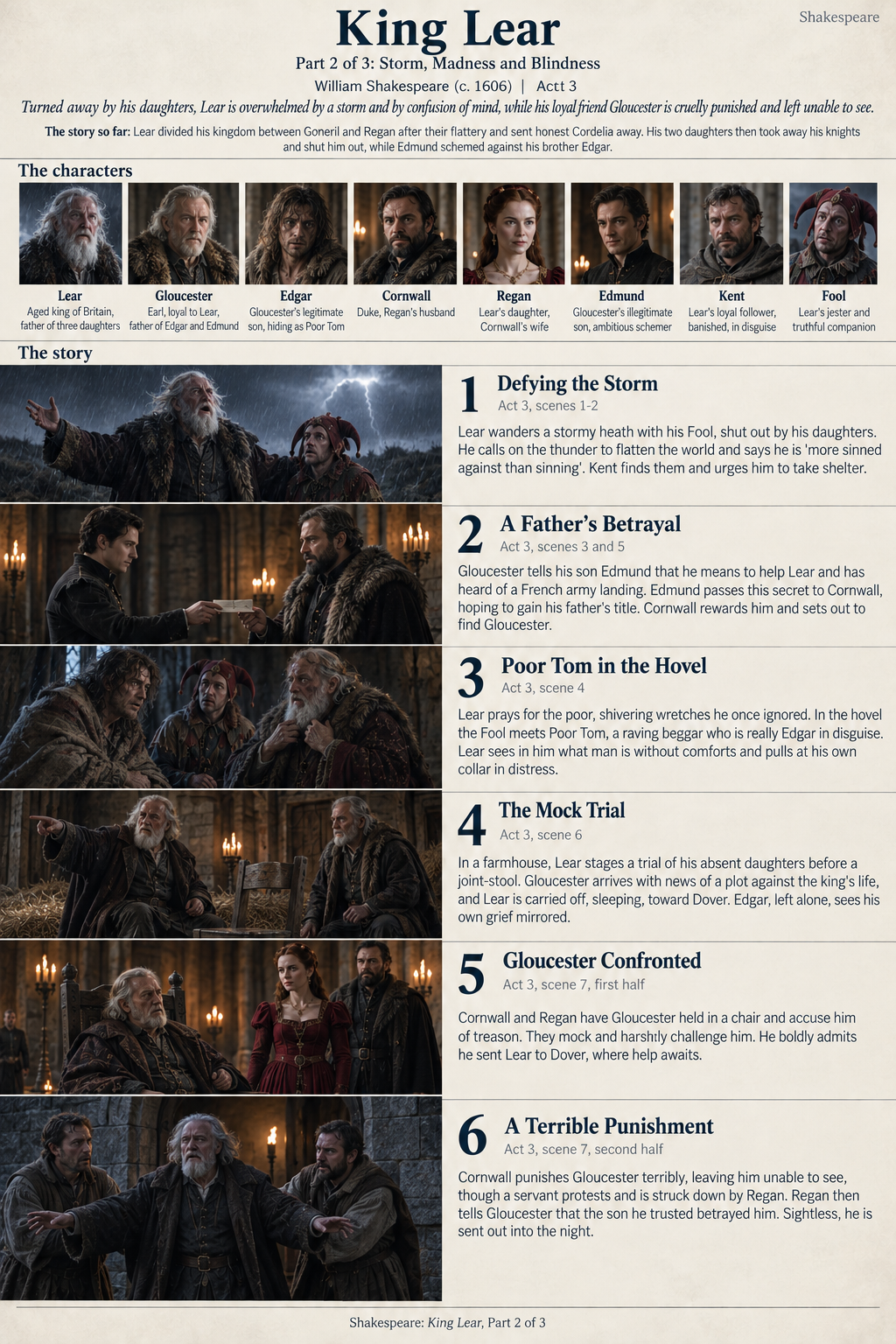
Act 3 opens on a wild heath in a violent storm. Lear, accompanied only by his Fool, calls on the thunder to destroy the world and insists that he is 'more sinned against than sinning'. Kent, in disguise, finds him and leads him toward a hovel. Gloucester, troubled by the daughters' cruelty, confides to Edmund that he will help the king and has learned of a French force preparing to land. Edmund promptly betrays him to Cornwall, Regan's husband, who rewards him with Gloucester's title. In the hovel Lear meets Poor Tom, a half-naked madman who is really Edgar in disguise. Lear sees in him what a man is without comforts, tears at his own clothes and calls him his philosopher. Gloucester finds them and takes them to a farmhouse, where Lear holds a mock trial of Goneril and Regan. Gloucester then warns of a plot against the king and Lear is carried off toward Dover.
Then comes the play's most shocking scene. Cornwall and Regan have Gloucester tied to a chair and accuse him of treason. When he admits he sent Lear to Dover, Cornwall puts out one of his eyes. A servant, appalled, draws his sword and wounds Cornwall, and Regan kills him. Cornwall puts out the other eye. Regan then tells Gloucester that Edmund betrayed him, and Gloucester realises he has wronged Edgar. He is thrust out into the night.
The characters change under pressure. Lear, who once demanded flattery, begins to feel pity for the poor and for the first time sees how little power and clothing really mean. His anger and his mind slip together, and it is hard to say where justified rage ends and madness begins. Gloucester, who was easily deceived, shows courage by helping the king and pays horribly for it. Cornwall and Regan show how quickly power becomes cruelty once it believes itself unchallenged. Edmund shows ambition at its coldest, using his father's kindness as a weapon.
The act develops several themes. One is the difference between sight and insight: Gloucester loses his eyes just as he begins to see the truth. Another is the thin line between civilised man and the 'poor, bare, forked animal' beneath. Justice is also questioned, as Lear's mock trial replaces the real one that never comes. Critics disagree about whether the storm reflects a moral order or only a cruel, indifferent universe.
The lessons are sober ones. Power and status can hide how fragile we all are. Pity is learned most often through suffering, and usually late. Loyalty to the vulnerable can be costly, and the play does not promise that it will be rewarded. Finally, it warns that people who trust flattery, and who ignore those who speak plainly, may only see the truth when they have lost everything.
Further reading
- R. A. Foakes (ed.), King Lear (Arden Shakespeare, Third Series) (1997)
- A. C. Bradley, Shakespearean Tragedy (1904)
- Jan Kott, Shakespeare Our Contemporary (1964)