King Lear, Part 3 of 3: Never, Never, Never, Never, Never
Shakespeare · Part 3 of 3: Never, Never, Never, Never, Never
King Lear
William Shakespeare (c. 1606) · Acts 4-5
Mad Lear is reunited with Cordelia, a war breaks out, and the villains destroy one another in a catastrophe that engulfs the royal house.
The story so far: Lear gave his kingdom to two flattering daughters and banished honest Cordelia. They stripped him of power and drove him into a storm, where he went mad. Gloucester, helping him, was blinded.
At the end of Act 3, King Lear's world had collapsed. He had divided his kingdom between his daughters Goneril and Regan, who then turned him out, and he went mad on the storm-swept heath. The Earl of Gloucester, who tried to help him, had his eyes put out by Regan and her husband. Act 4 begins in the aftermath.
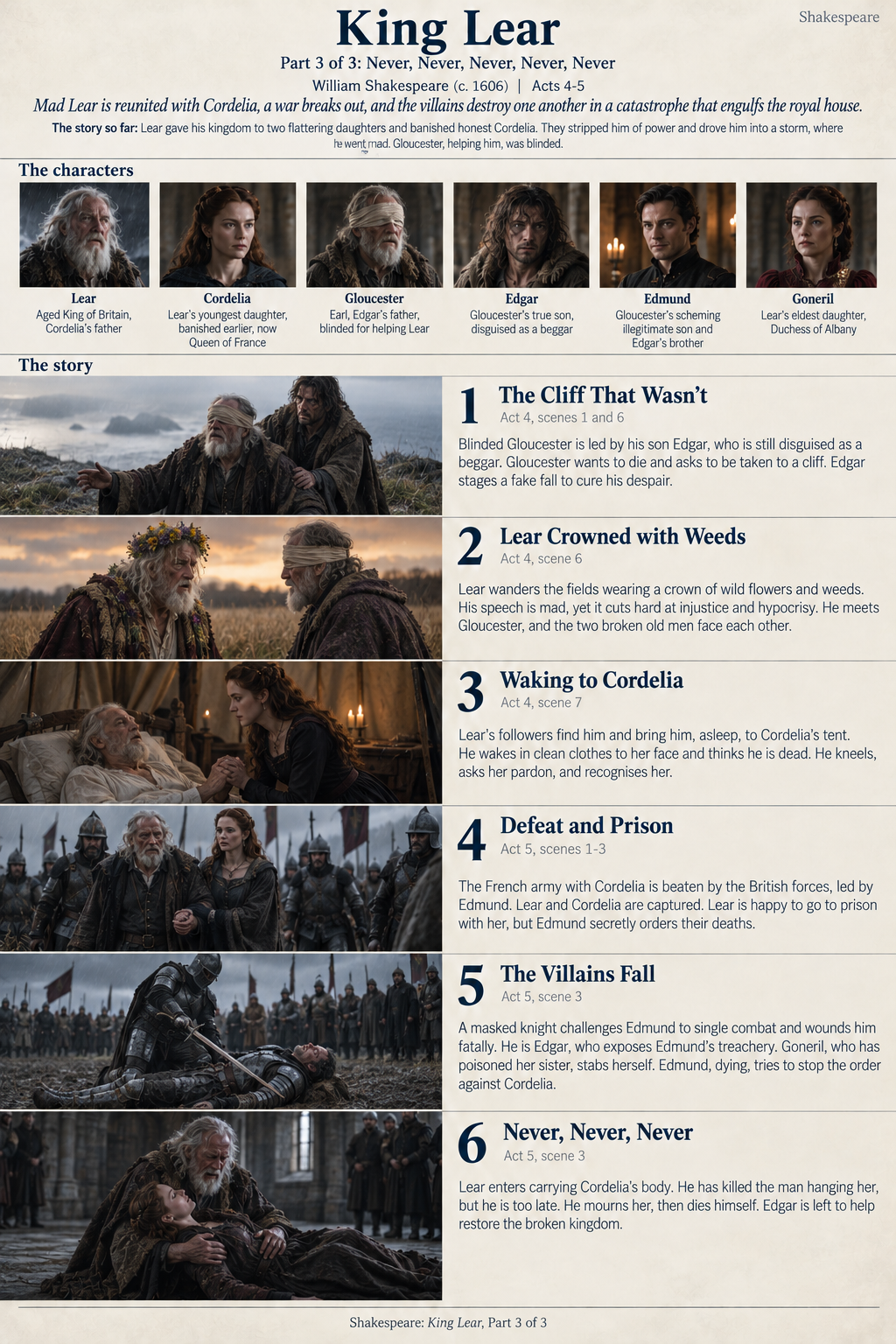
Gloucester, blind and cast out, is led across the countryside by an old man, and meets his son Edgar, whom he has wrongly banished and who is disguised as a madman called Poor Tom. Gloucester says that the gods kill us for their sport, as flies are killed by wanton boys. Edgar, still hiding, takes him towards Dover. Gloucester wants to die, so Edgar persuades him he is on a cliff-edge, and lets him fall on level ground. Convinced he has been saved by the gods, Gloucester agrees to endure. Soon after, the mad Lear arrives, wearing a crown of weeds. He talks wildly yet sees clearly how power and wealth hide injustice. Cordelia, now with a French army, has sent men to find him. They bring him to her tent, and he wakes calm and humble. He kneels, and says he is old and foolish, and asks her to forget and forgive.
Act 5 begins with the British forces, led by Edmund, Gloucester's illegitimate son. Both Goneril and Regan desire him. Edmund's army defeats the French, and Lear and Cordelia are taken prisoner. Lear is almost happy, because he thinks that in prison they will live together, singing like birds in a cage. But Edmund secretly orders that Cordelia be hanged. Then Edgar, in armour and unrecognised, challenges Edmund, wounds him fatally, and reveals the truth. Goneril, who has poisoned Regan, kills herself. Edmund, dying, tries to save Cordelia, but too late. Lear enters with her body in his arms, and soon after he dies, calling out that she may be breathing.
The characters change in ways that matter. Lear begins as a man who trusted flattery and ends as one who understands love and humility, but this wisdom comes at fearful cost. Gloucester, who was once blind to his true son, learns to see by losing his sight. Edgar moves from hiding to action. Edmund, ruthless to the end, wants for one moment to do some good.
The play explores justice, suffering and the thin line between power and helplessness. It asks whether the gods care, and Shakespeare gives no easy answer. Some critics see redemption in Lear's late love, while others find the ending as bleak as anything in drama. Cordelia's death is senseless, and an eighteenth-century version even rewrote it to be happy.
The lesson is hard but clear. Words are not love, and those who flatter may be those who betray. Pride and the hunger for power destroy families, and often wisdom comes only after great loss. A reader can take from it a duty to value honest affection while it is there, and to treat the weak with the kindness every one of us may someday need.
Further reading
- William Shakespeare, ed. R. A. Foakes, King Lear (Arden Shakespeare, Third Series) (1997)
- A. C. Bradley, Shakespearean Tragedy (1904)
- Jan Kott, Shakespeare Our Contemporary (1964)