Oliver Twist, Part 1 of 3: A Parish Boy's Progress
Dickens · Part 1 of 3: A Parish Boy's Progress
Oliver Twist
Charles Dickens (1838) · Chapters 1-17
An orphan asks for more gruel, is sold into apprenticeship, flees to London, falls among thieves and is briefly rescued by a kind gentleman.
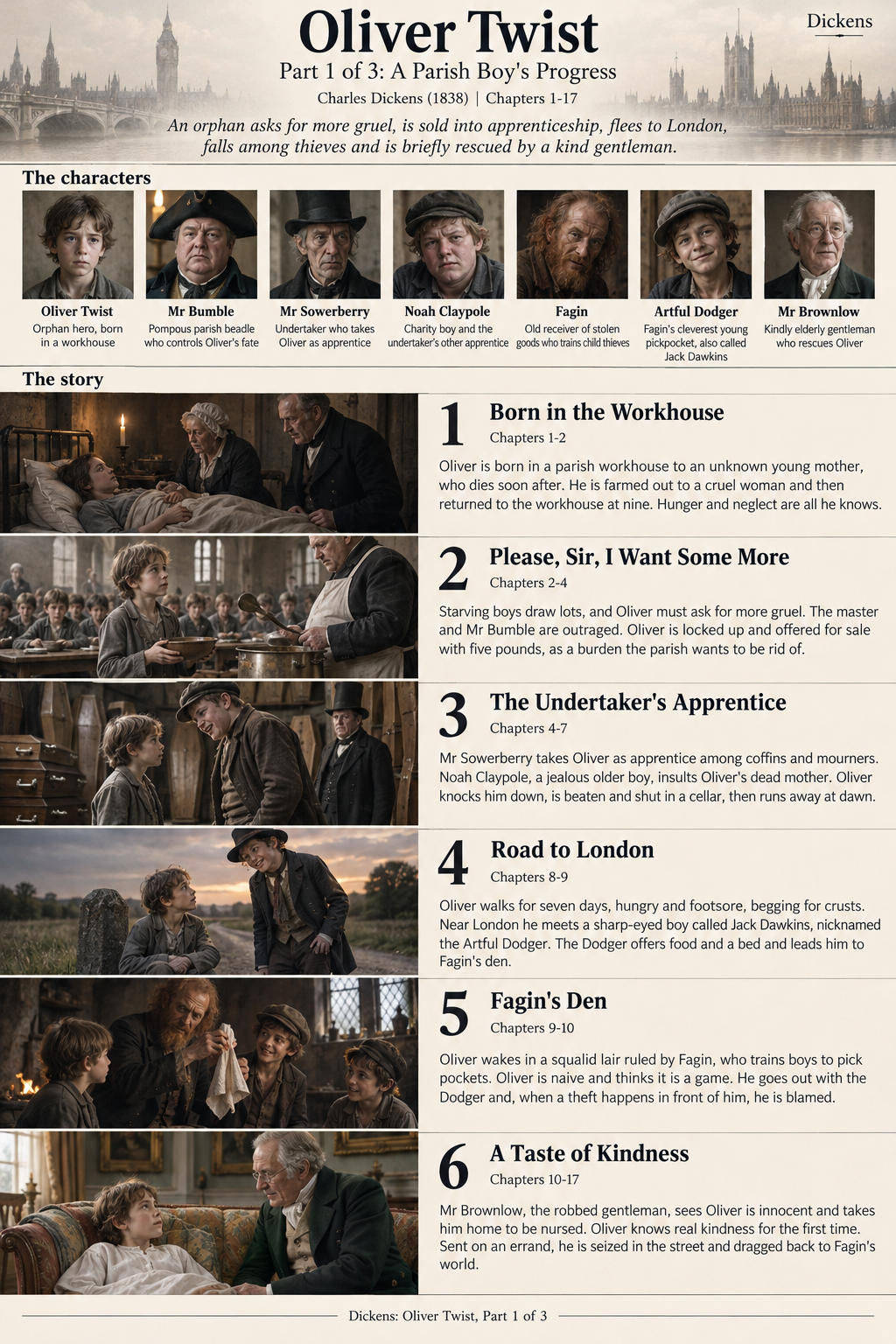
Oliver Twist opens in a bleak English market town, where a nameless young woman is brought to the parish workhouse and dies just after giving birth to a son. The boy is named Oliver Twist by the beadle, Mr Bumble, and raised on the parish's cold charity, first in a baby-farm run by a cruel woman and then, at nine, in the workhouse itself.
There the children are kept on thin gruel. Driven by hunger, Oliver is chosen by lot to ask for more, and his famous plea so outrages the authorities that he is locked away and advertised for sale with five pounds as a sweetener. After a narrow escape from a brutal chimney sweep, he is apprenticed to the undertaker Mr Sowerberry. Another apprentice, Noah Claypole, torments him until he insults Oliver's dead mother. Oliver, usually meek, knocks him down, is beaten and confined, and runs away at dawn, bound for London.
He walks for seven days, near starving, until he meets Jack Dawkins, the Artful Dodger, who takes him to a squalid house near Saffron Hill. Its master, Fagin, trains boys to steal, dressing it up as a game with handkerchiefs and pockets. Oliver, innocent of the truth, goes out with the Dodger and another boy and sees them rob the elderly Mr Brownlow. Oliver runs and is caught, but the bookseller who saw the theft clears him, and Mr Brownlow, struck by the boy's face, takes him home. Oliver is nursed through fever and begins to know warmth and kindness. He notices that his face resembles a portrait on the wall, a hint of a mystery. Fagin, fearing betrayal, sends two of his gang to seize Oliver back during an errand, and the part ends with Mr Brownlow left believing the boy has stolen from him.
Motives are plain. The parish officials care for rules and reputation, not children. Fagin's crew steal to survive. Oliver wants only food, safety and affection, and his small acts of defiance show a stubborn moral core rather than anger.
Dickens develops several themes: the cruelty of institutions that treat poverty as crime, the way hunger and neglect push children toward crime, and the contrast between self-satisfied respectability and real kindness. Chance rescue and the portrait suggest a hidden past that matters to the story. Scholars debate whether Oliver's innate goodness is a Romantic idea of inherited virtue or a convenient plot device.
For a reader today, the lessons are that systems can be cruel even when staffed by ordinary people, that children are shaped by how they are treated, and that one person's decent act can change a life.
Further reading
- Charles Dickens (ed. Philip Horne), Oliver Twist (Penguin Classics) (2002)
- Peter Ackroyd, Dickens (1990)
- John Bayley, The Characters of Love / Dickens essays; see also Juliet John, Dickens's Villains (2001)