The Iliad, Part 2 of 3: The Ships Burn, Patroclus Falls
Ancient and Classical · Part 2 of 3: The Ships Burn, Patroclus Falls
The Iliad
Homer (c. 8th century BC) · Books 9-16
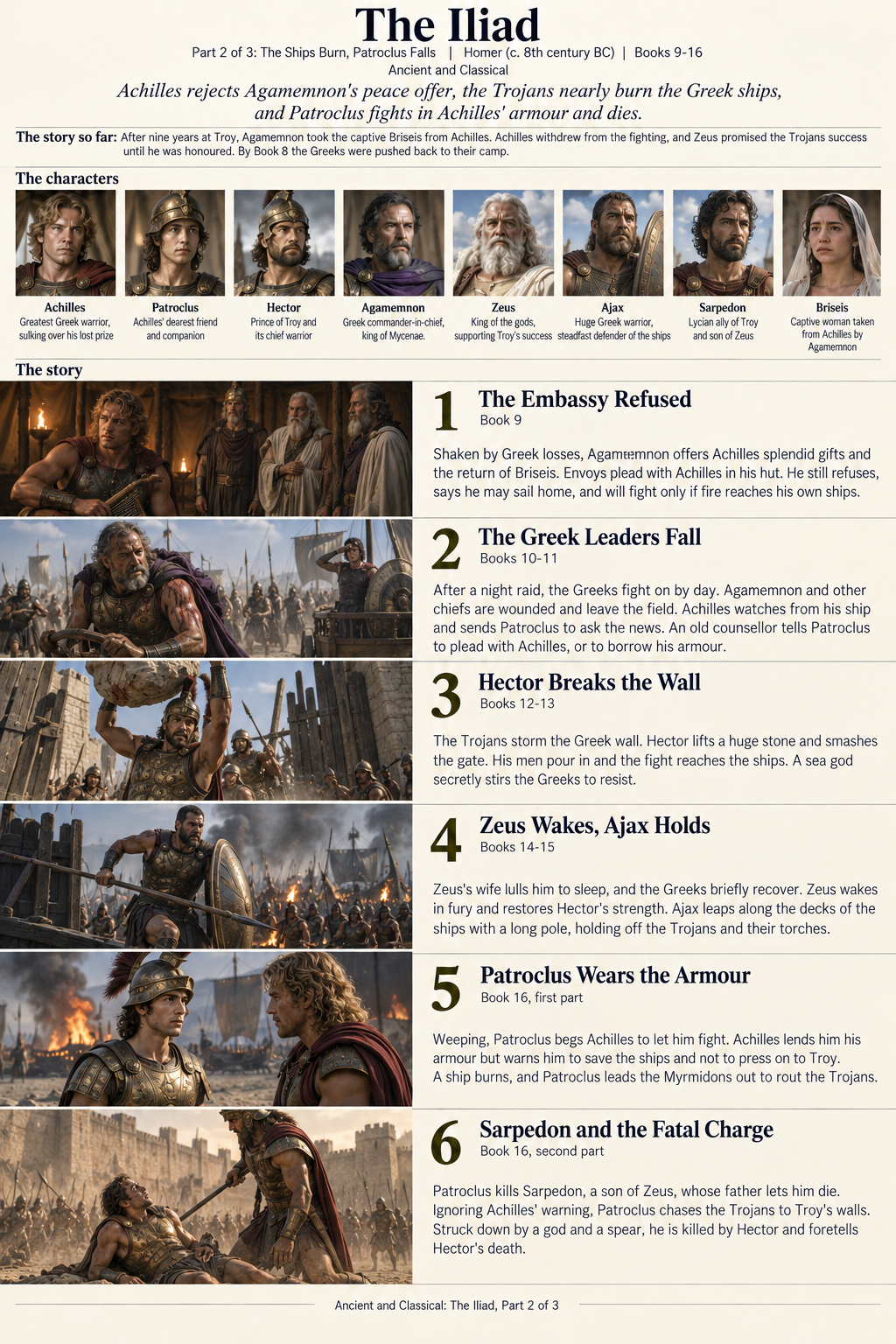
Achilles rejects Agamemnon's peace offer, the Trojans nearly burn the Greek ships, and Patroclus fights in Achilles' armour and dies.
The story so far: After nine years at Troy, Agamemnon took the captive Briseis from Achilles. Achilles withdrew from the fighting, and Zeus promised the Trojans success until he was honoured. By Book 8 the Greeks were pushed back to their camp.
In Books 1 to 8, the Greeks had been besieging Troy for nearly ten years when Agamemnon, their commander, seized the captive woman Briseis from Achilles, the greatest of their fighters. Insulted, Achilles withdrew from the war. At his mother's request, Zeus promised the Trojans success until Achilles was honoured. By the end of Book 8 the Trojans were camped on the plain, their fires burning before the Greek ships.
Book 9 opens in despair. Agamemnon admits he was wrong and offers Achilles great treasure, seven cities and the return of Briseis. Odysseus, the old tutor Phoenix and Ajax carry the offer to Achilles' hut while Patroclus sits silent. Achilles refuses. He says he will decide about sailing home, and will fight only when the fire reaches his own ships. Phoenix's and Ajax's appeals leave some doubt in the matter. After a night raid in Book 10, the Greek chiefs, including Agamemnon, Diomedes and Odysseus, are wounded in Book 11. Achilles sends Patroclus to ask the news, and the old counsellor Nestor urges him to plead with Achilles, or to borrow his armour.
In Books 12 and 13 Hector smashes the gate of the Greek wall with a boulder, and the Trojans pour in. The sea god Poseidon secretly rallies the Greeks. In Book 14 Hera lulls Zeus to sleep and the Greeks recover. In Book 15 Zeus wakes in fury and restores Hector, while Ajax strides along the decks of the ships with a long pole. In Book 16 Patroclus begs Achilles to let him help, weeping like a child. Achilles lends him his armour, but warns him to save the ships and not to press on towards Troy. As a ship burns, Patroclus leads the Myrmidons out and drives the Trojans back. He kills Sarpedon, a son of Zeus, whom Zeus lets die. Carried away, Patroclus ignores Achilles' warning and attacks Troy's walls. Apollo strikes him, a Trojan spear wounds him, and Hector kills him. Dying, Patroclus tells Hector that Achilles will soon kill him.
The motives are tangled. Agamemnon changes from arrogance to anxious humility, but Achilles' pride is wounded beyond gifts. Patroclus is moved by pity, not by pride, and that compassion carries him past the limit set for him. Zeus, who loves his own son, still accepts that fate cannot be overruled.
The part develops themes of honour and what it is worth, the cost of anger, and the power of fate over gods and mortals. Scholars still debate whether Achilles' refusal is noble or a fatal error, and Homer lets us feel both.
The lessons are sober. Stubborn pride can destroy what we love, and an apology offered too late may not heal a wound. Good intentions do not protect us when we overreach. Achilles' choice sends his friend into danger in his place, and consequences fall on others as well as on ourselves.
Further reading
- Emily Wilson (translator), The Iliad (2023)
- Caroline Alexander, The War That Killed Achilles (2009)
- Jasper Griffin, Homer on Life and Death (1980)