The Iliad, Part 1 of 3: A Quarrel That Shakes Heaven
Ancient and Classical · Part 1 of 3: A Quarrel That Shakes Heaven
The Iliad
Homer (c. 8th century BC) · Books 1-8
A quarrel between two Greek leaders sends the greatest warrior sulking to his tent, while Troy's army gains strength and the Greeks are pushed back.
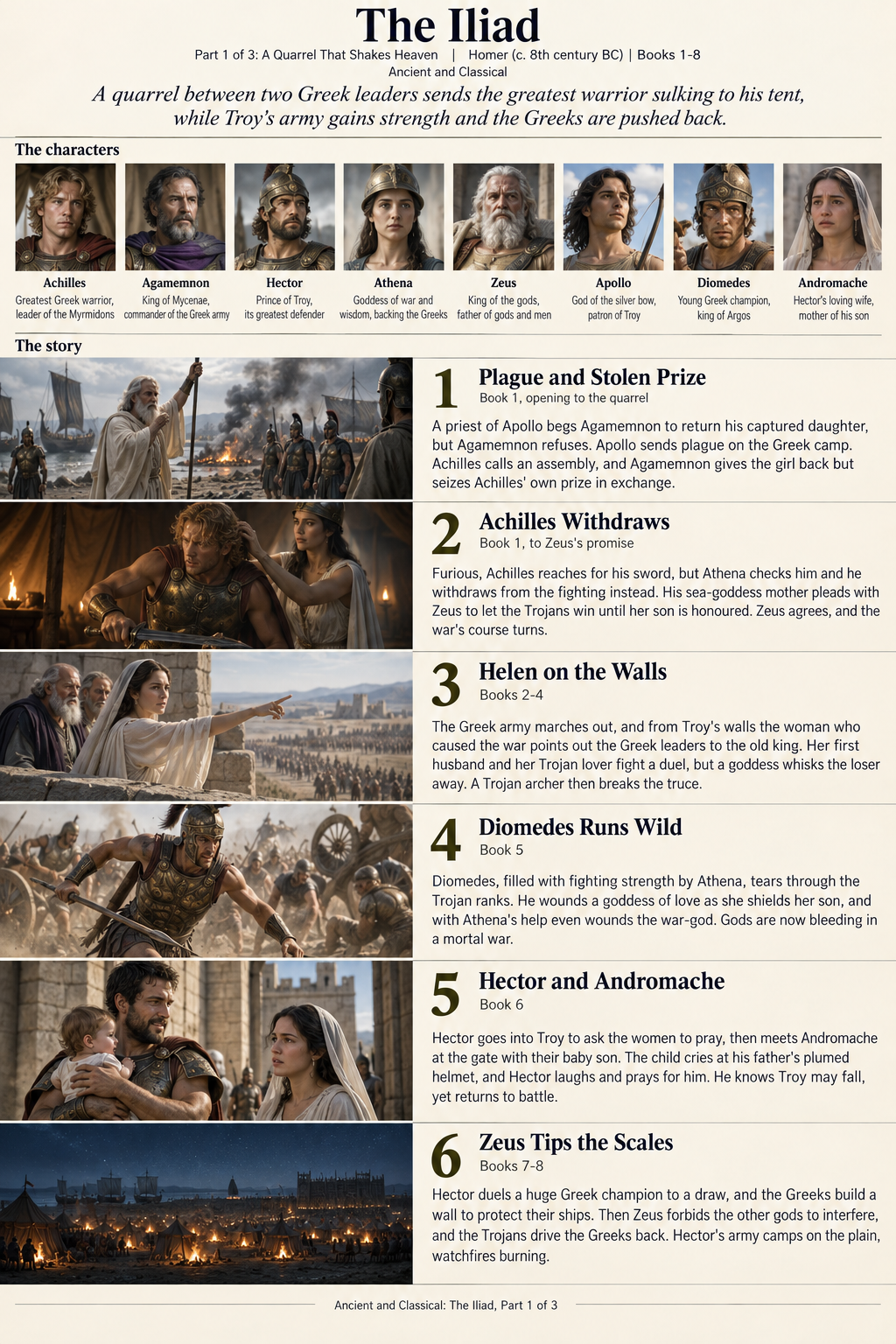
The Iliad opens in the tenth year of the Greek siege of Troy. The Greek army is camped beside its beached ships on the coast of Asia Minor, and Homer announces his subject at once: the destructive anger of Achilles, the greatest of the Greek warriors, and the suffering it brings.
In Book 1 Chryses, a priest of Apollo, offers ransom for his daughter Chryseis, who has been taken as a prize by Agamemnon, commander of the Greek forces. Agamemnon sends him away with insults, and Apollo strikes the camp with plague. Achilles calls an assembly, and the seer Calchas declares that the girl must be returned. Agamemnon agrees, but demands Achilles' own prize, Briseis, in compensation. Achilles reaches for his sword, but Athena seizes him by the hair and persuades him to keep to words. He withdraws from the fighting, and his mother, the sea-goddess Thetis, begs Zeus to let the Trojans prevail until her son is honoured. Zeus agrees, despite his wife Hera's anger.
The next books widen the view. Agamemnon tests his army, and the soldiers nearly stampede for the ships. In Book 3 Helen, standing on the walls of Troy, names the Greek heroes for King Priam, and her first husband Menelaus fights her lover Paris in single combat. Aphrodite rescues Paris, and in Book 4 the archer Pandarus wounds Menelaus and breaks the truce. In Book 5 Diomedes, strengthened by Athena, wounds both Aphrodite and the war-god Ares. In Book 6 Hector goes into Troy, and at the Scaean Gate he meets his wife Andromache and baby son Astyanax. The child is frightened by his father's helmet, and Hector laughs and prays that the boy will grow up a better man. In Book 7 Hector and the great Ajax fight to a draw and exchange gifts, and the Greeks build a wall around their ships. In Book 8 Zeus forbids the other gods to join in, and the Trojans drive the Greeks back. They camp on the plain that night with their watchfires burning.
The motives are human and sharply drawn. Agamemnon is driven by pride and fear of losing status, while Achilles is wounded in his sense of honour and cannot forgive the insult. Hector fights not from hunger for glory but from duty, though he knows what defeat would mean for Andromache and their son. Even the gods are shown to be partial and quarrelsome.
The themes follow from this. The poem considers honour and how fragile it is, the gap between a leader's power and his wisdom, and the way a private quarrel can destroy thousands. It also shows the pull between public duty and family love, and the fact that mortals face death while the gods do not.
A modern reader can take away some plain lessons. Pride in those in authority, and wounded pride in those under them, can do terrible damage. Anger may feel justified and still be ruinous. And Homer asks us to see the enemy as human: Hector's tenderness at the gate is as real as any Greek's grievance.
Further reading
- Emily Wilson (translator), The Iliad (2023)
- Caroline Alexander, The War That Killed Achilles (2009)
- Jasper Griffin, Homer on Life and Death (1980)