The Scarlet Letter, Part 3 of 3: Forest Freedom, Scaffold Truth
American · Part 3 of 3: Forest Freedom, Scaffold Truth
The Scarlet Letter
Nathaniel Hawthorne (1850) · Chapters 17-24
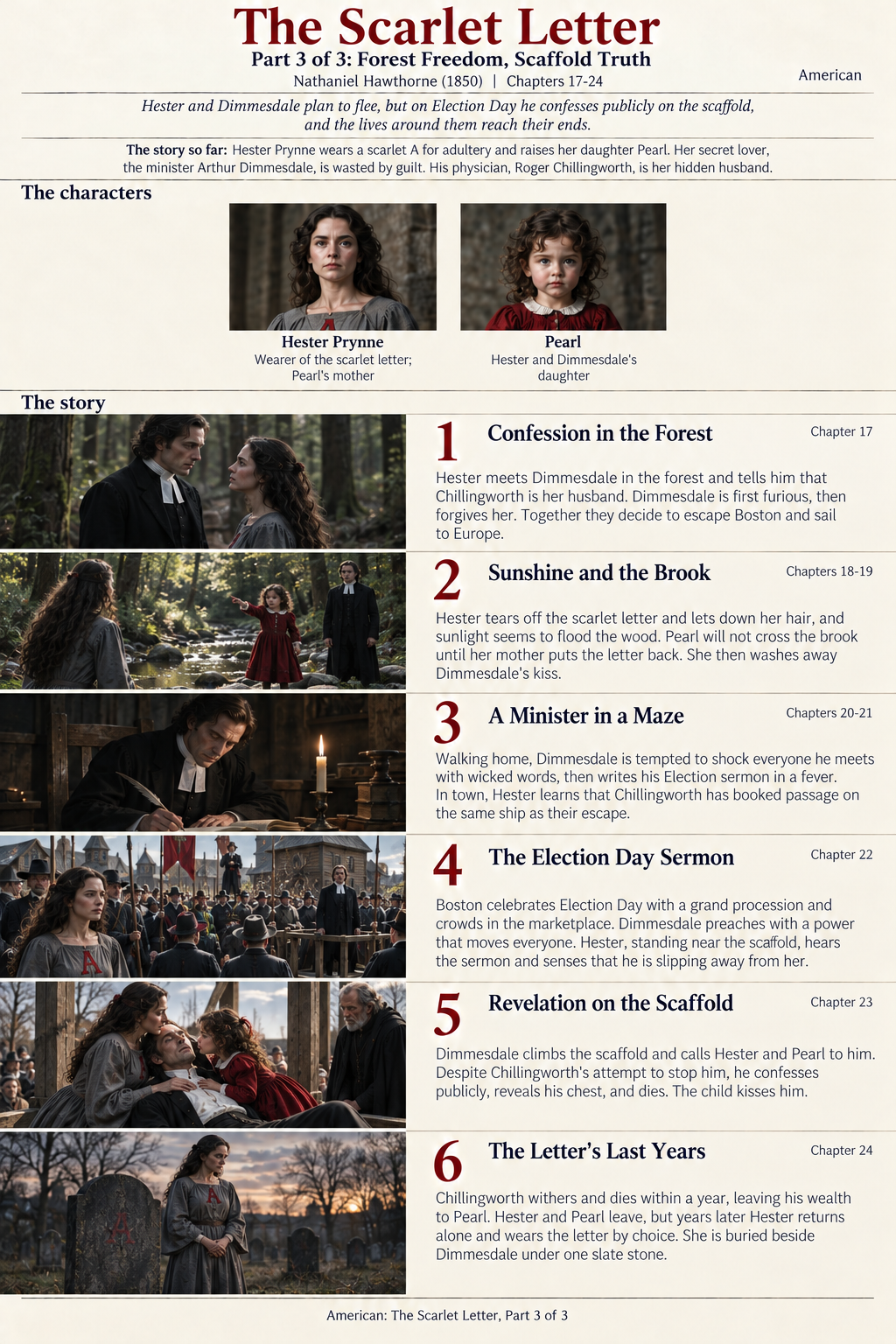
Hester and Dimmesdale plan to flee, but on Election Day he confesses publicly on the scaffold, and the lives around them reach their ends.
The story so far: Hester Prynne wears a scarlet A for adultery and raises her daughter Pearl. Her secret lover, the minister Arthur Dimmesdale, is wasted by guilt. His physician, Roger Chillingworth, is her hidden husband.
Hester Prynne, forced to wear a scarlet A for adultery, lives on the edge of Puritan Boston with her daughter Pearl. Pearl's father is the minister Arthur Dimmesdale, who hides his sin and wastes away with guilt. His physician, Roger Chillingworth, is secretly Hester's husband, and he has guessed the truth.
This part opens in the forest, where Hester meets Dimmesdale and tells him that Chillingworth is her husband. Dimmesdale's anger gives way to forgiveness, and the two plan to sail for Europe. Hester pulls off the letter and lets down her hair, and sunshine seems to flood the wood. Pearl, however, will not cross the brook until her mother puts the letter back, and she scrubs away Dimmesdale's kiss in the water. Walking home, Dimmesdale is tormented by urges to shock the people he meets with blasphemies. He then writes his Election Day sermon in a fever. In Boston, Hester learns from a shipmaster that Chillingworth has booked passage on the same vessel.
On Election Day the town crowds the marketplace for the procession. Dimmesdale preaches with a power that moves every hearer. Afterwards, instead of accepting the praise, he climbs the scaffold, calls Hester and Pearl to him and, despite Chillingworth's attempt to stop him, confesses publicly. He reveals a mark on his chest and dies. In the short conclusion, Chillingworth withers and dies within a year, leaving Pearl a fortune. Hester and Pearl leave Boston. Years later Hester returns alone, wears the letter by choice and comforts troubled women. She is buried beside Dimmesdale beneath a slate stone showing a letter A, red on black.
The characters' motives sharpen and shift. Hester wants escape and a chance at happiness, and the forest briefly lets her imagine it. Dimmesdale swings between weakness and conviction, but in the end he chooses truth over reputation. Chillingworth's revenge depends on Dimmesdale's secrecy, so when the minister confesses, his purpose collapses and he has nothing left to live for.
The part develops the book's central themes: concealed guilt against open acknowledgement, the pull between wild nature and rigid society, and revenge as a form of self-destruction. The letter itself changes meaning, from a mark of shame to a sign of endurance. Scholars differ over Dimmesdale's mark, which the book leaves deliberately uncertain, and over whether his death is a true redemption or a tragic defeat.
The lessons are quiet ones. Hidden guilt corrodes a person from within, and honesty, however costly, can bring release. Hatred consumes the hater more than its target. Finally, we cannot always choose what is done to us, but we can shape what a mark of shame comes to mean by how we carry it and how we treat others.
Further reading
- Nathaniel Hawthorne, The Scarlet Letter (Penguin Classics, introduction by Nina Baym) (2003)
- Brenda Wineapple, Hawthorne: A Life (2003)
- Michael J. Colacurcio (ed.), New Essays on The Scarlet Letter (1985)