The Hunchback of Notre-Dame, Part 3 of 3: Sanctuary, Siege and Gibbet
French and European · Part 3 of 3: Sanctuary, Siege and Gibbet
The Hunchback of Notre-Dame
Victor Hugo (1831) · Books 9-11
Esmeralda shelters in Notre-Dame, is lured out by the priest who desires her, and meets her fate on the gallows.
The story so far: In fifteenth-century Paris, the street dancer Esmeralda was condemned for a stabbing committed by Archdeacon Claude Frollo. Quasimodo, the deaf bell-ringer, rescued her from the gallows and carried her into Notre-Dame.
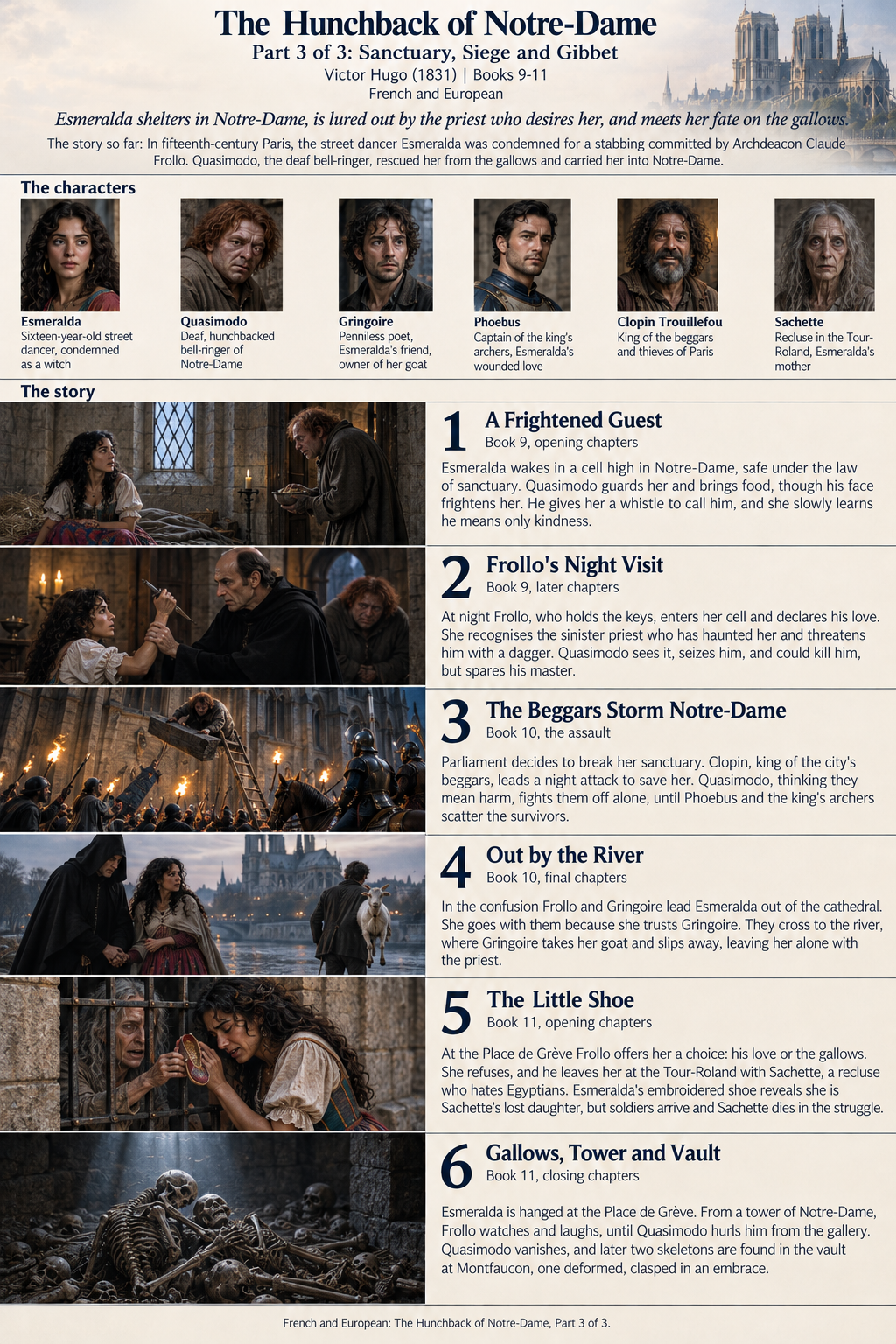
By the end of the previous part, Esmeralda, a sixteen-year-old street dancer in fifteenth-century Paris, has been condemned to hang for the stabbing of Phoebus, captain of the king's archers, and for witchcraft. The real attacker was Claude Frollo, archdeacon of Notre-Dame, who desires her. Quasimodo, the deaf bell-ringer, snatched her from the gallows and carried her into the cathedral, where the law of sanctuary protects her.
Book 9 opens with Esmeralda waking in a cell high in Notre-Dame. Quasimodo watches over her and brings food, though his appearance terrifies her. He gives her a whistle to summon him, and she slowly sees his gentleness. Then Frollo, who holds the keys, enters by night and declares his love. She answers with loathing and threatens him with a dagger. Quasimodo seizes the priest and, though he could kill him, spares him.
In Book 10 the Parliament resolves to violate the sanctuary and hang her. The poet Gringoire, who befriended her, tells the beggars of the Court of Miracles, and their king, Clopin Trouillefou, leads a night assault on the cathedral. Quasimodo, believing they intend harm, fights them off alone. Phoebus, who survived the stabbing, arrives with the king's archers and scatters the survivors. In the chaos Frollo and Gringoire take Esmeralda out secretly to the river. Gringoire leaves with her goat. At the Place de Grève, Frollo offers her a choice between his love and the gallows. She refuses, and he leaves her at the Tour-Roland, home of Sachette, a recluse who hates Egyptians. In Book 11 Esmeralda's embroidered shoe reveals that she is Sachette's lost daughter. Their reunion lasts moments. Soldiers seize Esmeralda, Sachette dies in the struggle, and Esmeralda is hanged. Frollo laughs as he watches from a tower of Notre-Dame, and Quasimodo hurls him from the gallery to his death. Quasimodo vanishes. Some eighteen months to two years later, workers in the vault at Montfaucon find a deformed skeleton clasping a woman's, and it crumbles to dust when they try to part them.
Motives drive everything. Frollo's desire curdles into hatred, so that he would rather see Esmeralda dead than free. Quasimodo, long obedient to his master, finally sees the truth and turns on him. The beggars act from loyalty, and Gringoire from a weaker mixture of kindness and self-interest.
The part develops Hugo's central themes: the cruelty of law and public opinion, the gap between appearance and goodness, and the destructive power of possessive love. Sanctuary, a medieval safeguard, proves fragile against state power. Fate seems to work through small things, such as a shoe, a missed meeting or a cry in the street.
The lessons are sober ones. Desire that demands ownership destroys what it claims to love. Judging people by their looks, as nearly everyone does here, blinds us to real worth. Good intentions without courage, like Gringoire's, can be as harmful as malice.
Further reading
- Victor Hugo, translated by Alban Krailsheimer, Notre-Dame de Paris (The Hunchback of Notre-Dame), Oxford World's Classics (1993)
- Graham Robb, Victor Hugo: A Biography (1997)
- Joanna Richardson, Victor Hugo (1976)