The Scarlet Letter, Part 1 of 3: Shame, Vow and Wild Child
American · Part 1 of 3: Shame, Vow and Wild Child
The Scarlet Letter
Nathaniel Hawthorne (1850) · Chapters 1-8
Hester Prynne is publicly shamed in Puritan Boston, swears silence to her secret husband, and fights to keep her daughter.
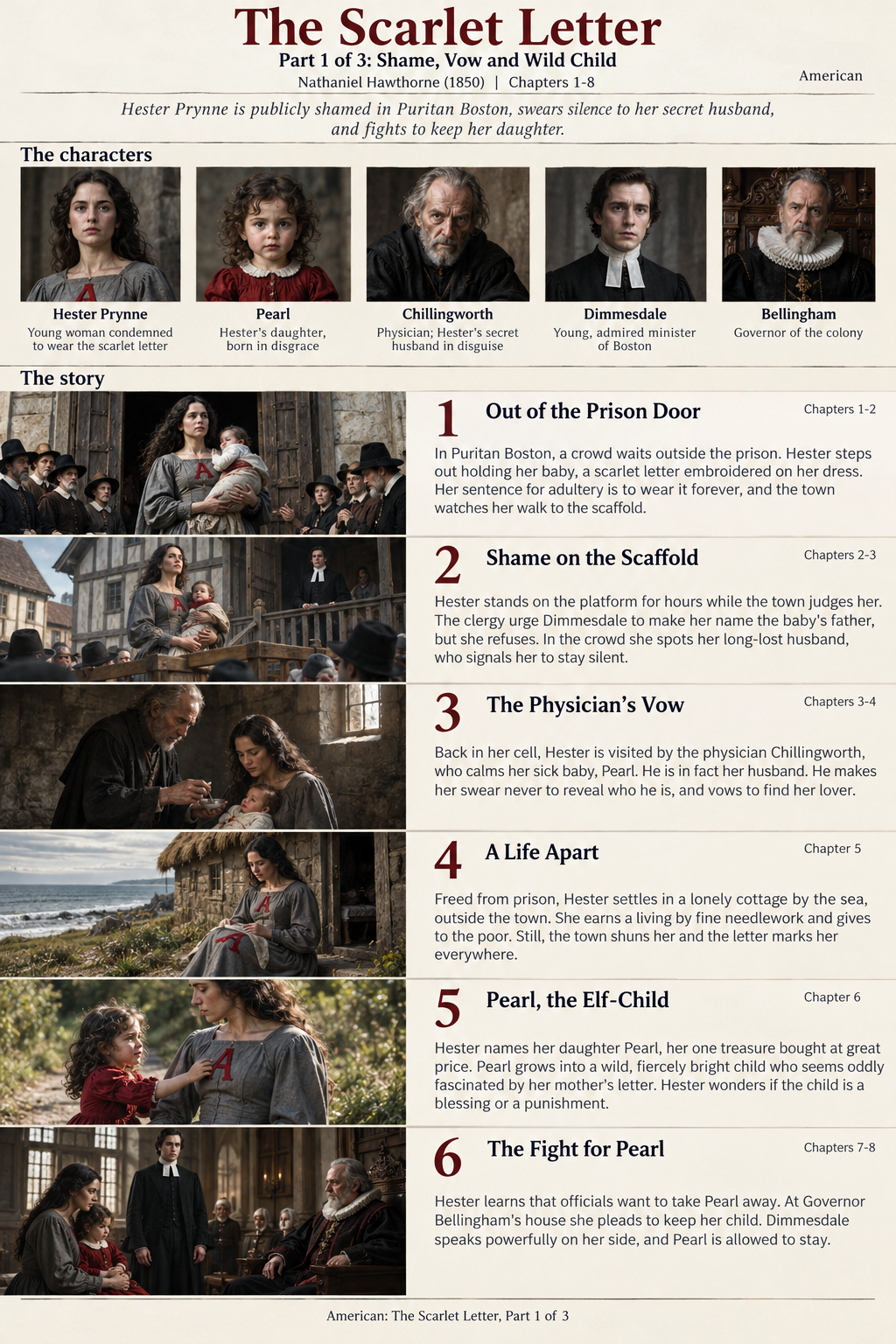
The Scarlet Letter opens in Boston in the 1640s, a young Puritan settlement that has already built a prison and a graveyard. Outside the prison door grows a wild rosebush, a small sign of hope in a harsh place. Out of that door, at the start of the story, comes Hester Prynne, a young woman convicted of adultery. She carries a newborn baby, and on her dress she wears a letter A in scarlet cloth, embroidered so richly in gold thread that it seems almost defiant.
Hester is made to stand on the marketplace scaffold while the townspeople stare. Governor Bellingham and the clergy press her to name the child's father, and the young minister Arthur Dimmesdale is asked to urge her to do so. She refuses. In the crowd she recognises an elderly stranger, one shoulder higher than the other: her husband, whom she had believed lost at sea. He signals her to silence. That night, in her cell, he appears as a physician and treats her and the sick baby, Pearl. He makes Hester swear never to reveal that he is her husband, and he declares he will discover her lover. He takes the name Roger Chillingworth.
Once free, Hester settles in a lonely cottage on the shore beyond the town. She supports herself by exquisite needlework and gives much of her earnings to the poor, but she is still shunned and stared at. Pearl grows into a brilliant, wilful, elfin child who seems fascinated by the scarlet letter. When rumours spread that the authorities may take Pearl from her, Hester goes to the governor's mansion, ostensibly to deliver gloves. There Bellingham and the Reverend Wilson question Pearl, who answers strangely, claiming she was plucked from the rosebush by the prison door. Hester appeals to Dimmesdale, who argues that Pearl is both her mother's punishment and her blessing. With support from Chillingworth, Pearl stays.
Hester's motives are fierce loyalty and a refusal to give up her only love. She protects her lover's name and keeps her oath to her husband, even at great cost. Dimmesdale is torn between his duty and his private feelings, while Chillingworth is driven by wounded pride and a cold hunger for knowledge.
The part develops the themes of public shame against private truth, the harshness of a rigid community, and the ambiguous nature of sin and love. Hawthorne lets us wonder whether the letter really brands guilt, or whether it also creates strength and sympathy. Scholars disagree about whether he condemns Puritan society or admires its seriousness.
Readers can take from these chapters a warning about how easily communities punish visibly and judge hastily. They also see how a person can keep her dignity while society tries to define her by her worst moment, and how secrets weigh on everyone who keeps them.
Further reading
- Nathaniel Hawthorne, The Scarlet Letter (Penguin Classics, ed. Nina Baym) (2003)
- Brenda Wineapple, Hawthorne: A Life (2003)
- Sacvan Bercovitch, The Office of The Scarlet Letter (1991)