The Hunchback of Notre-Dame, Part 2 of 3: Pillory, Dagger and Death Sentence
French and European · Part 2 of 3: Pillory, Dagger and Death Sentence
The Hunchback of Notre-Dame
Victor Hugo (1831) · Books 5-8
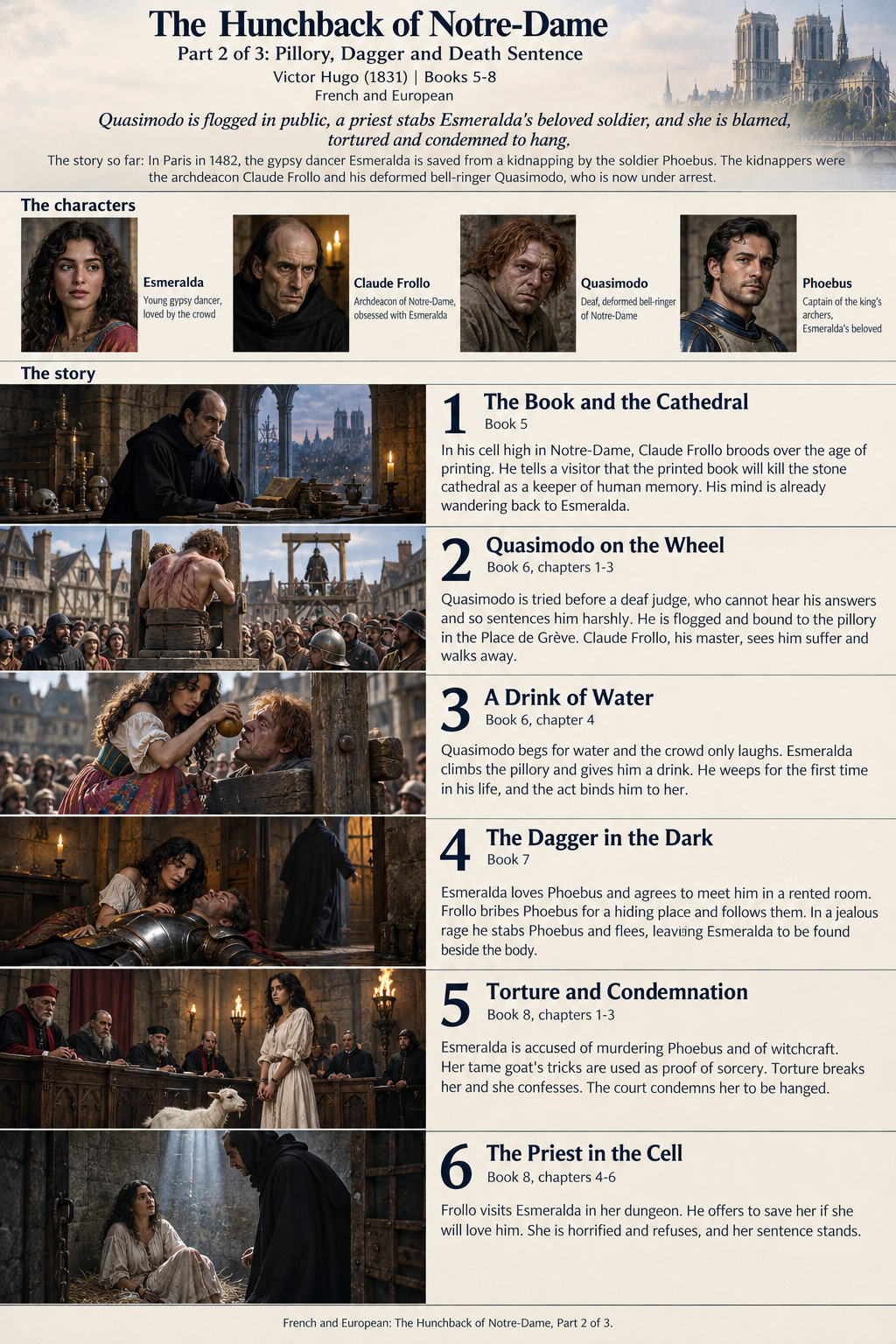
Quasimodo is flogged in public, a priest stabs Esmeralda's beloved soldier, and she is blamed, tortured and condemned to hang.
The story so far: In Paris in 1482, the gypsy dancer Esmeralda is saved from a kidnapping by the soldier Phoebus. The kidnappers were the archdeacon Claude Frollo and his deformed bell-ringer Quasimodo, who is now under arrest.
In the first part, Paris celebrates the Feast of Fools in 1482. The beautiful gypsy dancer Esmeralda is nearly abducted by Quasimodo, the deaf, deformed bell-ringer of Notre-Dame, who acts on the orders of his master, the archdeacon Claude Frollo. The king's archer Phoebus rescues her, and Quasimodo is arrested.
This part opens with Frollo in his cell, brooding that the printed book will destroy the cathedral's old role as a record in stone. Then the story turns to Quasimodo, who is tried by a deaf judge, so the two cannot understand each other. He is flogged and bound to the pillory in the Place de Grève. Frollo watches and walks away. When Quasimodo begs for water, the crowd mocks him until Esmeralda climbs up and gives him a drink. He weeps for the first time, and his loyalty shifts from the priest to the girl.
Esmeralda, meanwhile, is infatuated with Phoebus, who is engaged to a wealthy young woman but is happy to deceive both. He arranges to meet Esmeralda in a rented room. Frollo has followed them and persuades Phoebus to let him hide there. As the two kiss, Frollo stabs the soldier and escapes. Esmeralda faints, and when she wakes she is arrested as the apparent killer.
Her trial is a grim parody of justice. She is accused of murder and witchcraft, and her goat's tricks are taken as evidence of sorcery. Under torture she confesses to crimes she did not commit, and the court sentences her to hang. Frollo then comes to her cell and offers to save her if she will give herself to him. She recoils from the man she has long feared as a spectre, and her refusal leaves her condemned.
The characters are driven by need. Frollo's desire has turned into possessiveness, and he would rather destroy Esmeralda than see her loved by someone else. Phoebus is shallow, charming and careless. Quasimodo, the supposed monster, is changed by a moment of compassion, while the respectable crowd and officials behave cruelly.
The part develops Hugo's central themes: the gap between appearance and worth, the injustice of institutions that cannot listen, and the danger of lust disguised as devotion. It also shows the decline of one kind of power, the cathedral as a book in stone, just as another begins.
A modern reader can take away several lessons. Kindness is often most powerful when it is least expected, and Esmeralda's single gesture reshapes another life. Systems of authority can punish the innocent if they hear only what they expect. And obsession, however pious its cover, harms those it claims to love.
Further reading
- Victor Hugo, translated by Alban Krailsheimer, The Hunchback of Notre-Dame (Oxford World's Classics) (1993)
- Graham Robb, Victor Hugo: A Biography (1997)
- Kathryn M. Grossman, The Early Novels of Victor Hugo: Towards a Poetics of Harmony (1986)