The Hunchback of Notre-Dame, Part 1 of 3: Fools, Dancers and a Cathedral
French and European · Part 1 of 3: Fools, Dancers and a Cathedral
The Hunchback of Notre-Dame
Victor Hugo (1831) · Books 1-4
On Epiphany 1482 a disastrous play, a crowned monster and a dancing girl draw a poet into Paris's underworld and the cathedral's secrets.
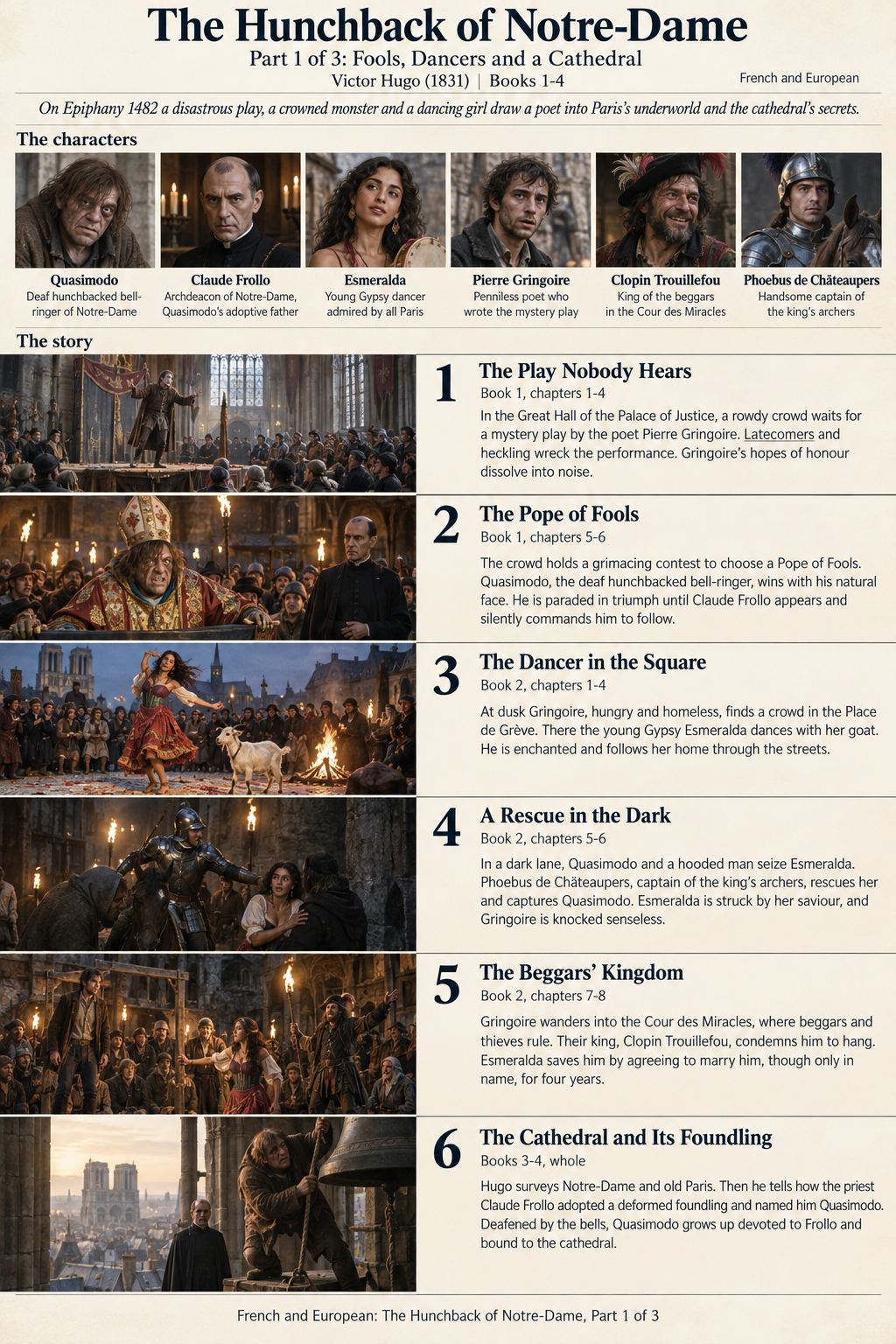
The novel opens in Paris on 6 January 1482, the day of Epiphany and of the Feast of Fools. In the Great Hall of the Palace of Justice, a crowd of students, tradesmen and thieves waits impatiently for a mystery play by the penniless poet Pierre Gringoire, staged to honour Flemish ambassadors and a cardinal. Hugo uses the restless hall to show a city of many ranks and appetites.
The play collapses under heckling, and Gringoire's hopes go with it. The crowd turns to a contest of grimaces, with the winner to be crowned Pope of Fools. The victor is Quasimodo, the deaf, one-eyed, hunchbacked bell-ringer of Notre-Dame, whose natural face outdoes every mask. He is carried through the streets in triumph until the archdeacon Claude Frollo appears. At a single gesture Quasimodo abandons his mock splendour and follows him.
That evening Gringoire, hungry and without lodging, follows the young Gypsy dancer Esmeralda, who performs with her clever goat. He sees her seized by Quasimodo and a hooded man, then rescued by Phoebus de Châteaupers, captain of the king's archers. Gringoire wanders on and stumbles into the Cour des Miracles, the beggars' kingdom, where its king, Clopin Trouillefou, sentences him to hang. He is saved only when Esmeralda agrees to marry him, a four-year bargain she intends to keep in name only.
Hugo then pauses the action to describe Notre-Dame and give a bird's-eye view of medieval Paris, treating the cathedral almost as a living character. Next he tells the history of Quasimodo and Frollo. A deformed baby is abandoned on the foundling bed on Quasimodo Sunday, and the young priest Claude Frollo, who already cares for his own younger brother Jehan, takes the child in and names him. The bells leave Quasimodo deaf, the cathedral becomes his whole world, and Frollo's signs are the only language he fully understands.
The motives are already telling. Gringoire is vain but quick to save himself. Esmeralda is generous, rescuing a stranger out of pity. Phoebus is a dashing soldier, and the crowd is cruel and cheerful by turns. Frollo, a learned and austere scholar, is bound to Quasimodo by charity and control, and Quasimodo repays him with total obedience. A hint of Frollo's hidden troubles already shadows his role.
The themes include the contrast between outward appearance and inner worth, the unruly power of the crowd, the gulf between rich and poor, and Hugo's love of the Gothic cathedral as a record of a people's lives. Scholars still debate whether the cathedral or the characters are the book's true centre.
A reader can take away a few lessons. Mobs and festivals reward noise and spectacle, and people are often judged by their looks before their acts. Kindness may come from the unlikeliest people, such as a Gypsy dancer, while respectable robes can hide unease. Gratitude and obedience can bind a person as tightly as a chain.
Further reading
- Victor Hugo, trans. Alban Krailsheimer, The Hunchback of Notre-Dame (Oxford World's Classics) (1993)
- Graham Robb, Victor Hugo: A Biography (1997)
- Kathryn M. Grossman, The Early Novels of Victor Hugo (1986)