Anna Karenina, Part 3 of 3: The Railway and the Storm
Russian · Part 3 of 3: The Railway and the Storm
Anna Karenina
Leo Tolstoy (1878) · Parts 6-8
Anna and Vronsky's love sours into jealousy and ends in tragedy at a railway station, while Levin finds a quiet faith.
The story so far: Anna has left her husband Karenin for Vronsky and lives as a social outcast. Levin, once refused by Kitty, has married her and watched his brother die.
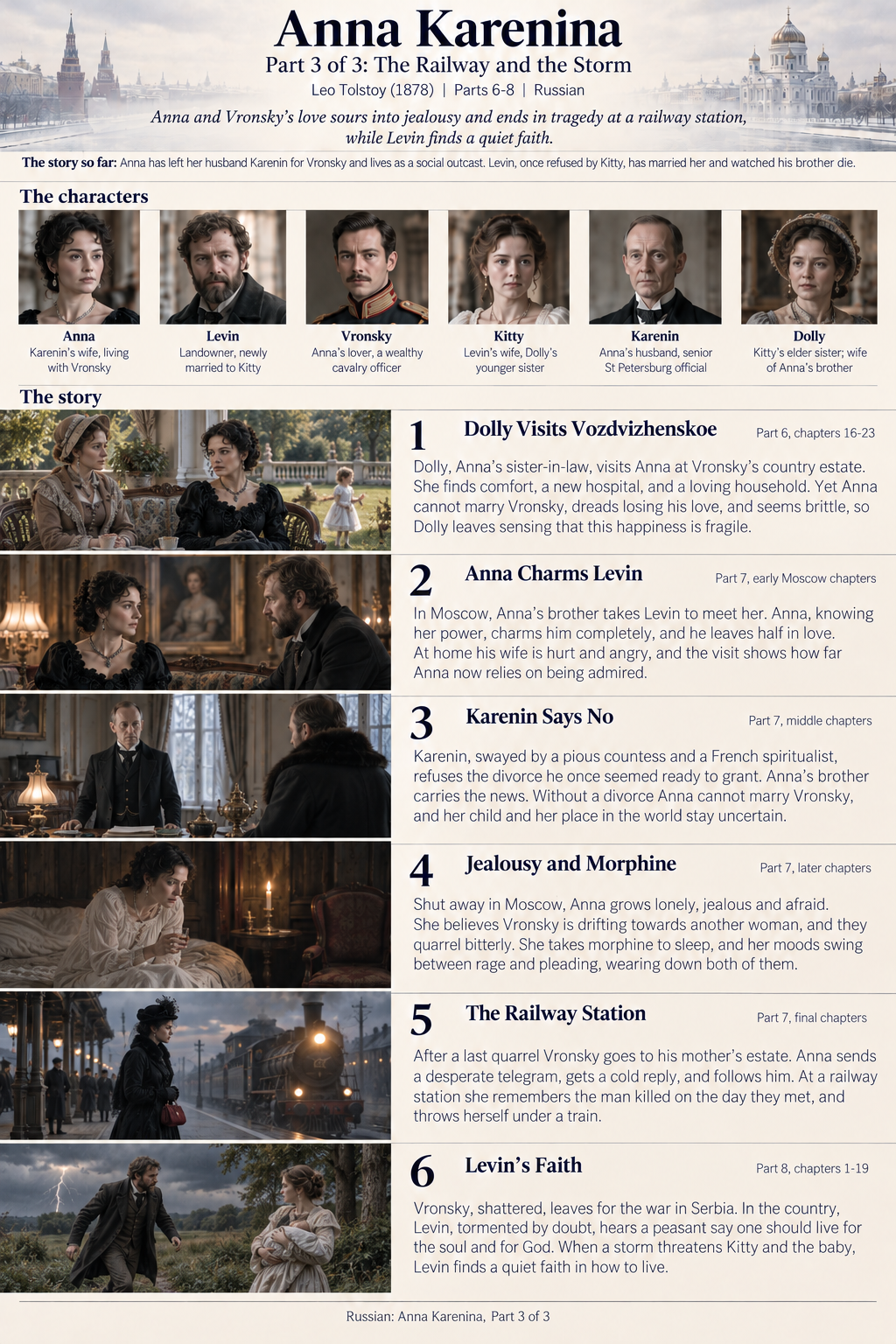
By the end of Part 5, Anna Karenina has left her husband, the St Petersburg official Alexei Karenin, to live with Count Vronsky. Society shuns her, and she is cut off from her son Seryozha. Meanwhile Konstantin Levin, once refused by Kitty, has married her and watched his brother die.
In Part 6, Levin's wife Kitty welcomes her sister Dolly to their country house, and Levin's marriage is tested by jealousy of a flirtatious guest. Dolly then visits Anna at Vronsky's estate, Vozdvizhenskoe. She finds comfort, a new hospital, a small daughter and a loving couple, yet she senses strain. Anna cannot marry Vronsky and fears losing him. In Part 7 they move to Moscow to await a divorce. There Levin is taken to meet Anna and is enchanted, which hurts Kitty. Karenin, swayed by a pious countess and a French spiritualist, refuses the divorce. Kitty gives birth to a son, and Levin is awed and frightened. Anna, meanwhile, suspects Vronsky of wanting another woman, takes morphine to sleep, and after a last quarrel follows him towards his mother's estate. At a railway station she remembers the man crushed by a train on the day they met, and throws herself under one.
Part 8 opens after her death. Vronsky, broken, leaves to fight in Serbia. Back in the country, Levin's happiness is shadowed by questions about the meaning of life, so that he hides a rope and his gun from himself. A peasant's remark that a man should live for his soul and remember God shows him a way forward. During a thunderstorm, when Kitty and the baby are caught outdoors, he feels a quiet certainty about how to live.
Anna's ruin grows from her motives. Having given up everything for love, she makes Vronsky her whole world, so every absence feels like betrayal. Vronsky remains loyal but restless; he wants an ordinary place in society and resents her suspicion, which drives them apart. Levin's struggle is different. He is loved, yet cannot say why he lives. His change is not proof but acceptance that a good life can be lived without every question answered.
The part sets two ways of living side by side. Anna's love, cut off from family, duty and community, turns inward into jealousy and self-deception, while Levin's marriage, work and eventual faith give him something to stand on. Tolstoy also explores the gap between private feeling and public law, and the way a society can condemn a woman while excusing a man. Scholars disagree about the novel's epigraph, 'Vengeance is mine; I will repay': some read it as a judgment on Anna, others as a rebuke to those who judge her.
Readers may take several lessons. Love needs trust and a life larger than one person. Resentment and fear, left unspoken, can grow into catastrophe. Meaning is found less in argument than in daily work and kindness. And suffering deserves compassion before verdict.
Further reading
- Leo Tolstoy, translated by Richard Pevear and Larissa Volokhonsky, Anna Karenina (2000)
- Gary Saul Morson, Anna Karenina in Our Time (2007)
- Rosamund Bartlett, Tolstoy: A Russian Life (2010)