Anna Karenina, Part 2 of 3: Forgiveness, Weddings, and Exile
Russian · Part 2 of 3: Forgiveness, Weddings, and Exile
Anna Karenina
Leo Tolstoy (1878) · Parts 4-5
Karenin forgives the dying Anna, Levin and Kitty marry, and Anna leaves with Vronsky, only to find that love cannot shield her from society.
The story so far: Anna, married to the cold official Karenin, has fallen in love with the officer Vronsky and, after his fall at the races, told her husband she is Vronsky's lover. Levin, refused by Kitty, has retreated to his estate.
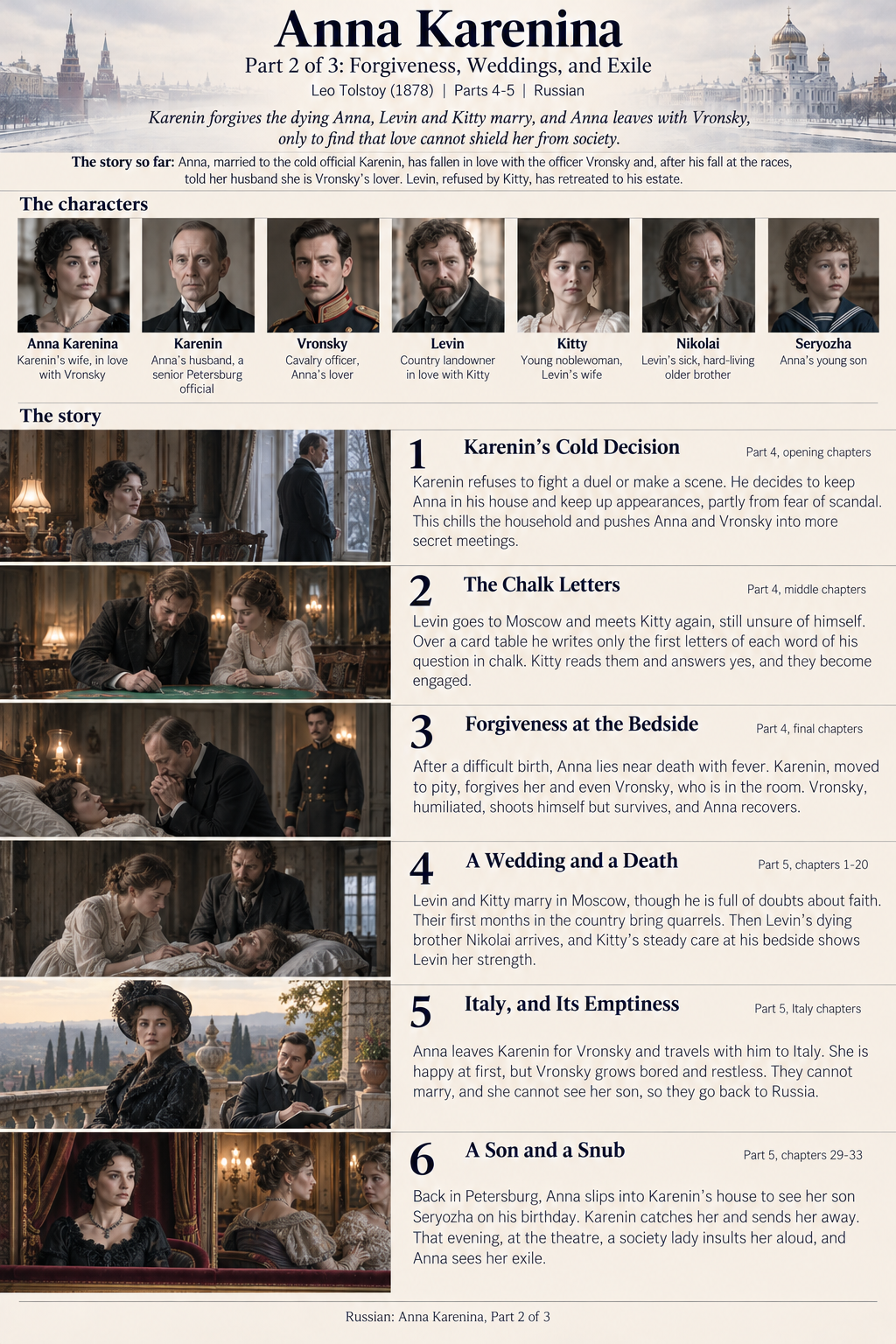
Anna Karenina, the wife of a cold senior official, Karenin, has fallen in love with the officer Vronsky and, after the races, has told her husband she is his rival's lover. Levin, a thoughtful country landowner, has been refused by Kitty and has retreated to his estate to work and brood.
Part 4 begins in the chill of that confession. Karenin, afraid of scandal and wanting to punish rather than release her, decides to keep Anna in his house and keep up appearances. Meanwhile Levin comes to Moscow and meets Kitty again. Without making a speech, he writes the first letters of each word of his question on a card table in chalk. Kitty reads them and answers yes. Back in Petersburg, Anna gives birth to Vronsky's child and falls into a fever. Believing she is dying, she begs Karenin's forgiveness. He weeps and forgives her, and even Vronsky. Overcome with shame, Vronsky shoots himself but survives. Anna recovers, and Karenin's generosity becomes unbearable to her. She leaves with Vronsky for Italy and leaves Seryozha behind.
Part 5 opens with Levin and Kitty's wedding in Moscow. Levin's doubts about faith trouble him, and the early months of marriage in the country bring jealousies and quarrels. Then his dying brother Nikolai arrives. Kitty cares for him tenderly, and Levin sees both death and his wife's strength more clearly. Anna and Vronsky, meanwhile, find that Italy cannot hold them. She is happy at first, but Vronsky grows bored and takes up painting. They return to Russia and to Petersburg, where Anna cannot see her son. She slips into Karenin's house on Seryozha's birthday, is found out, and is sent away. At the theatre that night, a society lady insults her in public.
The motives are plain. Karenin acts from pride, from fear of ridicule, and, briefly, from real compassion. Vronsky is driven by honour and passion, but cannot give his life purpose once he has won Anna. Anna's love is real but costs her her son, her place and her peace. Levin and Kitty begin as a very different couple, learning the daily work of marriage, honesty and care.
Tolstoy sets two kinds of love side by side: one built on passion and defiance of society, and one built slowly through family, duty and shared hardship. Forgiveness appears as a moral force that can reach people, but also as something that can humiliate. Society is shown to be hypocritical, forgiving men easily and condemning women.
A reader can take away that forgiveness given from pride may do more harm than good, and that love needs some life beyond itself to survive. Marriage, too, is shown as a practice, not a feeling. Tolstoy invites us to judge the characters carefully, and critics still debate how far he condemns Anna and how far he pities her.
Further reading
- Leo Tolstoy, translated by Rosamund Bartlett, Anna Karenina (Oxford World's Classics) (2014)
- Rosamund Bartlett, Tolstoy: A Russian Life (2010)
- Gary Saul Morson, Anna Karenina in Our Time: Seeing More Wisely (2007)