Anna Karenina, Part 1 of 3: Collision of Two Fates
Russian · Part 1 of 3: Collision of Two Fates
Anna Karenina
Leo Tolstoy (1878) · Parts 1-3
Anna comes to Moscow, captivates Vronsky and destroys Kitty's hopes, while Levin is refused and Anna's affair becomes public.
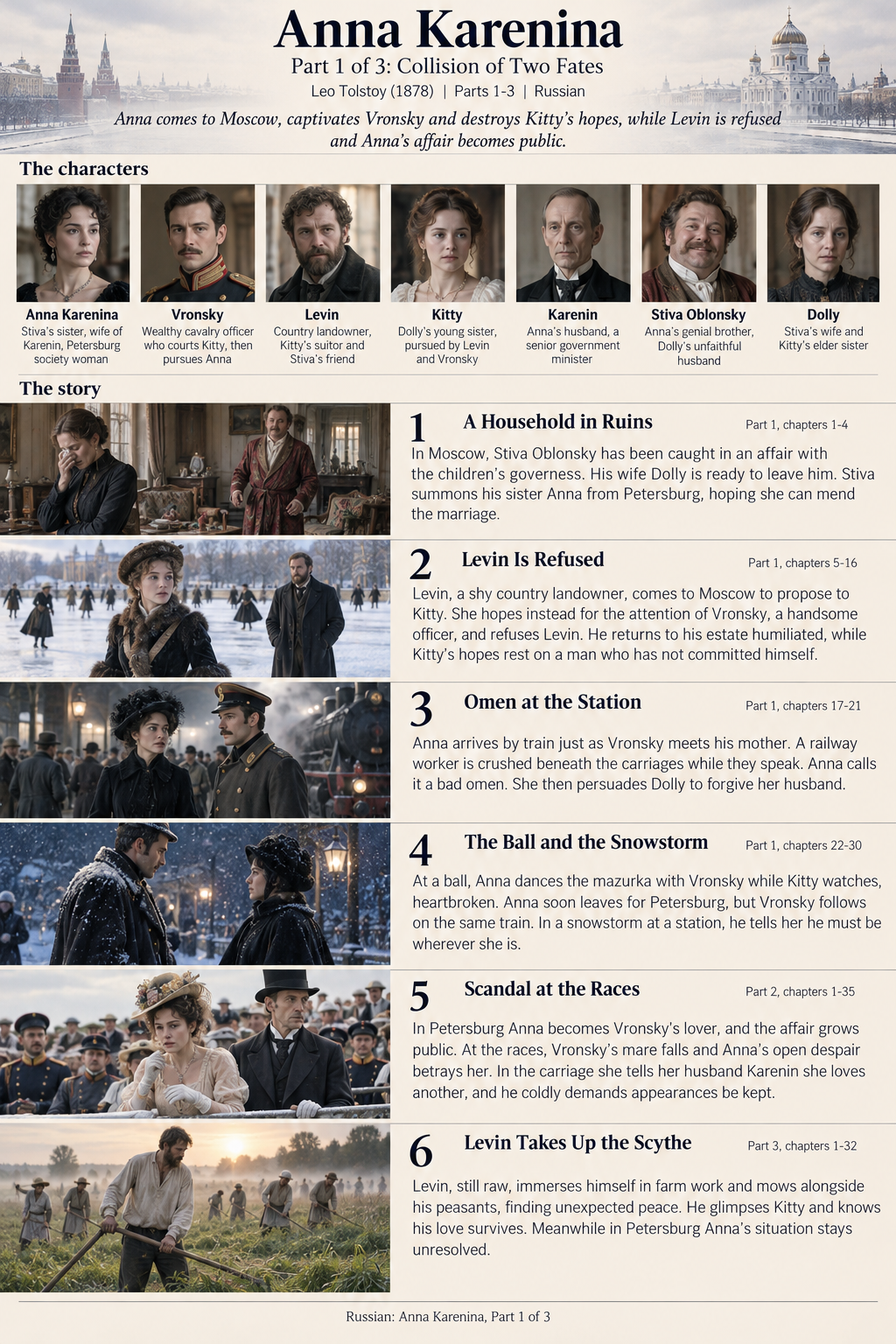
Tolstoy opens with his most famous sentence: all happy families are alike, but every unhappy family is unhappy in its own way. The novel begins in Moscow in the 1870s, in the home of Prince Stiva Oblonsky, a charming, easygoing aristocrat. His wife, Dolly, has discovered his affair with the children's governess, and the household is in chaos. Stiva sends for his sister, Anna Karenina, to mediate.
Meanwhile Konstantin Levin, a shy, earnest landowner who prefers his estate to city society, arrives in Moscow to propose to Dolly's younger sister, Kitty. Kitty likes him but is dazzled by Count Vronsky, a wealthy cavalry officer, and she refuses Levin, who retreats to the country in shame. Anna arrives at the Moscow station just as a railway worker is killed by a train, and she takes it as an evil omen. She reconciles Dolly with Stiva. At a ball she dances the mazurka with Vronsky so radiantly that Kitty, who had expected a proposal, is crushed. Anna hurries home to Petersburg, but Vronsky follows her, and in a snowbound station he tells her he cannot do otherwise.
In Petersburg, Anna's husband, Alexei Karenin, is a senior official many years her elder, correct, cold and absorbed in his career. Anna resists Vronsky, then yields, and society begins to talk. At an officers' steeplechase, Vronsky's mare Frou-Frou falls after his own clumsy movement in the saddle, and her back is broken. Anna's open despair betrays her in front of everyone. In the carriage afterwards she tells Karenin she loves another, and he answers by demanding only that appearances be maintained. Kitty, wounded, falls ill and is sent abroad. Part 3 turns to Levin, who throws himself into farm work, mows beside his peasants and finds a deep satisfaction, while his love for Kitty refuses to die. Anna's situation stays unresolved.
The characters' motives drive the drama. Anna is not simply seduced. She is a lively, intelligent woman living with a husband who treats feeling as an inconvenience, and Vronsky's attention wakes something she cannot ignore. Vronsky, who began as a pleasant flirt, becomes obsessed. Karenin, rigid and wounded, can only protect his reputation. Levin's humiliation pushes him back to land and labour, where he starts to find meaning.
The themes are already visible. Passion collides with duty and social convention. The double standard is plain: Stiva is quickly forgiven, while Anna will pay heavily for her affair. The contrast between city and country, and between artifice and honest work, runs through Levin's chapters. Scholars still disagree about how far Tolstoy judges Anna, given the biblical epigraph about vengeance, or sympathises with her.
A reader can take away several lessons. Self-deception is easy, and people often name their desires something nobler. Keeping up appearances can preserve a marriage and still empty it out. Charm is not the same as goodness, and plain sincerity, like Levin's, can look foolish before it is recognised as valuable.
Further reading
- Leo Tolstoy, translated by Richard Pevear and Larissa Volokhonsky, Anna Karenina (2000)
- Gary Saul Morson, Anna Karenina in Our Time: Seeing More Wisely (2007)
- Rosamund Bartlett, Tolstoy: A Russian Life (2010)