The Epic of Gilgamesh, Part 3 of 3: Beyond the Waters of Death
Ancient and Classical · Part 3 of 3: Beyond the Waters of Death
The Epic of Gilgamesh
Anonymous (c. 2100-1200 BC) · Tablets 9-11
Grieving Enkidu, Gilgamesh crosses a perilous wilderness to ask a survivor of the great flood whether humans can escape death.
The story so far: Gilgamesh, king of Uruk, found a friend in Enkidu. Together they killed Humbaba and the Bull of Heaven, but Enkidu died, leaving Gilgamesh terrified of his own mortality.
Gilgamesh, king of Uruk, once found an equal and a friend in Enkidu. Together they killed Humbaba and the Bull of Heaven, but Enkidu died. His loss leaves Gilgamesh mourning not only his friend but also the life he knows he must someday lose. He puts on rough clothing and sets out to find Utnapishtim, a man said to have escaped death.
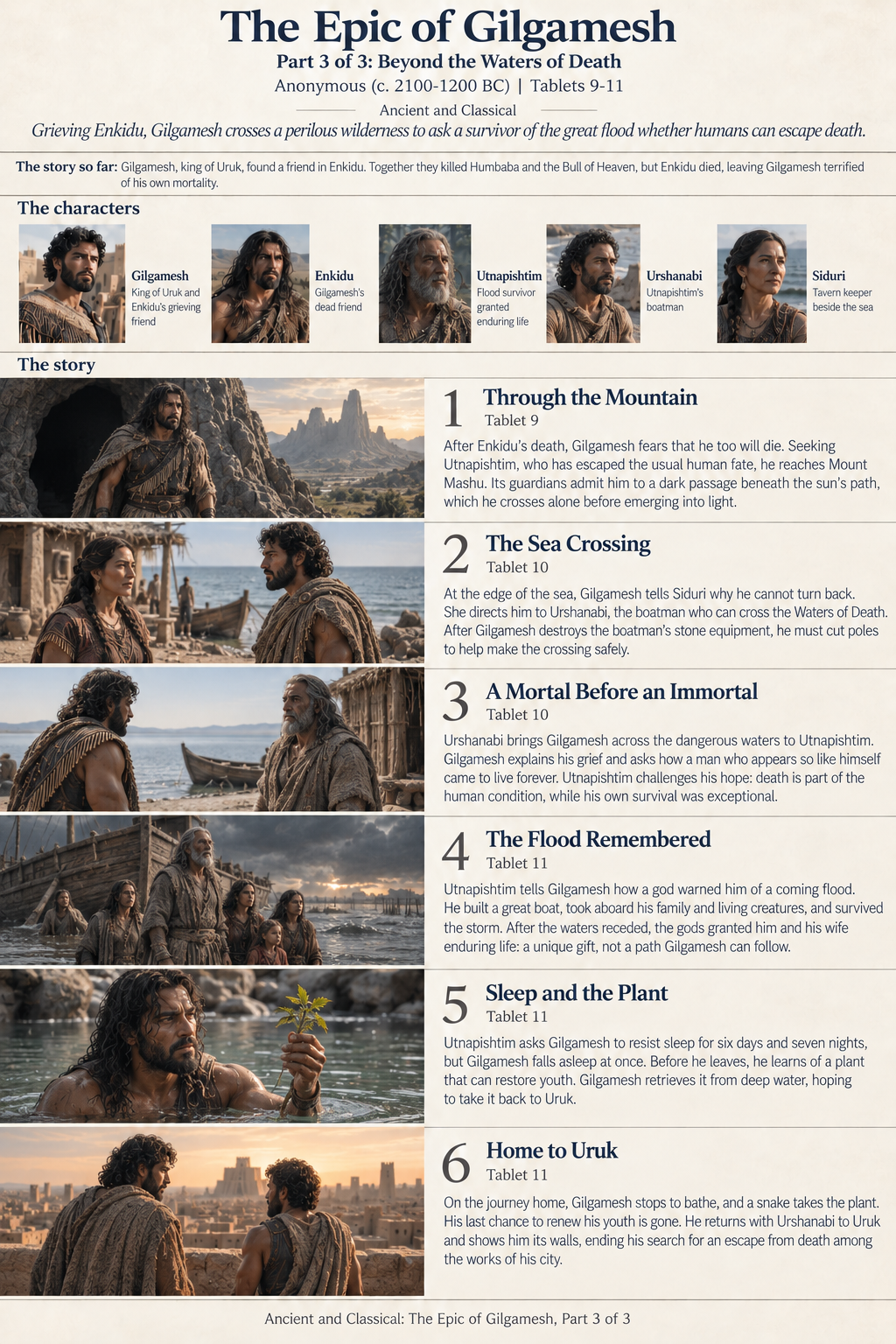
Gilgamesh reaches Mount Mashu, whose guardians watch over a passage traveled by the sun. They allow him through, and he presses across its long darkness until he comes into a garden of precious stones. At the sea, the tavern keeper Siduri hears why he has traveled so far and sends him to Urshanabi, Utnapishtim’s boatman. Gilgamesh damages the boatman’s stone equipment, then cuts poles so they can cross the Waters of Death without touching them. On the far shore, he meets Utnapishtim and asks how someone so much like himself obtained everlasting life.
Utnapishtim answers with the story of the flood. Warned by the god Ea that destruction was coming to Shuruppak, he built a great boat and brought aboard his family, craftsmen, and living creatures. The storm overwhelmed the world; when it ended, the boat came to rest on Mount Nimush. Utnapishtim released birds to discover whether the waters had fallen, then offered a sacrifice. Enlil, who had brought about the flood, granted Utnapishtim and his wife life without end. Gilgamesh has reached a living witness to divine mercy, but the account gives him no way to win the same gift.
Utnapishtim then gives Gilgamesh a smaller test: stay awake for six days and seven nights. Gilgamesh falls asleep almost immediately. Utnapishtim’s wife marks the passing days with loaves of bread, making it impossible for the waking Gilgamesh to deny what happened. As he prepares to leave, Utnapishtim tells him of a prickly plant beneath the water that can restore youth. Gilgamesh retrieves it and plans to take it to Uruk, where it can first be tried on an old man. On the homeward journey he stops to bathe. A snake takes the plant and sheds its skin as it departs.
Gilgamesh returns to Uruk with Urshanabi and points out the city’s walls. The journey has changed the question that drives him: he went looking for a way never to die, but comes home without even the plant that promised renewed youth. The epic does not simply tell him to stop grieving, nor does it present the flood survivor’s extraordinary fate as a reward he failed to earn. Readers differ on how hopeful the ending is. Its lasting image invites us to consider what mortal people can build, share, and care for, even when they cannot keep their lives from ending.
Further reading
- Andrew George, The Epic of Gilgamesh (1999)
- Andrew George, The Babylonian Gilgamesh Epic: Introduction, Critical Edition and Cuneiform Texts (2003)
- David Damrosch, The Buried Book: The Loss and Rediscovery of the Great Epic of Gilgamesh (2007)