Nineteen Eighty-Four, Part 1 of 3: A Diary Against the Party
Twentieth Century · Part 1 of 3: A Diary Against the Party
Nineteen Eighty-Four
George Orwell (1949) · Part One
Winston Smith begins a forbidden diary, questions the Party’s version of the past, and searches London for traces of a different life.
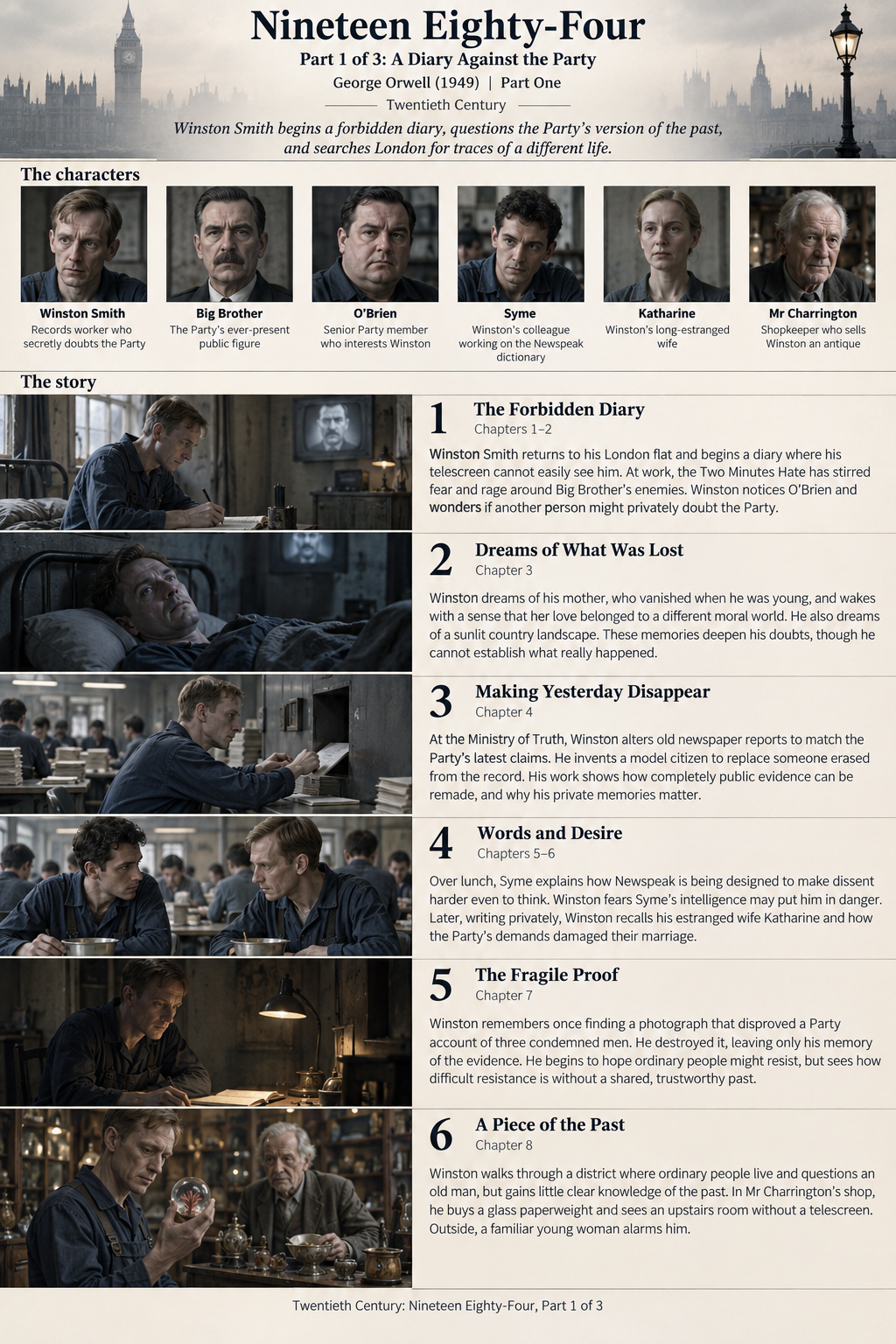
Winston Smith lives in London, now part of Airstrip One, where the Party governs through surveillance, fear and control of information. The year is supposedly 1984, though Winston cannot be sure of the date. From his flat in Victory Mansions, a telescreen broadcasts and watches. He finds a corner partly hidden from it and begins a diary, an act he knows could cost him his life. At the Ministry of Truth, the daily Two Minutes Hate urges workers to pour their anger onto the Party’s enemies. Winston notices O’Brien, a senior Party member, and briefly imagines that O’Brien may share his doubts. He has no proof.
A neighbour’s children, already eager to detect disloyalty, remind Winston how thoroughly the Party shapes even family life. As he sleeps, memories offer no secure refuge. He dreams of his mother and younger sister, who disappeared when he was a child. He feels that his mother’s love belonged to a time when private loyalties had meaning, but he cannot clearly reconstruct what happened to them. A dream of a beautiful country landscape gives him another glimpse of a life unlike the one he knows. Waking, he struggles to separate remembered experience from what the Party has taught him to believe.
At work, Winston’s task makes the problem concrete. He revises old issues of *The Times* whenever a past prediction or statement conflicts with the Party’s present account. The originals are destroyed, so the corrected version becomes the only available record. He even invents a loyal Party hero to replace a man who has fallen from favour. At lunch, his colleague Syme discusses Newspeak, a language being shaped to shrink the range of possible thought. Winston sees Syme’s intelligence clearly, and fears that being too perceptive may make him unsafe.
In his diary, Winston also confronts the Party’s intrusion into intimate life. He recalls his unhappy marriage to Katharine, from whom he has long been separated. She treated sex as a duty to the Party, leaving little room for tenderness or mutual desire. Winston’s own memories of desire trouble him, but they also reveal why he resists a system that claims authority over people’s feelings. His doubts grow sharper when he recalls a photograph he once held: it proved that three men accused of treason had confessed falsely. He destroyed the photograph. His certainty remains, but he can no longer show anyone the proof.
Winston comes to think that hope may lie with ordinary people outside the Party, yet he knows little about their lives or whether they could act together. He wanders through their district and questions an old man about the past, receiving memories too scattered to settle his questions. In Mr Charrington’s shop, he buys a glass paperweight enclosing a piece of coral and sees an upstairs room without a telescreen. Both seem to preserve something older and more private. But after he leaves, he spots a young woman he has seen before and fears she is following him. Part One leaves Winston with a difficult lesson: resisting a false account of reality begins with trusting one’s own judgment, but memory alone is fragile when evidence and trust have been destroyed.
Further reading
- George Orwell, Nineteen Eighty-Four (2003)
- Bernard Crick, George Orwell: A Life (1980)
- John Rodden, The Cambridge Companion to George Orwell (2007)