Nineteen Eighty-Four, Part 2 of 3: The Room Without Safety
Twentieth Century · Part 2 of 3: The Room Without Safety
Nineteen Eighty-Four
George Orwell (1949) · Part Two
Winston and Julia build a secret life together, seek help against the Party, and discover how little privacy they have.
The story so far: Winston Smith works at the Ministry of Truth, altering old records to suit the Party. He has begun a forbidden diary and fears that even his private thoughts can condemn him.
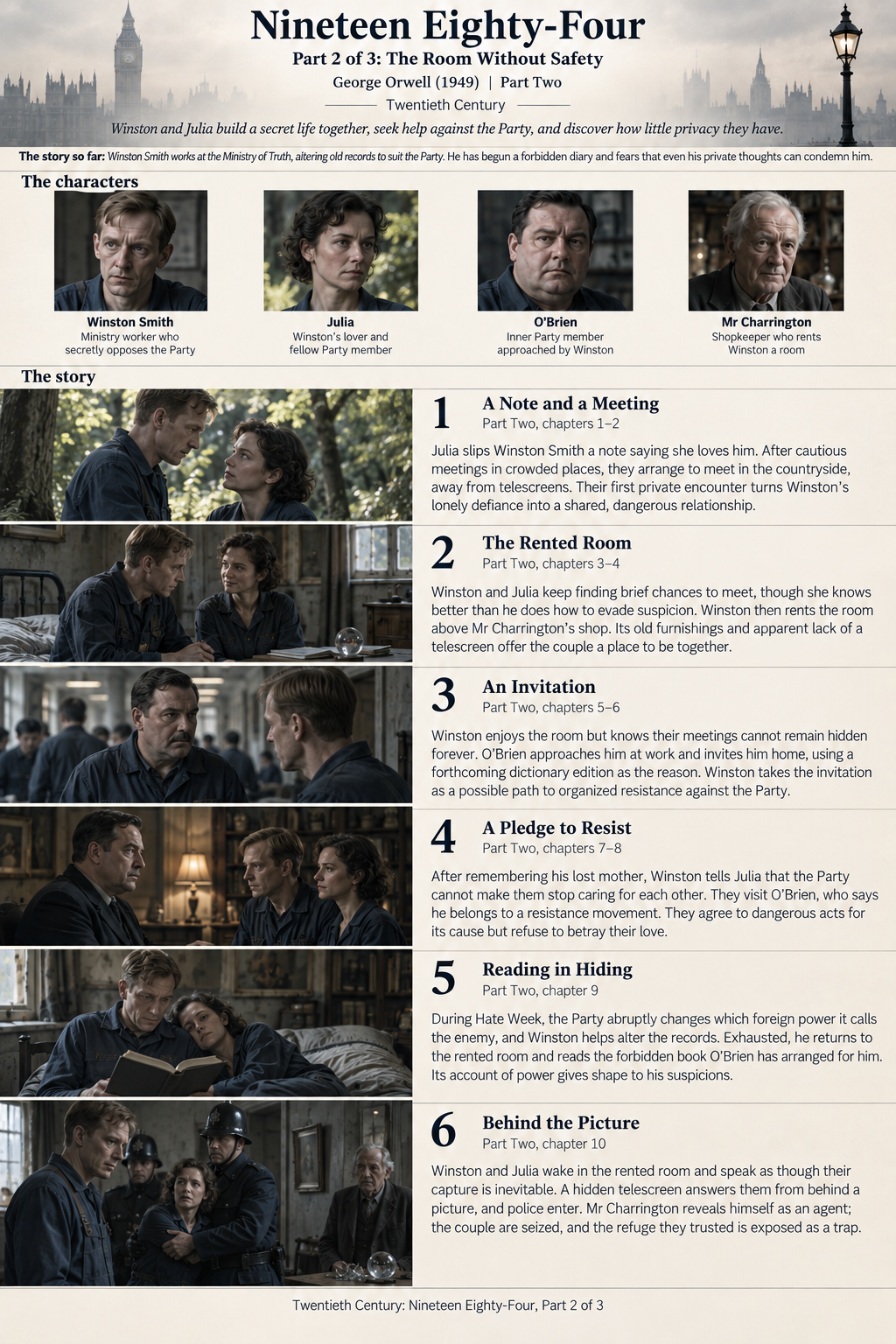
Winston Smith works at the Ministry of Truth in London, rewriting old records whenever the Party changes its claims. He has begun a secret diary, an act that could condemn him. Part Two begins when Julia, a young woman he has feared might be watching him, slips him a note declaring her love.
They exchange a few words where crowds might conceal them, then arrange a meeting in the countryside. Away from the telescreens, they begin an affair. Julia is practiced at finding ways around Party rules; Winston, who has felt isolated in his hatred of the Party, is astonished to find someone willing to take the risk with him. Their meetings remain hurried and difficult. Eventually Winston rents an upstairs room from Mr Charrington, the elderly proprietor of an antiques shop. It has old-fashioned furniture and, apparently, no telescreen. Julia brings food unavailable to ordinary Party members, and the room gives them the rare pleasure of spending unhurried time together.
Winston wants more than a private escape. O'Brien, an Inner Party member whom Winston has long suspected of sharing his doubts, approaches him at the Ministry and invites him to his apartment on the pretext of discussing a dictionary. Before the visit, Winston recalls the disappearance of his mother and begins to understand the human care he once took for granted. He tells Julia that, whatever the Party makes them say or do, it cannot make them cease loving each other.
At O'Brien's apartment, Winston and Julia say they want to join a movement against the Party. O'Brien says such a movement exists and asks whether they would accept terrible risks and commit harmful acts for it. They agree to much, but Julia refuses the suggestion that they separate permanently, and Winston agrees with her. O'Brien promises Winston a forbidden book explaining the Party's rule. Winston takes the conversation as evidence that his solitary rebellion belongs to a larger struggle, although he has little proof beyond O'Brien's word.
During Hate Week, the Party suddenly announces a different enemy. Winston and his colleagues labor to make earlier records match the new account. He receives the book, *The Theory and Practice of Oligarchical Collectivism*, attributed to Emmanuel Goldstein, and reads it in the rented room while Julia is there. It explains how a ruling group can maintain power through scarcity, perpetual war, and control of what people are allowed to know. For Winston, its account confirms much that he has observed, though he has not yet finished it.
When the couple wake, a voice repeats their words from behind a picture: the room has contained a hidden telescreen all along. Police enter, and Mr Charrington reveals himself as an agent. Winston and Julia are seized separately. Their discovery makes the room's comforts look different in retrospect. This part asks what love and private memory can preserve under constant surveillance, while showing how urgently people may want to trust a place—or a person—that seems to offer safety. It leaves a practical warning: the wish for refuge is human, but that wish alone cannot tell us whom to trust.
Further reading
- George Orwell, Nineteen Eighty-Four (2000)
- Bernard Crick, George Orwell: A Life (1980)
- D. J. Taylor, Orwell: The Life (2003)