Nineteen Eighty-Four, Part 3 of 3: The Last Private Thought
Twentieth Century · Part 3 of 3: The Last Private Thought
Nineteen Eighty-Four
George Orwell (1949) · Part Three
In the Ministry of Love, Winston learns what the Party demands of him and discovers how far his resistance can go.
The story so far: Winston secretly opposed the Party and began a relationship with Julia. Believing O'Brien shared their cause, they trusted him; their arrest in a rented room exposed that hope as a trap.
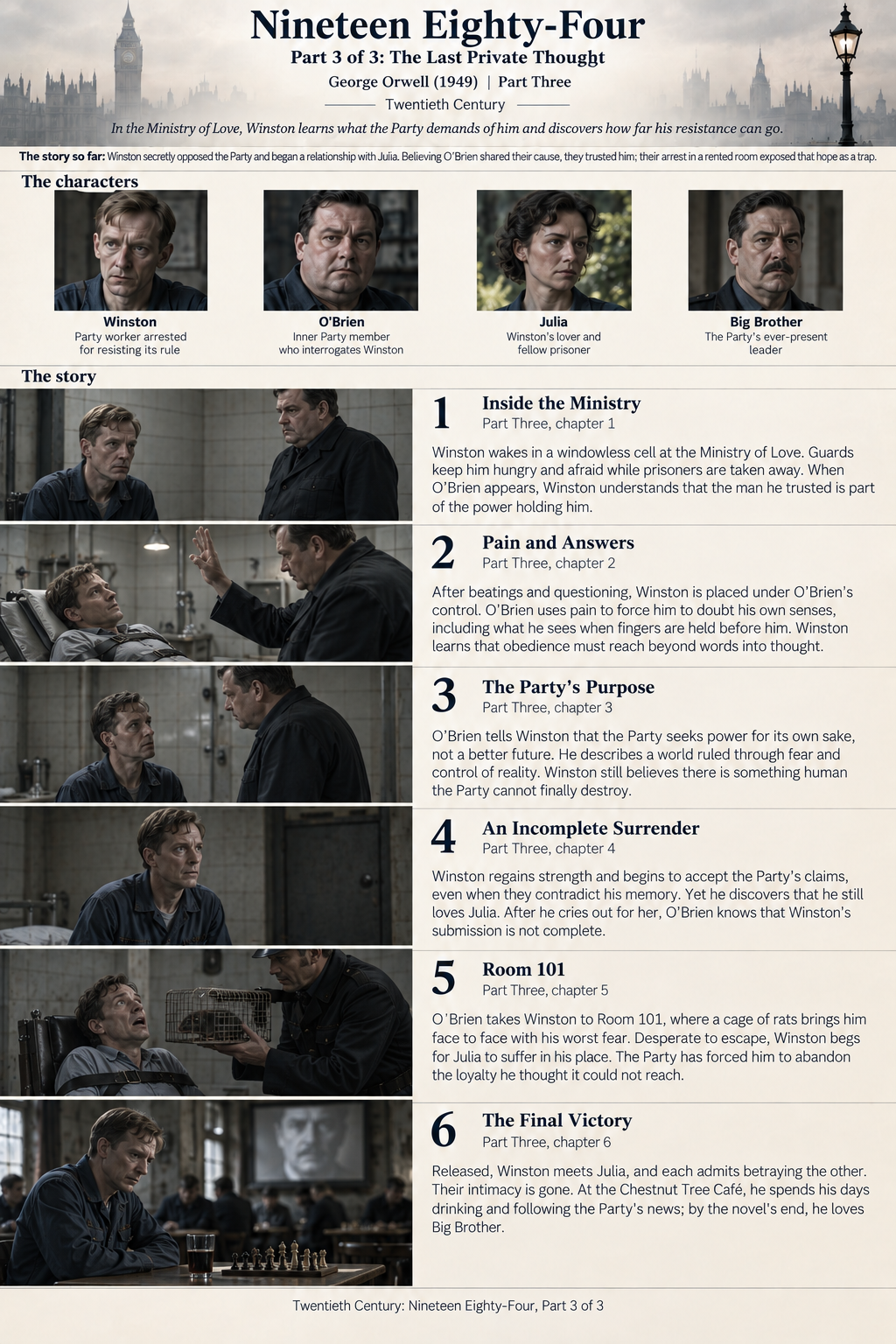
Winston Smith has tried to preserve a private life under the Party’s surveillance. He has kept a diary, loved Julia and trusted O'Brien, believing the Inner Party member might help them resist. Their arrest in the room above Mr Charrington's shop ended that hope. Part Three begins with Winston imprisoned in the Ministry of Love, uncertain how long he has been there.
The cell has no windows, and its lights never go out. Guards watch Winston constantly; hunger, fear and the treatment of other prisoners show him what awaits. O'Brien arrives not as a fellow rebel but as one of his captors. Winston is beaten and questioned, then put under O'Brien's direct control. The man who seemed to understand him now uses that understanding to find what Winston will resist.
O'Brien does not merely demand a confession. Using a device that inflicts pain, he tries to make Winston surrender his confidence in memory and perception. If the Party says that two and two make five, Winston must not simply repeat it to avoid punishment: he must accept the Party's authority over what is true. O'Brien says the Party seeks power for its own sake and intends to sustain it through fear. Winston argues that human beings cannot be remade completely. Yet pain steadily weakens his ability to defend what he knows.
As Winston recovers physically, he begins to practise the beliefs O'Brien has taught him. His resistance narrows to a final private attachment: he still loves Julia. When he cries out for her, O'Brien understands that Winston's submission is unfinished. Winston is taken to Room 101, where each prisoner faces what he most fears. For Winston, it is rats. With a cage brought close to his face, he begs his tormentors to do it to Julia instead. His terror makes him sacrifice the person he meant to protect.
After his release, Winston meets Julia outdoors. Each tells the other that they betrayed one another. They understand that their feelings have changed, and they part without recovering their former intimacy. Winston now spends much of his time at the Chestnut Tree Café, drinking Victory Gin, playing chess and listening to news from the telescreen. The novel ends not with a new act of defiance but with his love for Big Brother.
This ending makes the Party's ambition more terrible than ordinary censorship or the punishment of dissent. It seeks to govern memory, judgment and affection until no inward refuge remains. Orwell also asks what fear can do to loyalty: Winston and Julia's betrayal is not presented as a simple failure of courage, but as the result of deliberate, overwhelming coercion. Readers may differ over whether Winston's defeat is meant to feel inevitable. What this part leaves us to consider is the value of shared facts and human bonds—and the danger of a power that works to destroy both.
Further reading
- George Orwell, Nineteen Eighty-Four (2021)
- Bernard Crick, George Orwell: A Life (1980)
- John Rodden, The Cambridge Companion to George Orwell (2007)