Macbeth, Part 1 of 3: A Crown Promised in Blood
Shakespeare · Part 1 of 3: A Crown Promised in Blood
Macbeth
William Shakespeare (c. 1606) · Acts 1-2
After witches predict he will be king, a victorious soldier and his wife murder their royal guest to seize the crown.
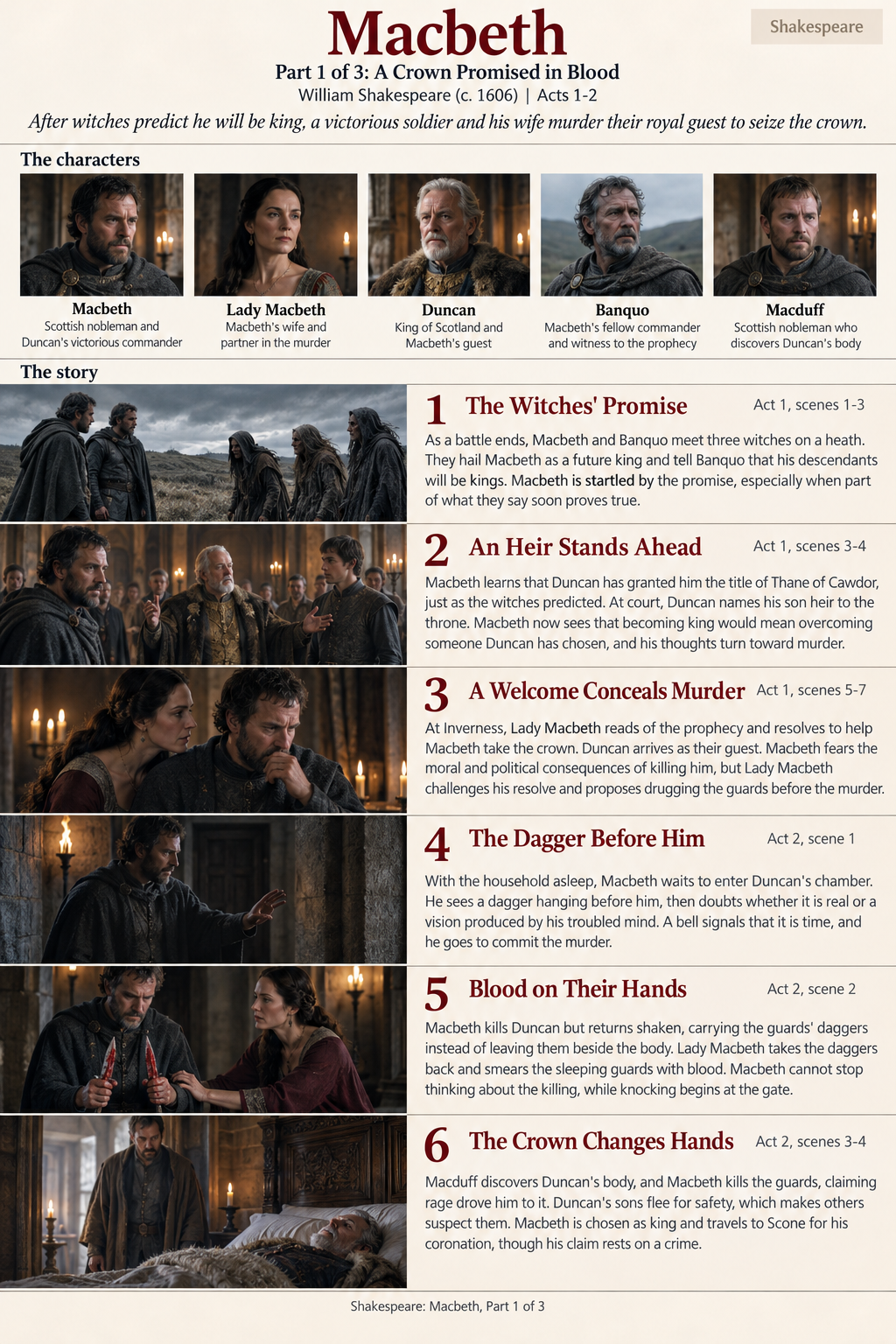
The play opens in Scotland amid war and unrest. Macbeth has fought bravely for King Duncan, and his victory earns him praise. Before Macbeth knows what reward the king has chosen for him, he and his fellow commander Banquo meet three witches on a heath. They greet Macbeth by his present title, by a new title, Thane of Cawdor, and as a future king. They tell Banquo that he will not reign but that his descendants will. Soon afterward, Macbeth learns that Duncan has indeed made him Thane of Cawdor. The fulfilled prediction gives the promise of a crown a troubling force.
At Duncan's court in Forres, the king names his son Malcolm Prince of Cumberland, placing him next in line for the throne. Macbeth sees Malcolm as an obstacle, even as Duncan trusts and honours him. Macbeth writes to Lady Macbeth about the witches, and she immediately fears that he will be too scrupulous to take the crown by force. When Duncan announces a visit to their castle at Inverness, she decides that he must die there. Her welcome to the king conceals that purpose. Macbeth hesitates: Duncan is his kinsman, his king and his guest, and Macbeth knows that killing him would invite terrible consequences. Lady Macbeth attacks his courage and lays out a plan to drug Duncan's guards and blame them.
Late that night, Banquo speaks of the witches while Macbeth claims that he has not been thinking about them. Alone, Macbeth sees a dagger before him and cannot tell whether it is real. The vision seems to lead him toward Duncan's chamber. After Lady Macbeth gives the signal, Macbeth goes in and kills the sleeping king. He returns horrified, still holding the guards' daggers, which the couple meant to leave beside Duncan. Lady Macbeth takes them back herself and smears the guards with blood. Macbeth hears knocking at the gate and fears that no washing can free him from what he has done.
When Macduff arrives and goes to wake Duncan, he discovers the body. Macbeth kills the guards before they can be questioned, saying that outrage at the murder overcame him. Duncan's sons, Malcolm and Donalbain, fear they may be next and flee separately, Malcolm to England and Donalbain to Ireland. Their departure arouses suspicion. Macbeth is chosen as king and goes to Scone to be crowned. By the end of Act 2, the witches' prediction has come true, but the murder behind it has left Macbeth fearful rather than secure.
These acts ask how a thought becomes a deed. The witches offer Macbeth a possibility; they do not order him to kill Duncan. Macbeth recognises the difference, yet lets ambition grow until he treats Malcolm's lawful claim as a barrier to remove. Lady Macbeth presents decisiveness as courage, but her ability to manage the immediate evidence cannot undo the crime. Shakespeare also makes hospitality matter: Macbeth betrays a man who has entered his home trusting him. Readers may disagree about how much power the witches have over events. What is clear here is the couple's responsibility for their choice—and the speed with which winning power costs them peace of mind.
Further reading
- William Shakespeare, edited by Sandra Clark and Pamela Mason, Macbeth (2015)
- A. C. Bradley, Shakespearean Tragedy (1904)
- Stephen Greenblatt, Will in the World: How Shakespeare Became Shakespeare (2004)