Macbeth, Part 2 of 3: A Crown Without Peace
Shakespeare · Part 2 of 3: A Crown Without Peace
Macbeth
William Shakespeare (c. 1606) · Act 3
Macbeth orders another murder to secure his crown, but a banquet reveals how little control he has gained.
The story so far: After the witches predicted he would become king, Macbeth murdered King Duncan with Lady Macbeth's help. Duncan's sons fled, and Macbeth took the throne.
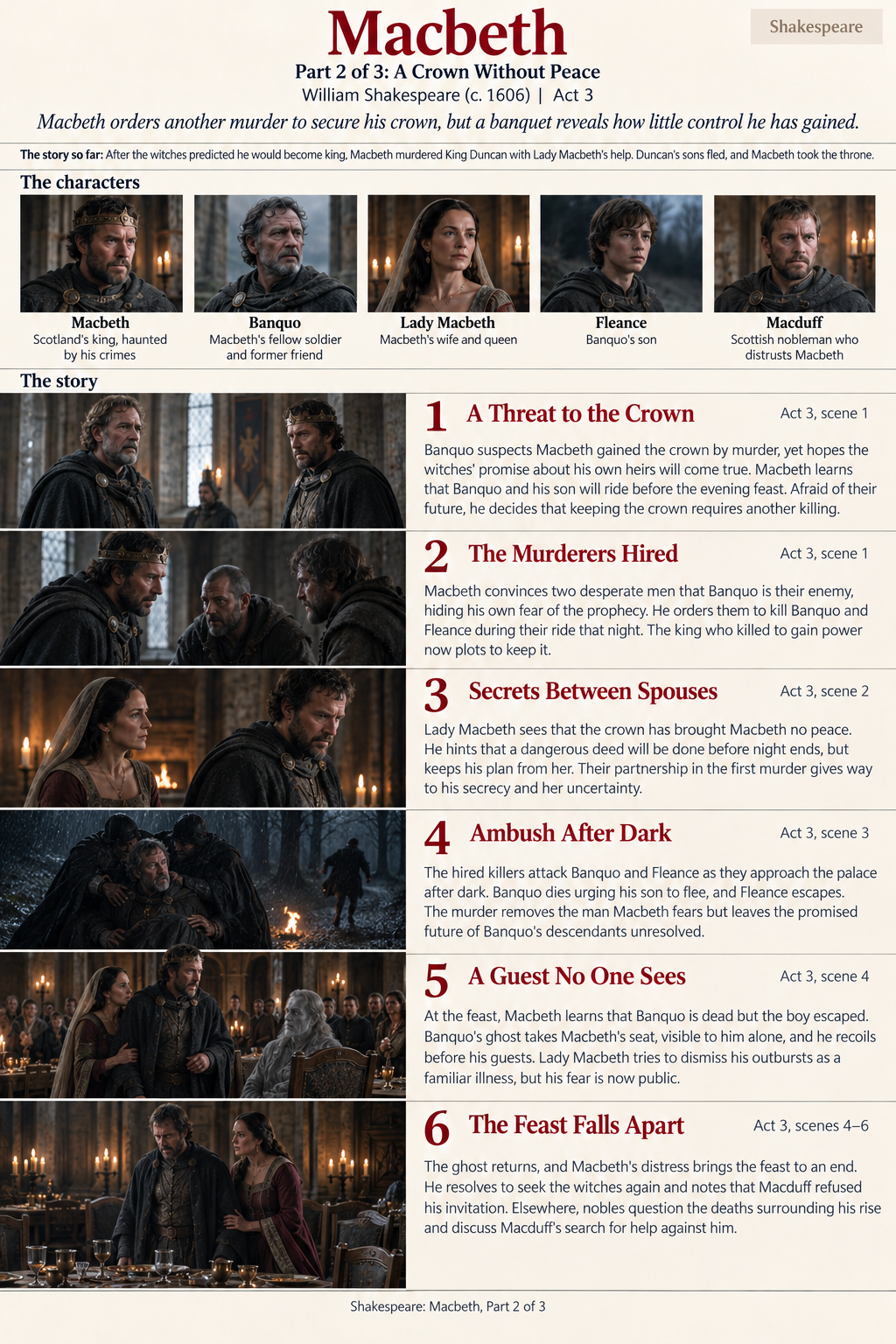
Macbeth is king of Scotland because he murdered King Duncan, aided by Lady Macbeth. Duncan's sons have fled, but the crime has not made its perpetrators secure. The witches also told Banquo, Macbeth's fellow soldier, that Banquo's descendants would be kings. Act 3 begins with Banquo suspecting how Macbeth gained the throne, while still hoping that the promise about his own family will prove true.
At the palace in Forres, Macbeth invites Banquo to a feast and learns that Banquo and his son Fleance will ride before returning that evening. Alone, Macbeth admits what troubles him: if Banquo's descendants inherit the crown, he has committed murder for someone else's future. He persuades two men that Banquo has wronged them and hires them to kill both father and son. Macbeth tells Lady Macbeth that danger remains, but does not explain his plan. She recognizes that their victory has brought no contentment; he now carries out violence without her counsel.
The attackers intercept Banquo and Fleance near the palace after dark. Banquo is killed, but he urges Fleance to escape, and the boy does. At the feast, a murderer reports this mixed result to Macbeth. Banquo can no longer challenge him, yet Fleance's escape keeps the witches' prediction alive in Macbeth's mind. The king must leave his guests to hear the news, then return to the public role he is struggling to perform.
That role collapses when Banquo's ghost appears in Macbeth's place at the table. No one else can see it. Macbeth addresses the figure in terror, while his guests see only a king speaking wildly to an empty chair. Lady Macbeth tries to cover for him, calling his behavior a familiar fit and urging the company not to stare. The ghost vanishes and returns; Macbeth cannot settle himself, and Lady Macbeth ends the feast. Whether the ghost is understood as supernatural or as an expression of guilt, the contrast is stark: Macbeth sees a consequence of his crime where his guests see a frightening loss of control.
Afterward, Macbeth says he will seek out the witches again and learn more, whatever the cost. He also notices that Macduff has refused to attend the feast. A brief scene shows Hecate planning with the witches to draw Macbeth into false confidence; scholars have questioned whether Shakespeare wrote this scene. In the final scene, nobles privately cast doubt on the accounts of Duncan's and Banquo's deaths. They speak of Macduff's journey to England to seek help against Macbeth. The king's efforts to protect himself have widened suspicion instead. Act 3 offers a practical warning without suggesting an easy escape: when fear drives each new decision, even apparent successes can leave a person less safe and less able to trust anyone.
Further reading
- William Shakespeare, edited by Sandra Clark and Pamela Mason, Macbeth (2015)
- A. C. Bradley, Shakespearean Tragedy (1904)
- Harold Bloom, Shakespeare: The Invention of the Human (1998)