Macbeth, Part 3 of 3: The Wood Comes to Dunsinane
Shakespeare · Part 3 of 3: The Wood Comes to Dunsinane
Macbeth
William Shakespeare (c. 1606) · Acts 4-5
Macbeth trusts new prophecies as his enemies gather, but the promises that reassure him prove dangerously easy to misunderstand.
The story so far: Macbeth murdered King Duncan and took Scotland’s throne. Fearing a prophecy about Banquo’s heirs, he had Banquo killed; Banquo’s ghost then appeared at a royal banquet.
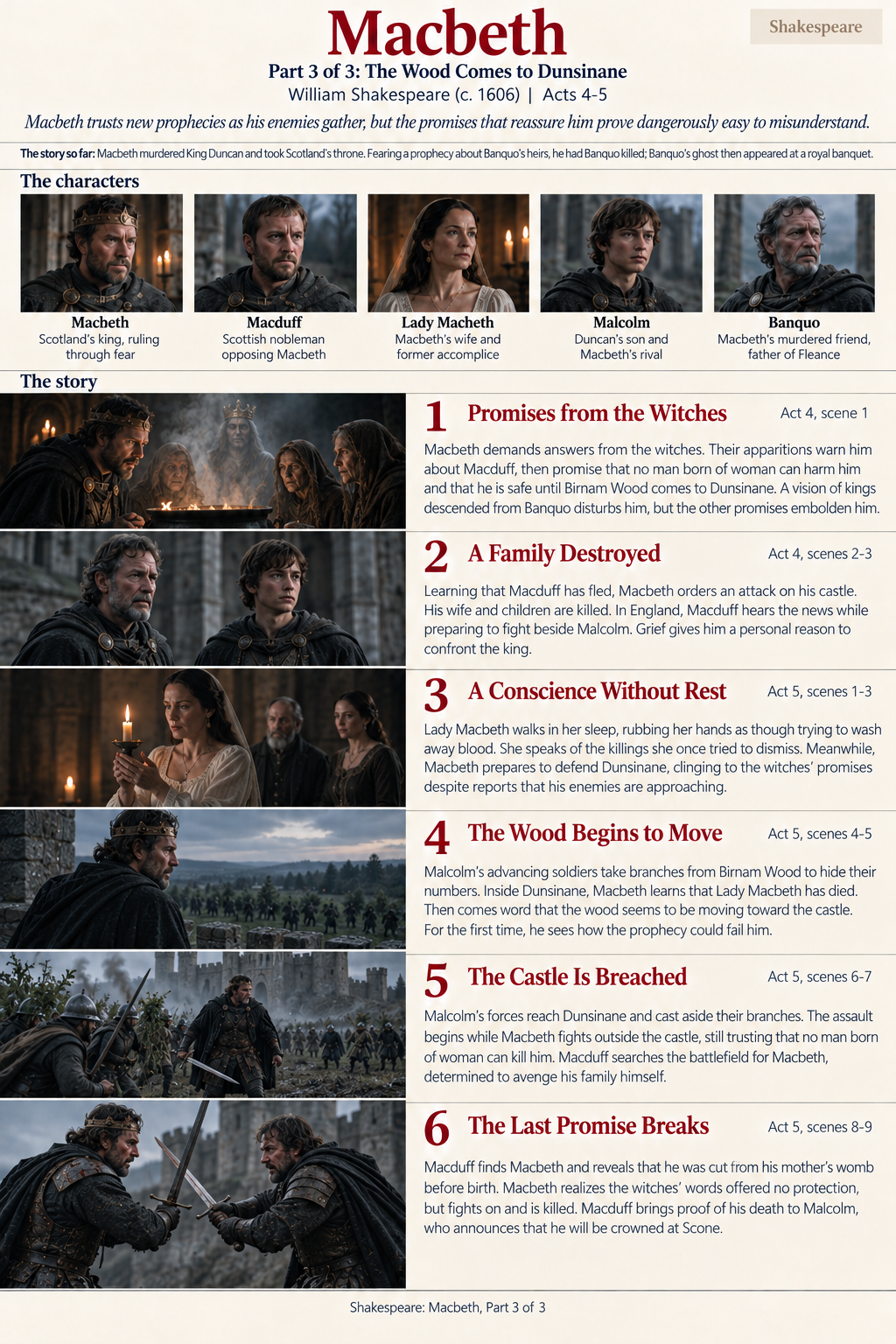
Macbeth has gained Scotland’s throne by murdering Duncan, but kingship has brought him no peace. He has arranged the murder of his friend Banquo, whose heirs the witches foretold would become kings, and has been shaken by Banquo’s ghost. Now Macbeth returns to the witches for the certainty that power cannot give him. Their apparitions tell him to beware Macduff, but also say that no man born of woman will harm him and that he will not be defeated until Birnam Wood comes to Dunsinane. A procession of kings, followed by Banquo’s ghost, shows that Banquo’s descendants still threaten Macbeth’s hopes for a lasting dynasty.
The prophecies make Macbeth feel secure without making him merciful. When he learns that Macduff has fled to England, he orders an attack on Macduff’s castle. Murderers kill Macduff’s wife and son; the assault also destroys the rest of his household. In England, Malcolm, Duncan’s son, tests whether Macduff can be trusted before the two prepare to fight Macbeth. News of the slaughter then reaches Macduff. Malcolm urges him to turn his grief toward their cause, but Macduff insists on feeling his loss as well as avenging it. Their resistance is now both a struggle for Scotland and a deeply personal reckoning.
Back in Scotland, the cost of Macbeth’s earlier crimes has overtaken Lady Macbeth. A physician and an attendant watch her walk in her sleep, rubbing her hands as if washing them. Her broken speech returns to the deaths that she once urged Macbeth to put out of mind. Macbeth, meanwhile, prepares to defend his stronghold at Dunsinane. He knows that his rule is failing and that the people around him obey from fear rather than love. Even so, he takes comfort in the apparitions’ words instead of reconsidering what they might mean.
Malcolm’s army gathers at Birnam Wood. To disguise its size, each soldier takes a branch and carries it toward Dunsinane. Inside the castle, Macbeth hears that Lady Macbeth has died. He responds with a bleak reflection on life’s passing, then receives a report that the wood appears to be moving. The promised impossibility has become an ordinary military tactic. As the attackers reach the castle, Macbeth continues fighting. He kills an opposing soldier and searches for safety in the claim that no man born of woman can harm him; Macduff, in turn, searches the battlefield for Macbeth.
When they meet, Macduff reveals that he was cut from his mother’s womb before birth. Macbeth finally understands that the witches’ assurances were worded to mislead him. He refuses to surrender, and Macduff kills him. Macduff brings Macbeth’s severed head to Malcolm, who thanks his supporters, calls home those who fled Macbeth’s rule, and announces his coronation at Scone. The ending restores a prospect of lawful government, but it cannot undo the deaths that preceded it. Shakespeare leaves readers with a practical warning about hearing only what they want to hear—and a harder question about how ambition, once joined to violence, can make every attempted safeguard another crime.
Further reading
- William Shakespeare, edited by Sandra Clark and Pamela Mason, Macbeth (2015)
- A. C. Bradley, Shakespearean Tragedy (1904)
- Marjorie Garber, Shakespeare After All (2004)