A Christmas Carol, Part 1 of 3: The Light of Christmas Past
Dickens · Part 1 of 3: The Light of Christmas Past
A Christmas Carol
Charles Dickens (1843) · Staves 1-2
A miser receives a warning from his dead partner and is taken back through Christmases he would rather forget.
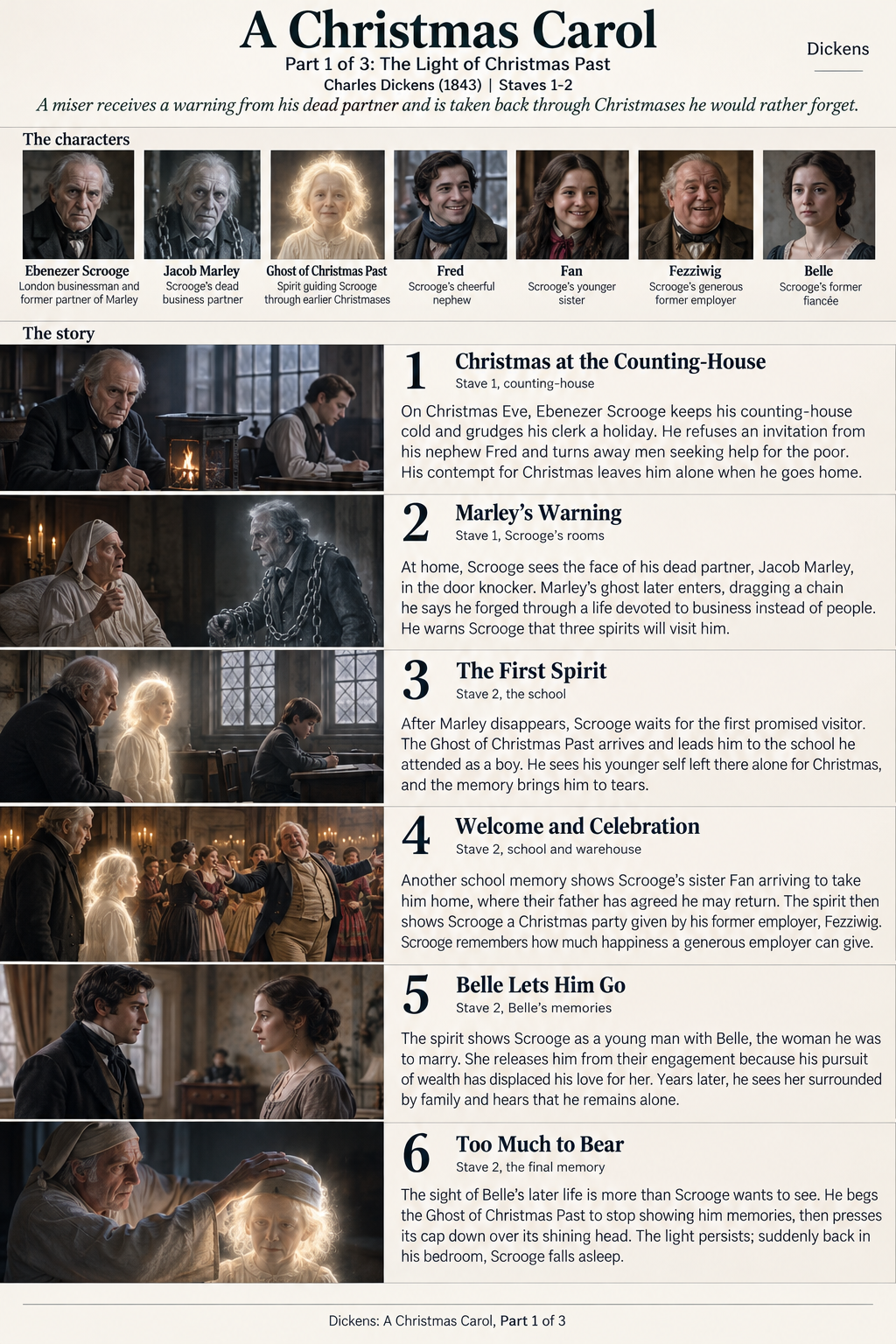
On Christmas Eve in London, Ebenezer Scrooge sits in his counting-house, concerned with business and hostile to the season’s warmth. His former partner, Jacob Marley, has been dead for seven years. Scrooge keeps his clerk’s working space cold, rejects his nephew Fred’s invitation to dinner, and refuses to contribute to a collection for the poor. He calls Christmas a humbug and goes home to spend the evening alone.
At his front door, Scrooge sees Marley’s face appear in the knocker. He tries to dismiss what he has seen, but bells ring through his rooms and Marley’s ghost enters. The ghost drags a long chain made from objects associated with business. Marley says he forged it himself during a life spent attending to his own affairs while neglecting other people. Now he must wander without the power to offer the help he withheld in life. He tells Scrooge that three spirits will visit him and that their visits are his chance to escape the same fate. After Marley leaves, Scrooge sees other restless spirits outside before shutting his window and going to bed.
The first visitor, the Ghost of Christmas Past, arrives and takes Scrooge to the countryside of his childhood. At his old school, Scrooge sees himself as a boy left there alone during the holidays. He remembers how much comfort he found in imagined adventures. On a later Christmas, his sister Fan comes to bring him home: their father has become kinder and has agreed that Scrooge may return. The adult Scrooge is moved by these scenes. Thinking of the lonely boy, he regrets having turned away a child who sang at his door the previous night.
The spirit next takes him to the warehouse where he once worked for Fezziwig. His employer has cleared the space for a lively Christmas party, welcoming his workers and guests. Scrooge delights in the memory. When the spirit asks whether such a celebration cost much, Scrooge understands that Fezziwig’s kindness mattered far more than its price. He wishes he could say something to his own clerk.
Later memories are harder to face. Belle, the woman Scrooge expected to marry, tells his younger self that another love—wealth—has taken her place, and she releases him from their engagement. The spirit then shows her years later with her family. Her husband has seen Scrooge sitting alone in his office. Scrooge begs the spirit to stop and tries to cover its shining head, but the light persists. Back in his bedroom, he falls asleep. These visits have not yet made him a different man, but they have broken his certainty about himself. The memories suggest that loneliness is not only something he suffered: it is also something his choices have deepened. They invite readers to ask what their daily treatment of others reveals about what they value.
Further reading
- Charles Dickens, edited by Robert Douglas-Fairhurst, A Christmas Carol and Other Christmas Books (2006)
- John O. Jordan, editor, The Cambridge Companion to Charles Dickens (2001)
- Michael Slater, Charles Dickens (2009)