The Epic of Gilgamesh, Part 2 of 3: Victory and Its Cost
Ancient and Classical · Part 2 of 3: Victory and Its Cost
The Epic of Gilgamesh
Anonymous (c. 2100-1200 BC) · Tablets 5-8
Gilgamesh and Enkidu win two astonishing victories, but the gods' response changes their friendship forever.
The story so far: Gilgamesh, king of Uruk, befriended the wild man Enkidu after their first clash. Seeking lasting fame, they set out together for the Cedar Forest, guarded by Humbaba.
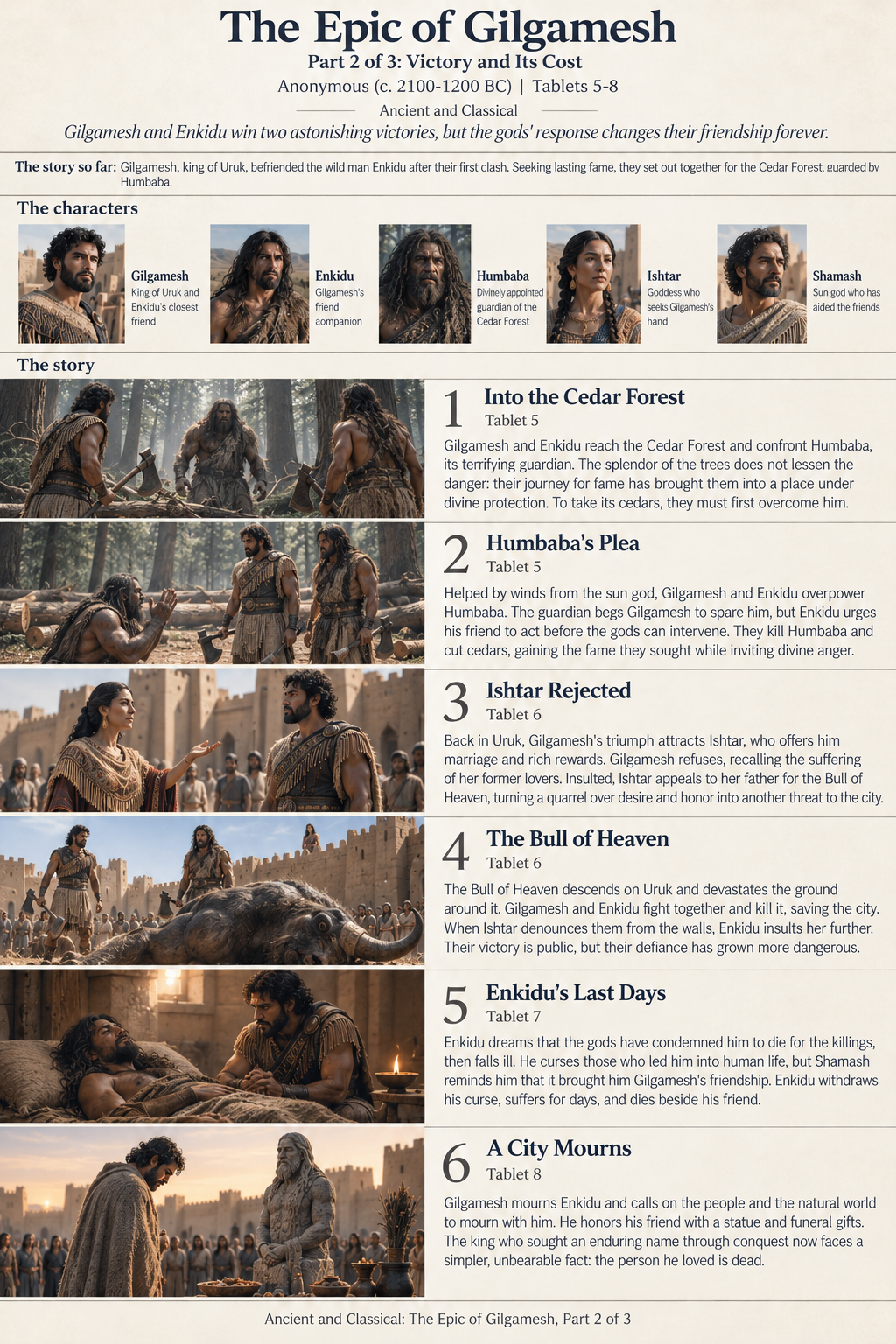
Gilgamesh, king of Uruk, has found a friend and equal in Enkidu, a wild man brought into human society. Hoping to make names that will outlast them, they have travelled to the Cedar Forest to challenge its guardian, Humbaba. Tablet 5 brings them into the forest itself. Its magnificent trees are also a warning: this is not ordinary timberland but a place protected by the gods. The friends press on, and winds sent by the sun god Shamash help them overpower Humbaba.
Defeated, Humbaba begs Gilgamesh to spare him and offers to serve him. Enkidu urges Gilgamesh to kill the guardian before divine help can arrive. They do so and cut cedars from the forest. What looks like an heroic achievement also breaks a sacred boundary. The epic does not make the choice comfortable: Humbaba is frightening, yet he pleads for his life, and Enkidu's advice is driven as much by fear of what may follow as by courage.
After the friends return to Uruk, the goddess Ishtar offers Gilgamesh marriage, power and wealth. He rejects her, recounting what became of her earlier lovers. Furious at the insult, Ishtar obtains the Bull of Heaven from her father and sends it against Uruk. The bull tears up the ground, but Gilgamesh and Enkidu kill it together. Enkidu then insults Ishtar as she laments their victory from the city wall. Once again the friends have proved their strength; once again a victory has made enemies among the gods.
In Tablet 7, Enkidu dreams of a divine council deciding that one of the two friends must die for killing Humbaba and the bull. Enkidu is chosen. As illness overtakes him, he curses the means by which he entered human life. Shamash reminds him that this change brought him food, honor and, above all, Gilgamesh's friendship; Enkidu takes back his curse on the woman who introduced him to that life. He also dreams of the bleak dwelling of the dead. His strength cannot save him. After days of suffering, Enkidu dies, and Gilgamesh is left with a loss no feat of arms can undo.
Tablet 8 dwells on Gilgamesh's grief. He calls on the people of Uruk and the landscape they travelled through to mourn Enkidu. He commissions a statue in his friend's likeness and arranges funeral gifts. The long lament gives Enkidu an honor that conquest alone could not provide: he is remembered as a person loved. Readers may differ on how far the poem condemns the friends' earlier deeds, but their consequences are unmistakable. Their courage and loyalty are real; so are their rashness and disregard for limits. This part asks us to notice what a triumph costs, and to recognize that love makes another person's mortality impossible to treat as an abstraction.
Further reading
- Andrew George, The Epic of Gilgamesh (1999)
- David Damrosch, The Buried Book: The Loss and Rediscovery of the Great Epic of Gilgamesh (2007)
- John R. Maier, Gilgamesh: A Reader (1997)