The Epic of Gilgamesh, Part 1 of 3: From Uruk to the Cedars
Ancient and Classical · Part 1 of 3: From Uruk to the Cedars
The Epic of Gilgamesh
Anonymous (c. 2100-1200 BC) · Tablets 1-4
A troubled king befriends the wild man sent to challenge him, and together they set out for a dangerous forest.
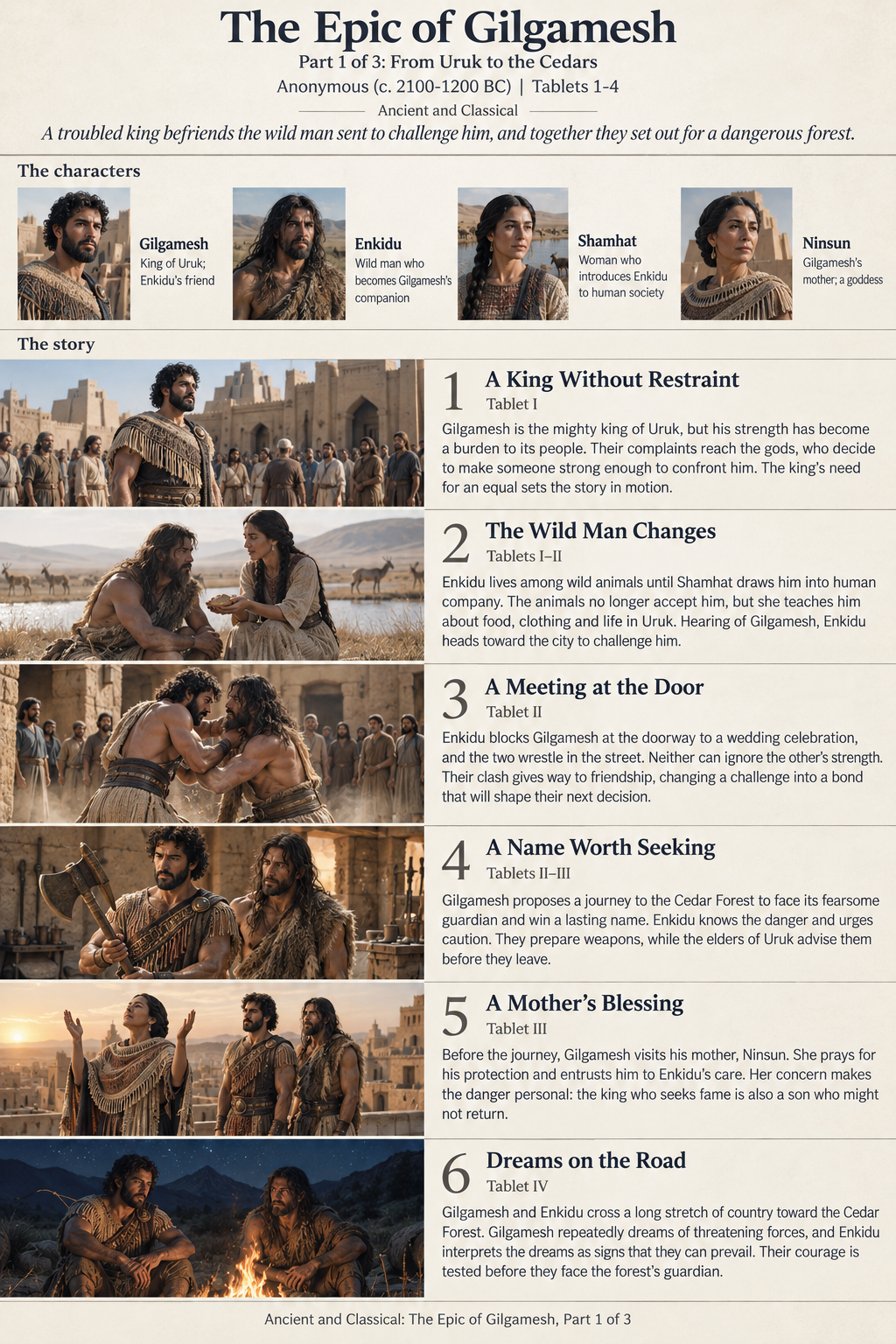
The epic opens by praising the walls of Uruk and the remarkable king who built them. Yet Gilgamesh’s power has made life hard for his people. He drives the young men relentlessly and takes liberties with the young women; the people appeal to the gods for relief. The gods answer by creating Enkidu, a man strong enough to meet the king on equal terms. At first Enkidu belongs to the steppe rather than the city. Covered in hair, he lives with animals and frees them from a hunter’s traps.
The hunter seeks help, and Shamhat goes to Enkidu at the watering place. After their encounter, the animals flee from him. Enkidu has lost his old place among them, but he has gained an understanding of human life. Shamhat leads him to the shepherds, where he learns to eat bread, drink beer, wear clothes and guard the flocks. When he hears how Gilgamesh behaves in Uruk, Enkidu is determined to stand in his way. Their meeting approaches as a confrontation between two kinds of strength: a king’s power over a city and a wild man’s untested freedom.
Enkidu bars Gilgamesh’s way at a wedding, and they wrestle fiercely. The struggle ends not in lasting hostility but in friendship. For Gilgamesh, Enkidu is the equal he lacked; for Enkidu, Gilgamesh offers a place in human society that does not depend on obedience. Gilgamesh soon proposes a perilous undertaking. They will travel to the Cedar Forest and confront its guardian, Humbaba. Gilgamesh wants to make a name that will endure, even though he knows human life will not. Enkidu, who knows something of the forest and its guardian, warns him against treating the danger lightly.
Despite that warning, they prepare to go. Weapons are made, and the elders of Uruk advise Gilgamesh to listen to Enkidu on the road. Gilgamesh also visits his mother, Ninsun. She prays to the sun god Shamash for his safety and places Enkidu under a special obligation to care for him. These farewells complicate Gilgamesh’s pursuit of glory. The expedition is his choice, but others must live with their fear for him. Enkidu remains beside him, not because he shares his confidence, but because friendship now binds them.
Tablet IV follows the companions across a vast distance. At their camps, Gilgamesh has a series of frightening dreams, and Enkidu interprets them as promises of help rather than defeat. The interpretations steady Gilgamesh, but the dreams also show how much he fears the encounter ahead. The forest and its guardian remain before them. These opening tablets ask whether strength can become something better than domination. Enkidu’s challenge changes Gilgamesh more than his subjects’ complaints could, while Enkidu’s passage into human society costs him the life he knew. Their journey suggests a practical lesson without settling the question of glory: courage needs a companion willing to speak of danger.
Further reading
- Andrew George, The Epic of Gilgamesh (1999)
- David Damrosch, The Buried Book: The Loss and Rediscovery of the Great Epic of Gilgamesh (2007)
- John Maier, Gilgamesh: A Reader (1997)