Moby-Dick, Part 3 of 3: The Last Chase
American · Part 3 of 3: The Last Chase
Moby-Dick
Herman Melville (1851) · Chapters 91-135 and the Epilogue
As the Pequod crosses the Pacific, Ahab drives its crew through storms and warnings toward a final encounter with the white whale.
The story so far: Ishmael joined the whaling ship Pequod with his friend Queequeg. Its captain, Ahab, has turned the voyage into a hunt for Moby Dick, the white whale that took his leg.
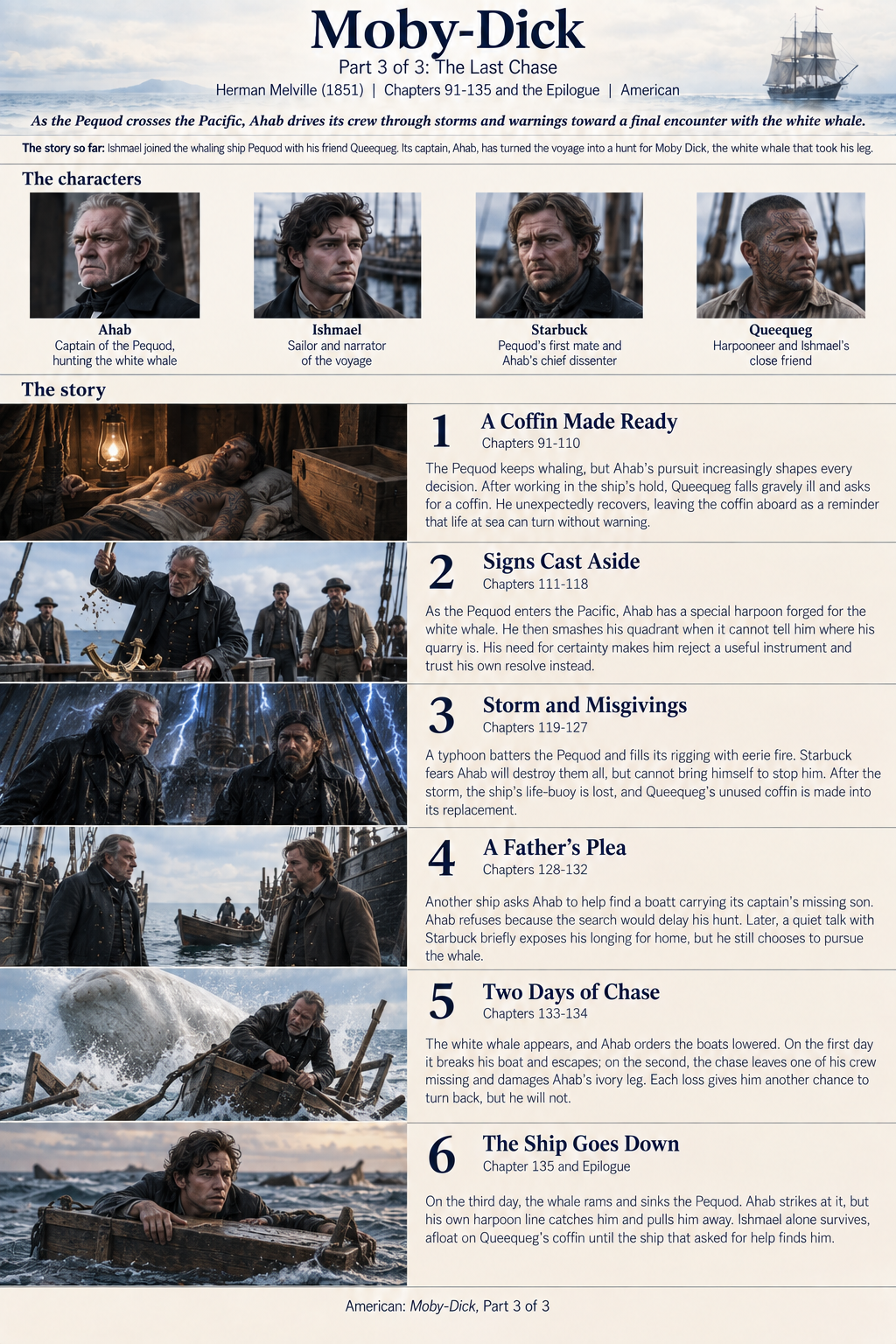
Ishmael has shipped aboard the Pequod with his friend Queequeg, but the voyage is no longer an ordinary hunt for whale oil. Captain Ahab is seeking Moby Dick, the white whale that took his leg. As the ship continues whaling, encounters with other vessels and the hard work aboard keep ordinary seafaring life in view. Ahab’s private purpose, however, governs the course. Queequeg becomes so ill after working in the hold that he requests a coffin. Then he decides he has more to do and recovers; the unused coffin remains on the ship.
In the Pacific, Ahab prepares for his quarry with fierce care. He has the blacksmith forge a special harpoon, which he tempers in the blood of the harpooneers. Yet preparation is not the same as control. Unable to make his quadrant reveal the whale’s whereabouts, Ahab smashes it. The contrast is striking: a captain who knows the sea’s practical demands will destroy a useful navigational instrument rather than accept what it cannot tell him. His officers must continue steering the Pequod under a man who increasingly treats every limit as a challenge.
A typhoon tests both ship and crew. Strange fire shines on the masts, and Starbuck, the first mate, sees in the storm another reason to fear Ahab’s command. Finding Ahab asleep, he considers killing him with a musket to save the crew, but does not do it. Afterward, when a sailor falls overboard and the life-buoy fails, Queequeg’s coffin is fitted out to replace it. The object once meant to hold a dead man becomes equipment intended to keep someone alive.
The Pequod then meets the Rachel. Its captain begs Ahab to help search for a missing boat carrying his son, but Ahab refuses to lose time. Later, on a calm day, he speaks with Starbuck about the years he has spent at sea and the wife and child he left at home. For a moment, he seems able to imagine another course. He nevertheless returns to the hunt. The refusal to aid the Rachel and the conversation with Starbuck show the distance between what Ahab can feel and what he will allow himself to do.
Moby Dick appears, and the chase lasts three days. On the first, the whale wrecks Ahab’s boat. On the second, another boat is destroyed, Fedallah disappears, and Ahab’s ivory leg is damaged. On the third, Ahab sees Fedallah’s body caught against the whale. Moby Dick rams the Pequod, which sinks with those aboard. Ahab hurls his harpoon, but the running line catches him and drags him away. Ishmael survives by clinging to Queequeg’s coffin, now a life-buoy. The Rachel, still searching, picks him up the next day.
The ending asks what a person owes others when conviction hardens into obsession. Ahab has courage and moments of tenderness, but repeatedly sacrifices judgment and other people’s needs to his aim. Readers and scholars differ over how far the whale should be read as a symbol rather than an animal. The crew’s fate makes one practical lesson clear without settling that question: strength of purpose is no substitute for listening, helping and knowing when to turn back.
Further reading
- Herman Melville, Moby-Dick (2002)
- Andrew Delbanco, Melville: His World and Work (2005)
- Hershel Parker, Herman Melville: A Biography, Volume 1, 1819–1851 (1996)