Moby-Dick, Part 2 of 3: Hunting What Cannot Be Known
American · Part 2 of 3: Hunting What Cannot Be Known
Moby-Dick
Herman Melville (1851) · Chapters 41-90
As the Pequod begins hunting whales, Ahab pursues reports of Moby Dick while Ishmael examines the animals the crew catches.
The story so far: Ishmael has sailed from Nantucket aboard the Pequod with his friend Queequeg. Captain Ahab has promised the crew a reward for sighting Moby Dick, the white whale that took his leg.
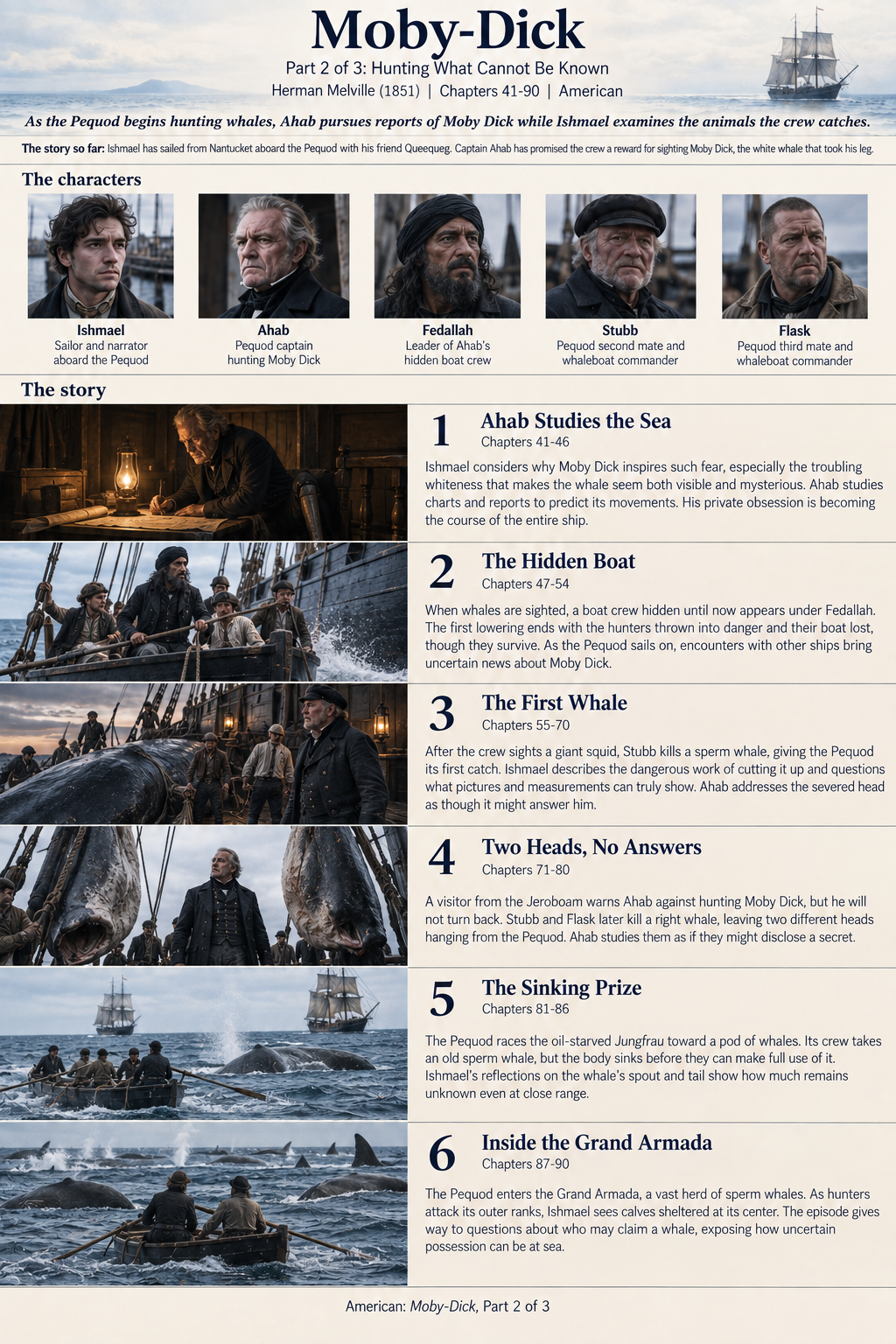
Ishmael has joined the whaling ship Pequod with his friend Queequeg. Captain Ahab has declared that the voyage has another purpose: to find Moby Dick, the white sperm whale that took his leg. Now Ishmael describes the whale’s fearful reputation and asks why its whiteness disturbs him so deeply. Ahab, meanwhile, studies charts and accounts of whale movements. He hopes to make a particular animal findable in the enormous sea, and his purpose increasingly directs the ship.
Ordinary whaling begins alongside that extraordinary pursuit. While Queequeg and Ishmael work together, the first sighting sends the boats down from the Pequod. Ahab’s own boat reveals a crew the sailors had not known was aboard, led by Fedallah. The lowering ends badly for Ishmael’s boat, but its men survive. Later, a strange spout seen at night seems to beckon the ship onward. An attempted exchange with the Albatross brings no useful answer about Moby Dick. Ishmael also recounts a story learned from the Town-Ho: after conflict aboard that ship, Moby Dick killed a cruel mate. News of the whale travels by human voices, but it does not give Ahab control over him.
Melville repeatedly pauses the voyage to examine how whales are represented and used. Ishmael finds pictures of them inadequate and describes a giant squid before the Pequod takes its first sperm whale. Stubb makes the kill; then comes the labor of securing and cutting up the immense body. The men face hazards from sharks, ropes, weight and water. Ishmael can explain the tools and procedures, yet the living animal still exceeds his explanations. Ahab speaks to its severed head, asking for knowledge it cannot give.
The Jeroboam brings a more direct warning. A man aboard it regards Moby Dick as sacred and urges Ahab not to pursue him; Ahab rejects the warning. Queequeg and Ishmael are later tied together by a rope during the dangerous work of cutting in, so that one man’s safety depends on the other’s. Stubb and Flask kill a right whale, and its head hangs opposite the sperm whale’s. Ishmael compares their different forms while Ahab remains intent on what, if anything, such heads can reveal. When the Pequod meets the oil-starved Jungfrau, the ships race after whales. The Pequod catches an old sperm whale, but its body sinks, taking the hoped-for profit with it.
In the Grand Armada, the hunters enter a huge herd. Ishmael finds himself near mothers and calves sheltered within it, a quiet center surrounded by pursuit and violence. He then considers the rules that decide whether a whale belongs to one claimant or is free for another to take. These chapters set practical knowledge and commercial claims beside uncertainty: people can hunt, classify and claim whales without fully understanding them. Readers may differ over whether Ahab’s search expresses a profound human need for meaning or a dangerous refusal to accept limits. For now, the work of the crew offers a sobering counterpoint: survival depends less on certainty than on attention, skill and care for one another.
Further reading
- Herman Melville, Moby-Dick (2002)
- Andrew Delbanco, Melville: His World and Work (2005)
- Hershel Parker, Herman Melville: A Biography, Volume 1, 1819–1851 (1996)