Moby-Dick, Part 1 of 3: The Voyage Takes Its Shape
American · Part 1 of 3: The Voyage Takes Its Shape
Moby-Dick
Herman Melville (1851) · Chapters 1-40
Ishmael finds a friend and joins a whaling voyage, only to discover that its captain has another purpose.
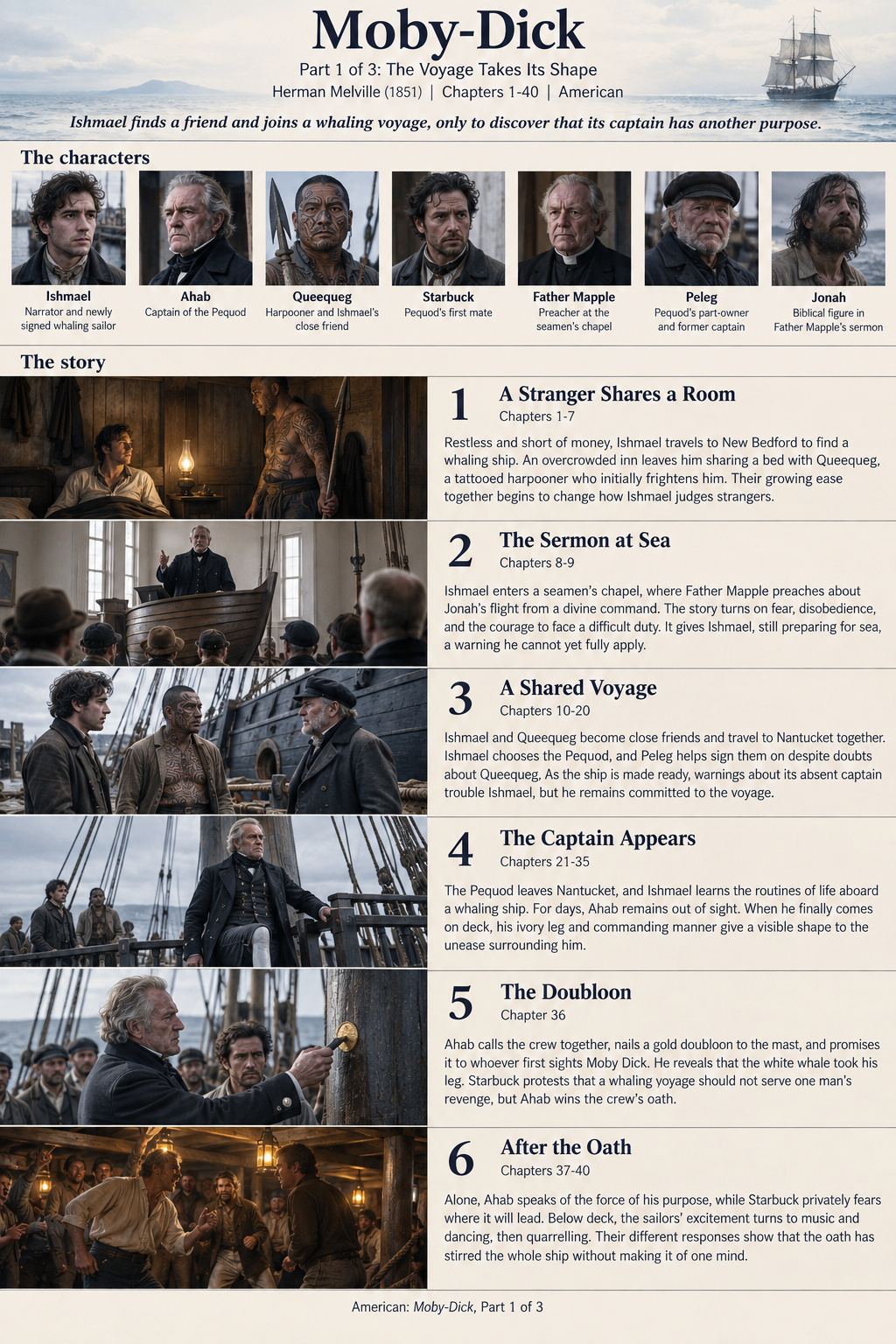
Ishmael opens by explaining an impulse familiar even to someone who has never been to sea: when life on land grows bleak, he seeks the water. Short of money, he goes to New Bedford intending to join a whaling voyage. At the Spouter-Inn, the only available bed must be shared with Queequeg, a tattooed harpooner whose appearance alarms him. Once they meet, Ishmael discovers that the man he feared is considerate and companionable. In a nearby seamen’s chapel, he also sees memorials to people lost at sea. The danger ahead is no abstraction, even before he boards a ship.
Father Mapple, a former sailor, preaches in the chapel about Jonah, who tries to flee a command from God by taking passage on a ship. A storm, a plunge into the sea, and time inside a great fish bring Jonah to acknowledge what he must do. Ishmael then deepens his friendship with Queequeg, and the two set out together for Nantucket. During the crossing, Queequeg saves a passenger who has fallen overboard. Ishmael’s first fearful impression of his new companion has given way to affection and trust, strengthened by something he has witnessed rather than merely been told.
On Nantucket, Ishmael selects the Pequod, a whaling ship whose fittings bear signs of earlier hunts. Its part-owners, Peleg and Bildad, sign him on. Queequeg’s admission meets resistance, but his skill with a harpoon helps settle the matter. Ishmael hears about the captain, Ahab, who lost a leg to a whale; he has not yet met him. A stranger named Elijah offers ominous warnings, while preparations for departure continue. Ishmael has reasons to wonder about the voyage, yet the prospect of sailing with Queequeg and the commitment he has made carry him aboard.
The Pequod sails from Nantucket, and Ishmael begins to observe its officers, crew, and daily work. Ahab stays out of sight for days before appearing on deck. His ivory leg makes the injury Ishmael has heard about unmistakable, but the captain says little at first about what he intends. Then he assembles the crew, nails a gold doubloon to the mast, and offers it to whoever first sights the white whale, Moby Dick. Ahab declares that this whale took his leg. Starbuck, the first mate, objects: they have come to hunt whales for a living, not to pursue one man’s vengeance. Ahab nevertheless draws the crew into an oath to join his hunt.
In the chapters that follow, Ahab speaks alone of his consuming purpose, and Starbuck privately considers the danger of resisting him. In the forecastle, sailors dance and quarrel after the excitement of the oath. The voyage now has two aims that may not sit easily together: the ship’s ordinary work and its captain’s personal pursuit. Ishmael’s growing friendship with Queequeg offers one way to meet an unfamiliar world—with attention instead of quick judgment. Ahab’s command raises a harder question: when a determined leader asks others to share his purpose, how carefully should they weigh what that purpose will cost?
Further reading
- Herman Melville, Moby-Dick (2012)
- Andrew Delbanco, Melville: His World and Work (2005)
- Robert S. Levine, The Cambridge Companion to Herman Melville (1998)