Les Misérables, Part 3 of 3: Mercy After the Barricade
French and European · Part 3 of 3: Mercy After the Barricade
Les Misérables
Victor Hugo (1862) · Volume 5, Jean Valjean
At a Paris barricade, Jean Valjean must decide what he owes the young man Cosette loves and the officer who has pursued him.
The story so far: Jean Valjean, a former convict, rescued and raised Cosette. She and Marius have fallen in love, while Marius has joined an uprising at a Paris barricade.
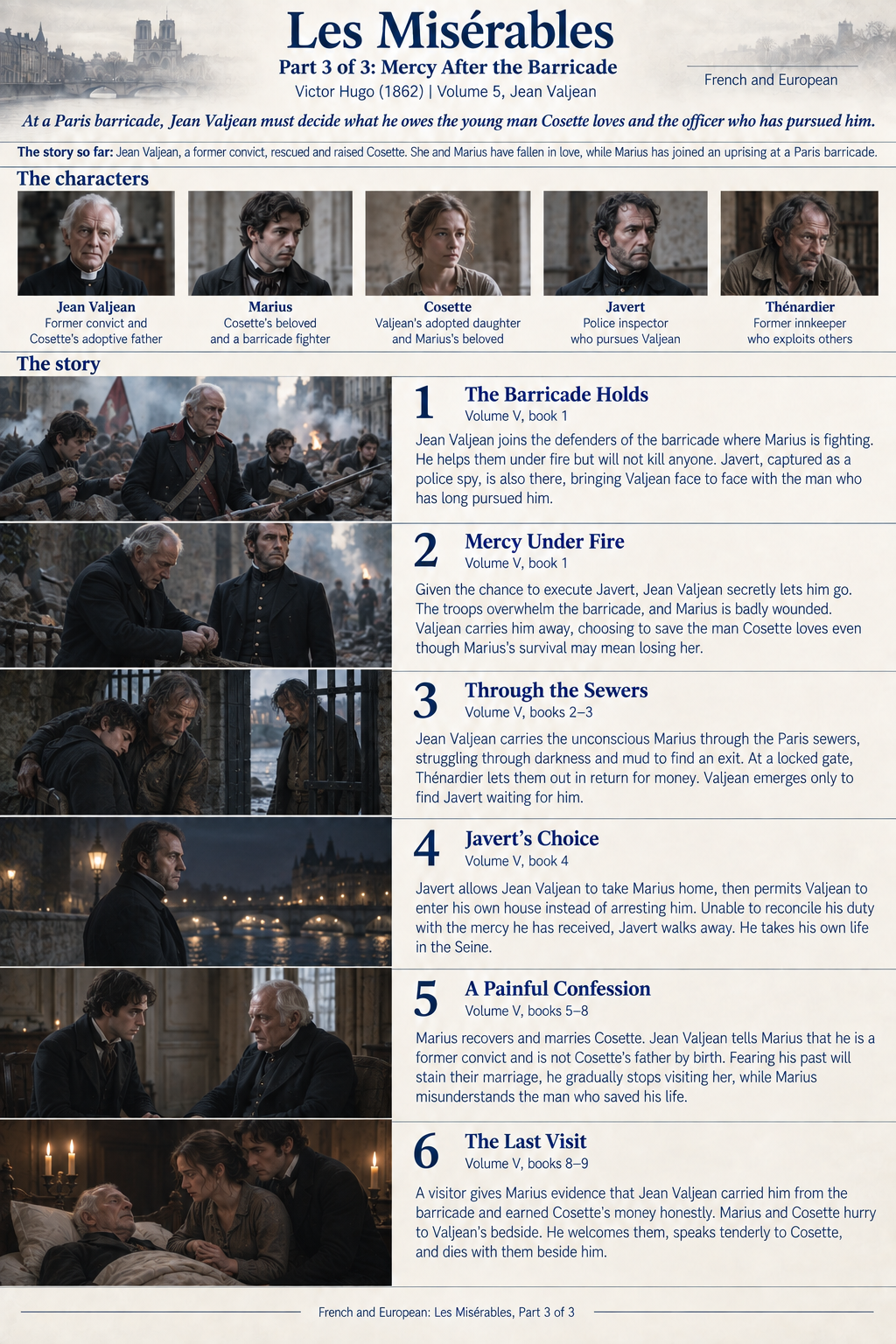
Jean Valjean, once imprisoned for stealing bread, has built a life around caring for Cosette, the child he rescued and raised. Now Cosette loves Marius, a young man fighting at a Paris barricade during the June 1832 uprising. Valjean goes there knowing that saving Marius may cost him the companionship he treasures most.
The defenders of the barricade are running out of time. Valjean helps them under fire, but refuses to kill. Among their prisoners is Javert, the police inspector who has pursued him for years. When Valjean is allowed to take Javert away to execute him, he cuts his bonds and lets him escape. The troops finally overrun the barricade. Marius is badly wounded, and Valjean carries him into the sewers beneath Paris, searching for a way out as his strength fails.
At a locked sewer gate, Valjean encounters Thénardier, who mistakes him for a murderer disposing of a body. Thénardier takes money and opens the gate. Javert is waiting outside. Rather than try to flee, Valjean asks to take the unconscious Marius to his grandfather's house. Javert agrees, then lets Valjean enter his own home. He does not wait to arrest him. Valjean's mercy has broken Javert's settled understanding of justice: the man he regards as a criminal has behaved with greater humanity than the law required. Unable to live with that contradiction, Javert kills himself in the Seine.
Marius recovers and marries Cosette. Valjean tells him that he is a former convict and that Cosette is not his daughter by birth. He does not tell Marius that he carried him out of the sewers. Valjean fears that his past might compromise the young couple's happiness; Marius, lacking the full story, comes to distrust him. Their visits grow fewer, leaving Valjean painfully separated from Cosette. Later Thénardier tries to sell Marius damaging information about Valjean. Instead, his evidence reveals that Valjean saved Marius and that the money given to Cosette came from Valjean's honest work. Marius and Cosette rush to Valjean, but he is dying. He welcomes them, speaks lovingly to Cosette, and dies with them beside him, near the candlesticks the bishop gave him long ago.
The ending asks what it takes to recognise goodness when a person's record, reputation, or silence points the other way. Valjean acts generously without expecting credit; Javert cannot adapt his rigid beliefs to what he has seen; Marius learns the cost of judging before he knows enough. Hugo leaves a practical challenge as well as a moving farewell: mercy can change a life, but gratitude and understanding should not wait until there is almost no time left.
Further reading
- Christine Donougher, Les Misérables (2013)
- David Bellos, The Novel of the Century: The Extraordinary Adventure of Les Misérables (2017)
- Graham Robb, Victor Hugo (1997)