Hamlet, Part 3 of 3: A Court Falls Silent
Shakespeare · Part 3 of 3: A Court Falls Silent
Hamlet
William Shakespeare (c. 1600) · Acts 4-5
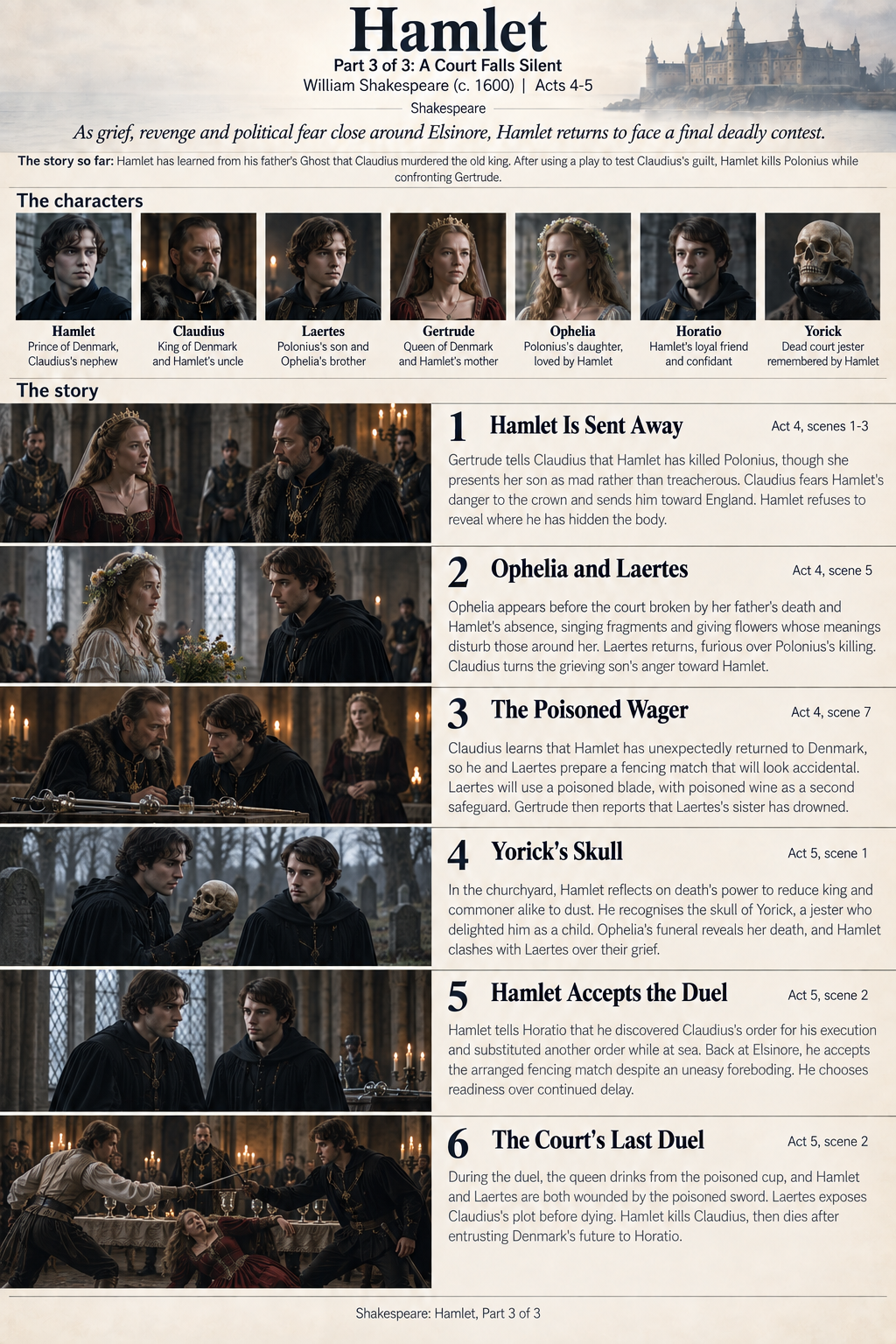
As grief, revenge and political fear close around Elsinore, Hamlet returns to face a final deadly contest.
The story so far: Hamlet has learned from his father's Ghost that Claudius murdered the old king. After using a play to test Claudius's guilt, Hamlet kills Polonius while confronting Gertrude.
Hamlet has discovered that his uncle Claudius murdered his father and married his mother, Gertrude. He has also made Claudius betray his guilt during a performance at Elsinore. But Hamlet's attempt to confront Gertrude ends with the accidental killing of Polonius, whom he mistakes for Claudius behind an arras.
At the beginning of Act 4, Gertrude tells Claudius about Polonius's death. Claudius, alarmed both by Hamlet's violence and by the prince's popularity, sends Hamlet to England under escort. His secret purpose is murder: letters carried with Hamlet order the English king to put him to death. Hamlet finds and alters the commission during the voyage, arranging instead for Rosencrantz and Guildenstern, who had escorted him, to be executed. He escapes from the ship and returns to Denmark.
Meanwhile, Polonius's death overwhelms Ophelia. She enters the court singing disjointed songs and distributing flowers, signs of a mind shattered by grief. Her brother Laertes returns from France and demands revenge. Claudius skillfully directs him against Hamlet. Once Hamlet's return is known, Claudius and Laertes devise a public fencing match: Laertes will use an unblunted rapier tipped with poison, while Claudius keeps poisoned wine ready as another means of killing Hamlet. Gertrude then reports that Ophelia has drowned after falling into a brook. The scene does not settle whether her death is accidental or self-inflicted.
In the churchyard, Hamlet watches gravediggers at work and meditates on mortality. Holding the skull of Yorick, the jester he knew as a child, he sees with painful clarity that charm, status and achievement all end in bodily decay. When Ophelia's funeral procession arrives, Hamlet learns whose grave it is. Laertes leaps into the grave in anguish, and Hamlet follows, declaring the depth of his own love for Ophelia. Their contest of grief is raw rather than healing.
Hamlet later tells Horatio how he escaped Claudius's letter. He accepts the fencing challenge despite a sense of foreboding, saying that readiness matters more than trying to control the future. In the match, Gertrude drinks from the poisoned cup intended for Hamlet. Laertes wounds Hamlet with the poisoned blade, but they exchange rapiers and Hamlet wounds Laertes. As Gertrude dies, Laertes confesses the plot. Hamlet kills Claudius, and then dies from the poison after asking Horatio to tell his story.
Fortinbras arrives to find the Danish court destroyed, and orders military honours for Hamlet. The ending makes revenge look less like restoration than contagion: Claudius's original crime spreads through families, friendships and the state. Yet Hamlet's final trust in Horatio suggests that truthful witness matters after violence. The play asks readers to pity grief without letting it become a weapon, and to recognise how secrecy, manipulation and delayed moral action can enlarge a single wrong into catastrophe.
Further reading
- William Shakespeare, edited by Barbara A. Mowat and Paul Werstine, Hamlet (2012)
- Stephen Greenblatt, Hamlet in Purgatory (2001)
- Stanley Wells, Shakespeare: A Very Short Introduction (2006)