Hamlet, Part 2 of 3: A Trap Springs Shut
Shakespeare · Part 2 of 3: A Trap Springs Shut
Hamlet
William Shakespeare (c. 1600) · Act 3
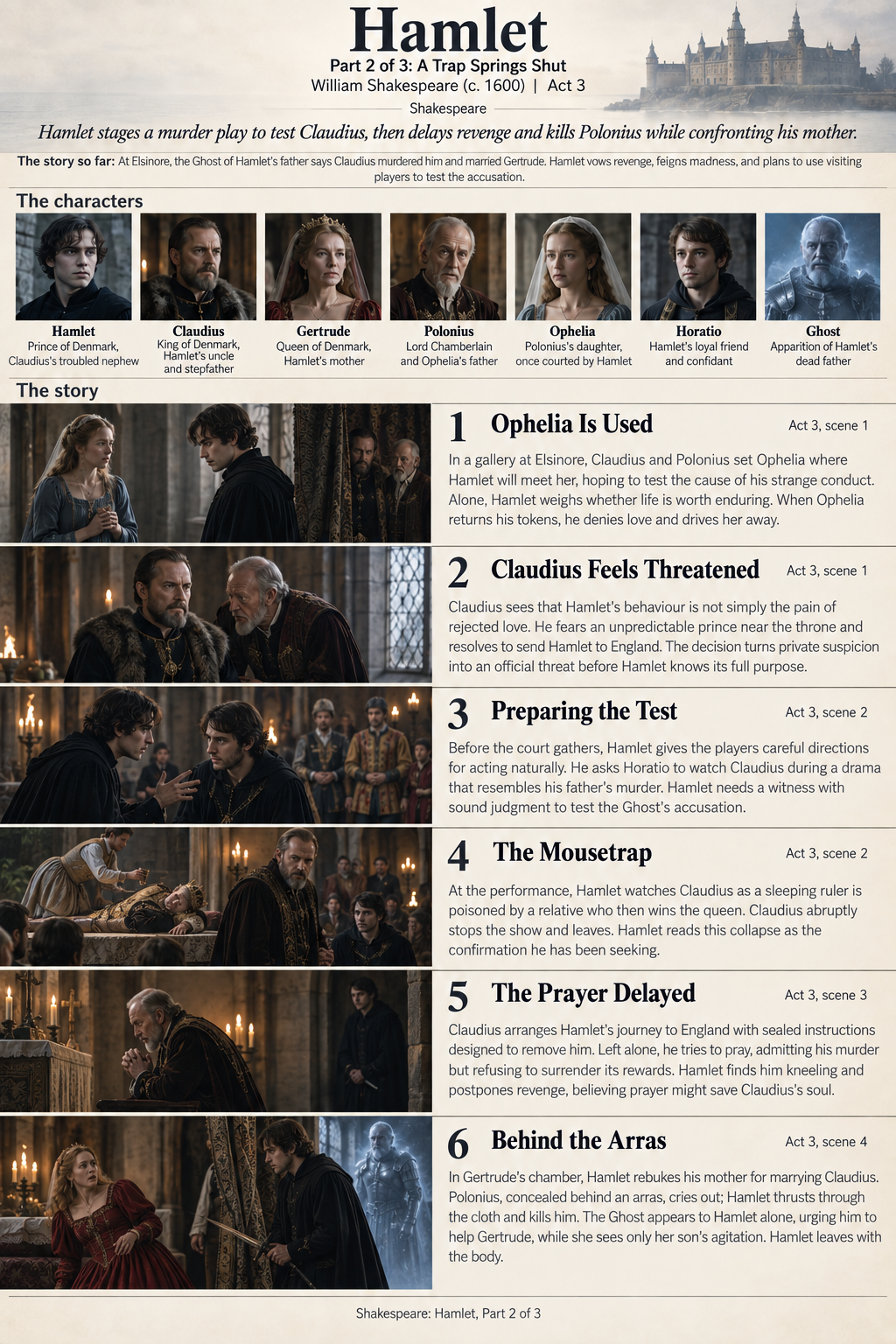
Hamlet stages a murder play to test Claudius, then delays revenge and kills Polonius while confronting his mother.
The story so far: At Elsinore, the Ghost of Hamlet's father says Claudius murdered him and married Gertrude. Hamlet vows revenge, feigns madness, and plans to use visiting players to test the accusation.
Hamlet has learned from the Ghost that his father was murdered by Claudius, who has taken the Danish crown and married Queen Gertrude. Unsure whether the apparition can be trusted, Hamlet has adopted an apparently mad manner and arranged for travelling players to perform a drama that may expose Claudius. Act 3 turns his investigation into open danger, but it also shows how badly his actions wound people around him.
Claudius and Polonius use Ophelia as bait, arranging for her to meet Hamlet while they secretly observe. Before she enters, Hamlet speaks alone about the misery of human life, death, and the fear of what may come after death. When Ophelia tries to return the gifts he gave her, he denies having loved her and tells her to go to a nunnery. His cruelty may be partly performed for the hidden watchers, but the scene gives no simple assurance that it is only an act. Scholars differ over how far Hamlet knows he is watched and how much of his anger is deliberate. Claudius concludes that love has not caused Hamlet's disturbance and decides to send him to England.
Hamlet then prepares the players for their performance, insisting that they speak and move naturally rather than exaggerate. He asks Horatio, whose judgment he trusts, to study Claudius's face during the play. The drama, which Hamlet calls The Mousetrap, shows a sleeping ruler murdered by poison poured into his ear; the murderer then gains the queen. The resemblance to the Ghost's story is pointed, though not exact. Claudius breaks off the performance and calls for light before leaving. To Hamlet, this reaction is the proof he needed that Claudius is guilty.
The apparent success changes Hamlet's confidence but not his ability to act cleanly. Claudius, now convinced that Hamlet is dangerous, orders his journey to England and arranges secret instructions intended to dispose of him. Alone, Claudius tries to pray. He admits that he killed his brother, yet recognizes that he still possesses the crown, power, and queen gained by the crime. His words of repentance rise, but his thoughts remain fixed on what he refuses to surrender.
Hamlet comes upon Claudius kneeling with sword drawn. He does not kill him, because he thinks death during prayer might send Claudius's soul to heaven. The audience has just heard that Claudius cannot truly pray, so Hamlet's calculation is tragically misinformed. Revenge here becomes tangled with theology, uncertainty, and Hamlet's wish not merely to punish Claudius but to control the moral meaning of his punishment. His delay is not simple cowardice; it is an attempt at justice that becomes warped by rage and speculation.
In Gertrude's chamber, Hamlet confronts his mother about her marriage. Polonius hides behind an arras to listen, cries out when Gertrude calls for help, and is immediately stabbed by Hamlet, who mistakes him for another hidden enemy. The Ghost appears again, visible only to Hamlet, and urges him to direct his attention toward Gertrude. Hamlet leaves carrying Polonius's body. The act shows the cost of turning suspicion into violence: Hamlet's search for truth has exposed Claudius, but his haste has killed a man who was not his intended target. It asks readers to notice that moral purpose does not protect anyone from the consequences of reckless action.
Further reading
- Barbara A. Mowat and Paul Werstine, Hamlet (2012)
- Stephen Greenblatt, Hamlet in Purgatory (2001)
- Harold Bloom, Hamlet: Poem Unlimited (2003)