Hamlet, Part 1 of 3: The Ghost's Command
Shakespeare · Part 1 of 3: The Ghost's Command
Hamlet
William Shakespeare (c. 1600) · Acts 1-2
A grieving prince learns a terrible secret, adopts an unsettling disguise, and finds a way to test it.
The play opens at Elsinore, the Danish royal castle, where the night watch has repeatedly seen a figure in armour resembling the dead King Hamlet. Horatio, Hamlet's friend, sees it too. Unable to make the apparition speak, he decides to tell the dead king's son, Prince Hamlet, whose grief already isolates him at court.
Claudius, the dead king's brother, now rules Denmark and has quickly married the widowed Queen Gertrude. In a formal court gathering, he treats the marriage as a practical restoration of order after bereavement. Hamlet, however, wears mourning black and feels disgusted by the speed of his mother's remarriage. When Horatio tells him of the Ghost, Hamlet agrees to watch on the battlements.
The Ghost appears and beckons Hamlet away. It identifies itself as Hamlet's father and says that Claudius murdered him while he slept in his orchard, pouring poison into his ear. It also says that Claudius won both the crown and Gertrude after the murder. The Ghost commands Hamlet to remember him and seek revenge, but tells him not to harm Gertrude. Shaken but resolved, Hamlet makes Horatio and Marcellus swear secrecy. He warns them that he may choose to put on an "antic disposition": he will behave as if mad.
At the palace, Ophelia tells her father, Polonius, that Hamlet entered her room with disordered clothing and a terrified, silent manner. Polonius concludes that Hamlet has been driven mad by love because Ophelia has obeyed him in avoiding the prince. In Act 2, scene 2, Polonius presents this theory to Claudius and Gertrude, reading Hamlet's passionate letter to Ophelia. They agree to observe a meeting between the two young people. Polonius's later conversation with Hamlet, full of Hamlet's mocking and evasive remarks, only strengthens his belief that love is the cause.
Hamlet's behaviour is strategic, but his distress is real. When travelling Players arrive at Elsinore, he welcomes them and asks one actor to recite an emotional speech about Troy. The actor's ability to weep for the imagined Hecuba makes Hamlet condemn his own apparent inaction. Yet he also recognizes a serious problem: the Ghost may be a devil exploiting his melancholy rather than his father's truthful spirit.
Hamlet therefore chooses evidence over immediate violence. He asks the Players to stage a play resembling the alleged murder and plans to observe Claudius's reaction: "The play's the thing / Wherein I'll catch the conscience of the king." This first part develops the pressure of grief, the uncertainty of appearances, and the danger of acting on untested claims. Hamlet's caution can look like delay, but it also shows a moral wish to know what is true before he commits an irreversible act.
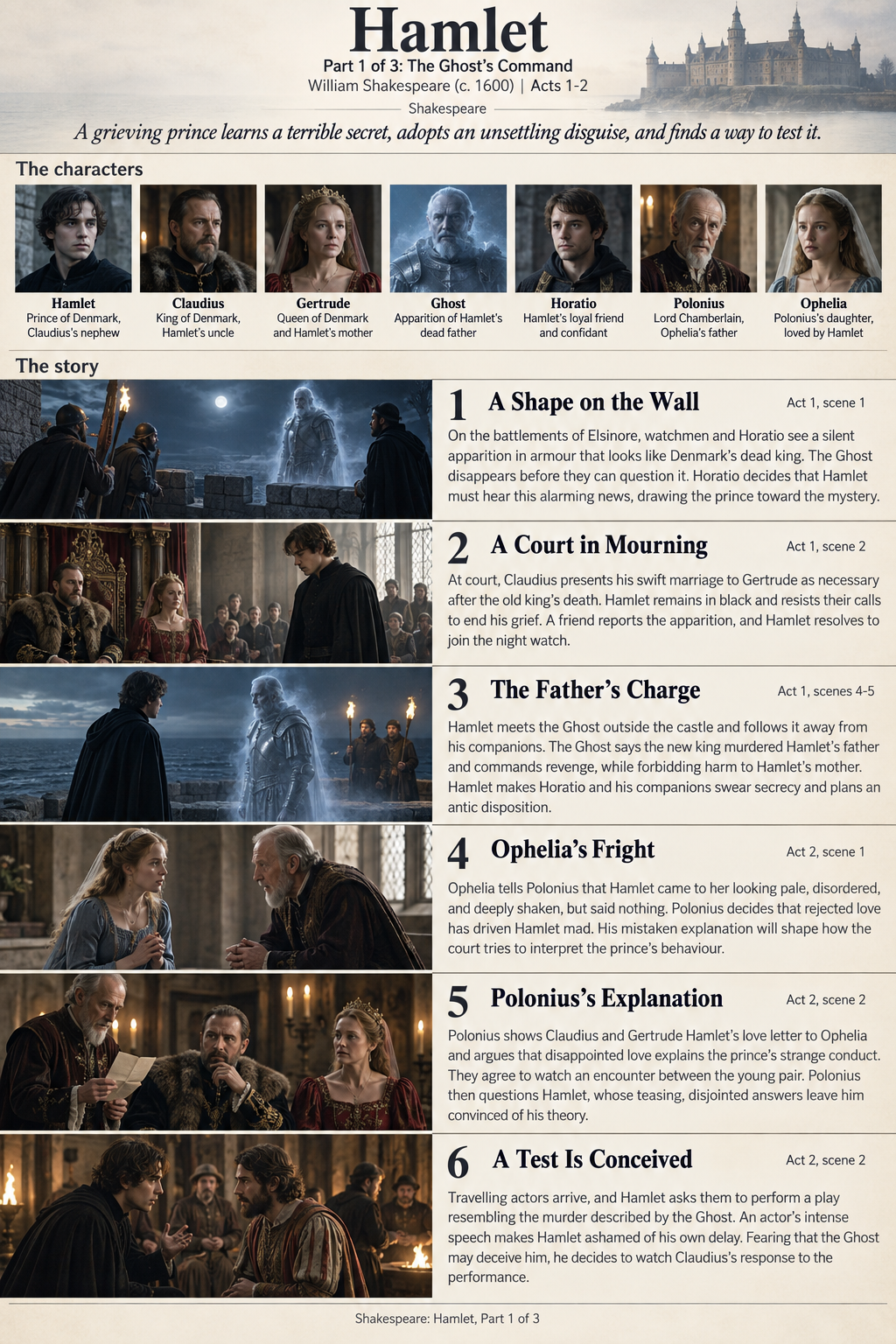
The characters
- Hamlet, Prince of Denmark, Claudius's nephew: Learns of murder and plans a test
- Claudius, King of Denmark, Hamlet's uncle: Defends his marriage and hears Polonius's theory
- Gertrude, Queen of Denmark and Hamlet's mother: Urges Hamlet to stop mourning; hears Polonius
- Ghost, Apparition of Hamlet's dead father: Accuses Claudius and demands revenge from Hamlet
- Horatio, Hamlet's loyal friend and confidant: Sees the Ghost and keeps Hamlet's secret
- Polonius, Lord Chamberlain, Ophelia's father: Mistakes Hamlet's distress for rejected love
- Ophelia, Polonius's daughter, loved by Hamlet: Reports Hamlet's alarming visit to Polonius
The story in six scenes
1. A Shape on the Wall Act 1, scene 1
On the battlements of Elsinore, watchmen and Horatio see a silent apparition in armour that looks like Denmark's dead king. The Ghost disappears before they can question it. Horatio decides that Hamlet must hear this alarming news, drawing the prince toward the mystery.
2. A Court in Mourning Act 1, scene 2
At court, Claudius presents his swift marriage to Gertrude as necessary after the old king's death. Hamlet remains in black and resists their calls to end his grief. A friend reports the apparition, and Hamlet resolves to join the night watch.
3. The Father's Charge Act 1, scenes 4-5
Hamlet meets the Ghost outside the castle and follows it away from his companions. The Ghost says the new king murdered Hamlet's father and commands revenge, while forbidding harm to Hamlet's mother. Hamlet makes Horatio and his companions swear secrecy and plans an antic disposition.
4. Ophelia's Fright Act 2, scene 1
Ophelia tells Polonius that Hamlet came to her looking pale, disordered, and deeply shaken, but said nothing. Polonius decides that rejected love has driven Hamlet mad. His mistaken explanation will shape how the court tries to interpret the prince's behaviour.
5. Polonius's Explanation Act 2, scene 2
Polonius shows Claudius and Gertrude Hamlet's love letter to Ophelia and argues that disappointed love explains the prince's strange conduct. They agree to watch an encounter between the young pair. Polonius then questions Hamlet, whose teasing, disjointed answers leave him convinced of his theory.
6. A Test Is Conceived Act 2, scene 2
Travelling actors arrive, and Hamlet asks them to perform a play resembling the murder described by the Ghost. An actor's intense speech makes Hamlet ashamed of his own delay. Fearing that the Ghost may deceive him, he decides to watch Claudius's response to the performance.
Further reading
- William Shakespeare, edited by Ann Thompson and Neil Taylor, Hamlet: The Arden Shakespeare, Third Series (2006)
- Stephen Greenblatt, Hamlet in Purgatory (2001)
- Harold Bloom, Hamlet: Poem Unlimited (2003)