Great Expectations, Part 1 of 3: The Making of Pip
Dickens · Part 1 of 3: The Making of Pip
Great Expectations
Charles Dickens (1861) · Chapters 1-19
An orphaned boy’s encounter with a fugitive and a strange rich woman leads him to unexpected prospects in London.
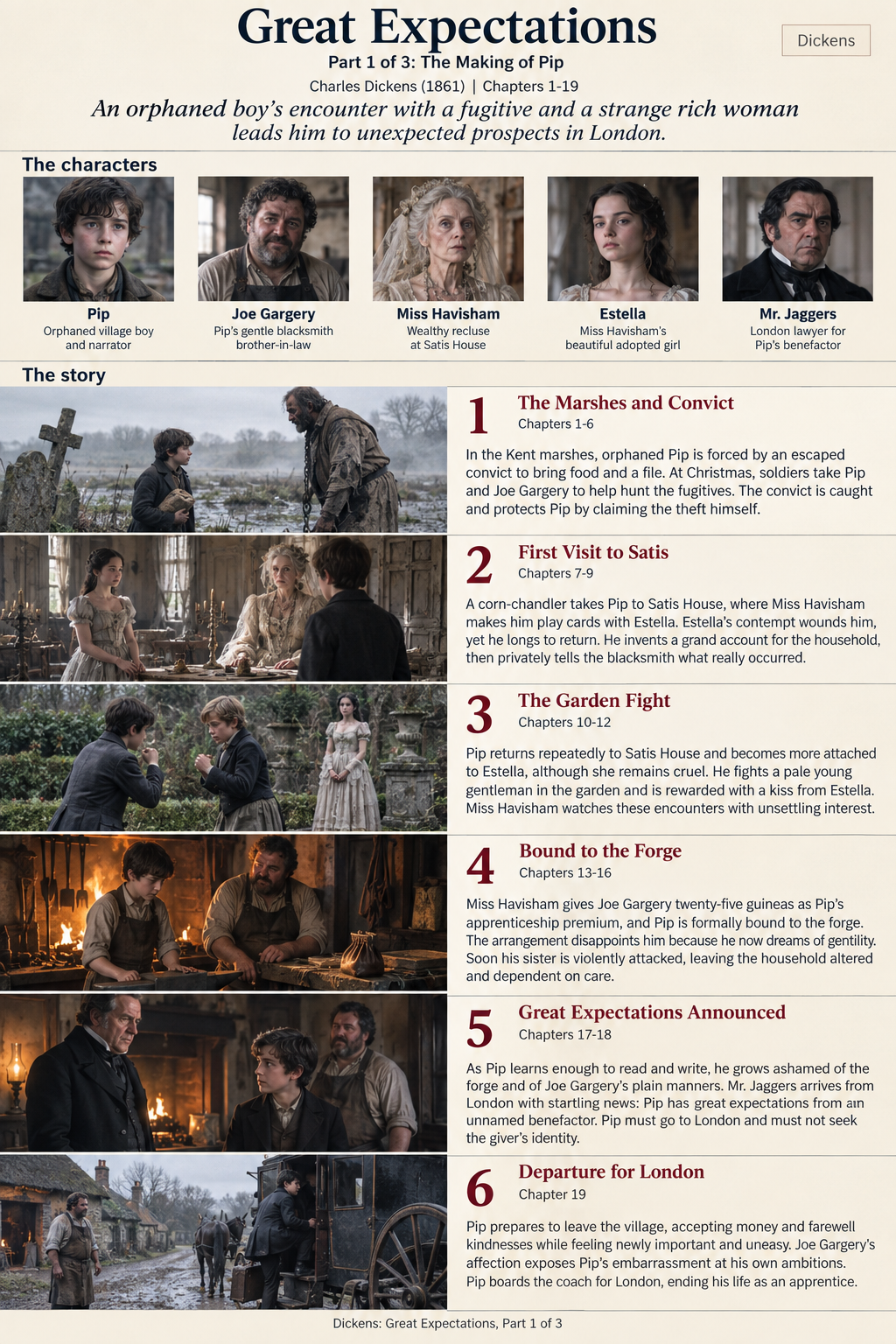
The novel opens in the early nineteenth-century Kent marshes, where Pip, an orphan, lives under the harsh authority of his sister and her gentle husband, the blacksmith Joe Gargery. Visiting his parents’ graves, Pip meets an escaped convict who threatens him into stealing food and a file. Pip obeys in terror. When soldiers later hunt two escaped prisoners, Pip and Joe accompany them; the convict is recaptured and claims responsibility for the stolen goods, sparing the boy.
Pip’s ordinary life changes when Mr. Pumblechook, Joe’s uncle and a corn-chandler, carries him to Satis House. There he meets Miss Havisham, a wealthy recluse who wears an old wedding dress amid the stopped, decaying rooms of her house. She makes Pip play cards with Estella, the beautiful girl in her care. Estella mocks Pip’s coarse hands and boots, but his hurt turns into fascination. Ashamed of the plain truth, he invents a splendid story about the visit for his household, then confesses privately to Joe.
Pip is summoned back to Satis House over many months. He grows increasingly attached to Estella despite her deliberate coldness. In the garden he fights a pale young gentleman, beats him, and receives a kiss from Estella as his reward. Miss Havisham observes Pip’s feelings with peculiar satisfaction. Pip begins to associate being a gentleman with winning Estella’s regard, and the forge that once seemed a secure home now appears to him humiliatingly common.
Miss Havisham eventually gives Joe twenty-five guineas to pay the premium for Pip’s apprenticeship. Pip is formally bound to Joe, although he enters the arrangement without joy. Soon afterwards, Pip’s sister is attacked by an unknown assailant and left severely injured. The violence changes the household, while Pip’s own hopes make him impatient with the life he is meant to lead. He learns to read and write more confidently, but education also sharpens his dissatisfaction and his embarrassment about Joe’s manners.
Then Mr. Jaggers, a powerful London lawyer, arrives with astonishing news. An unknown benefactor has provided Pip with “great expectations”: he is to be brought up as a gentleman, live in London, and use the name Pip. The benefactor insists on remaining unknown. Pip immediately assumes that Miss Havisham intends him for Estella, though Jaggers confirms nothing. In Chapter 19 Pip says farewell to the village and leaves by coach for London, thrilled by the prospect but already uneasy about the affection he has begun to treat as an obstacle.
This opening part develops Dickens’s great question about self-improvement: what does it cost to rise? Pip’s shame teaches him to confuse money, polish, and worth, while Joe’s steady goodness offers a quieter standard. The convict’s unexpected protection and Miss Havisham’s unsettling influence also show that appearances can mislead. Pip’s journey begins with understandable longing, but readers are invited to notice how ambition can make gratitude and loyalty difficult.
Further reading
- Charles Dickens, Great Expectations (2008)
- Peter Ackroyd, Dickens (1990)
- Claire Tomalin, Charles Dickens: A Life (2011)