Emma, Part 1 of 3: A Matchmaker's Costly Mistakes
Austen · Part 1 of 3: A Matchmaker's Costly Mistakes
Emma
Jane Austen (1815) · Volume 1, Chapters 1-18
Emma Woodhouse adopts a humble friend, Harriet Smith, and tries to arrange her marriage, but misreads everyone's feelings, including her own power.
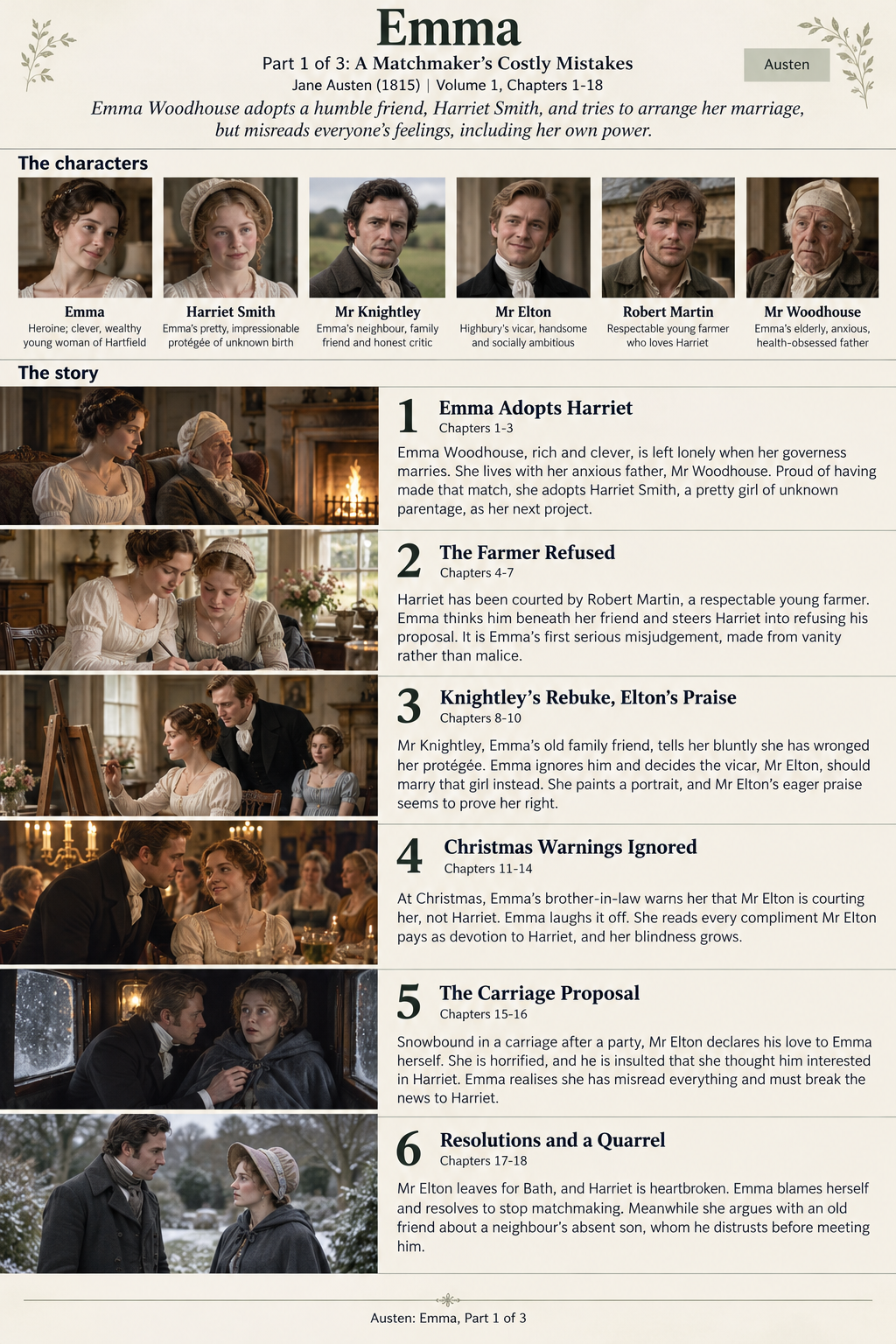
Emma opens with a heroine who seems to have everything. Emma Woodhouse is handsome, clever and rich, the mistress of Hartfield in the village of Highbury, and she lives with her devoted, nervous father, Mr Woodhouse. Her governess and closest companion, Miss Taylor, has just married a neighbour, Mr Weston, and Emma, congratulating herself on having arranged the match, feels the loss keenly.
To fill the gap she befriends Harriet Smith, a pretty seventeen-year-old boarder at a local school whose parentage is unknown. Emma decides to improve her and to find her a grand husband. When a respectable young farmer, Robert Martin, proposes by letter, Emma talks Harriet into refusing him, insisting he is beneath her. Mr Knightley, the brother of Emma's sister's husband and a sensible old friend, tells her bluntly that she has done Harriet a disservice. Emma refuses to listen, and the two part in disagreement.
Emma's next scheme is to match Harriet with Mr Elton, the vicar. She draws Harriet's portrait and Mr Elton gushes over it, which Emma takes as proof of love. At Christmas, Emma's brother-in-law, John Knightley, warns her that Mr Elton is paying court to her, but she waves it away. Then, shut in a carriage after a snowy dinner party, Mr Elton declares his love to Emma. She is appalled, and he is equally offended that she imagined he would stoop to Harriet. Emma has to confess to Harriet, who is heartbroken, while Mr Elton withdraws to Bath. Emma resolves, at least for now, to stop playing with other people's lives. The volume closes with talk of Mr Weston's son, Frank Churchill, who has been expected for years, and with a quarrel in which Mr Knightley judges him harshly before they have met.
Emma's motives are mostly kind but also vain. She likes being the person who arranges lives, and she mistakes her own wishes for facts. Her snobbery about Robert Martin and about Harriet's prospects shows how deeply class shapes her thinking. After the carriage scene she shows real remorse, and a first awareness of her own failings, though not yet a lasting change. Mr Knightley, by contrast, is steady and truthful, and the novel quietly sets his judgement against hers.
The main themes are self-deception, class and the limits of social control. Emma reads people through her own imagination, and the book repeatedly shows how reasoning from assumptions rather than evidence leads astray. Austen also explores how a young woman with power, but little to do, can misuse it. Scholars sometimes debate how far to sympathise with Emma and how far to see her as a satire on privileged complacency.
The lessons are practical. Good intentions do not excuse harm, and advice from honest friends deserves a hearing even when it stings. We should look at what people actually do rather than what we want them to feel. Above all, interfering in other people's hearts is dangerous, because their happiness is not ours to arrange.
Further reading
- Jane Austen, ed. Fiona Stafford, Emma (Penguin Classics) (2003)
- Claire Tomalin, Jane Austen: A Life (1997)
- Janet Todd, The Cambridge Introduction to Jane Austen (2006)