Emma, Part 2 of 3: Strangers Arrive in Highbury
Austen · Part 2 of 3: Strangers Arrive in Highbury
Emma
Jane Austen (1815) · Volume 2, Chapters 19-36
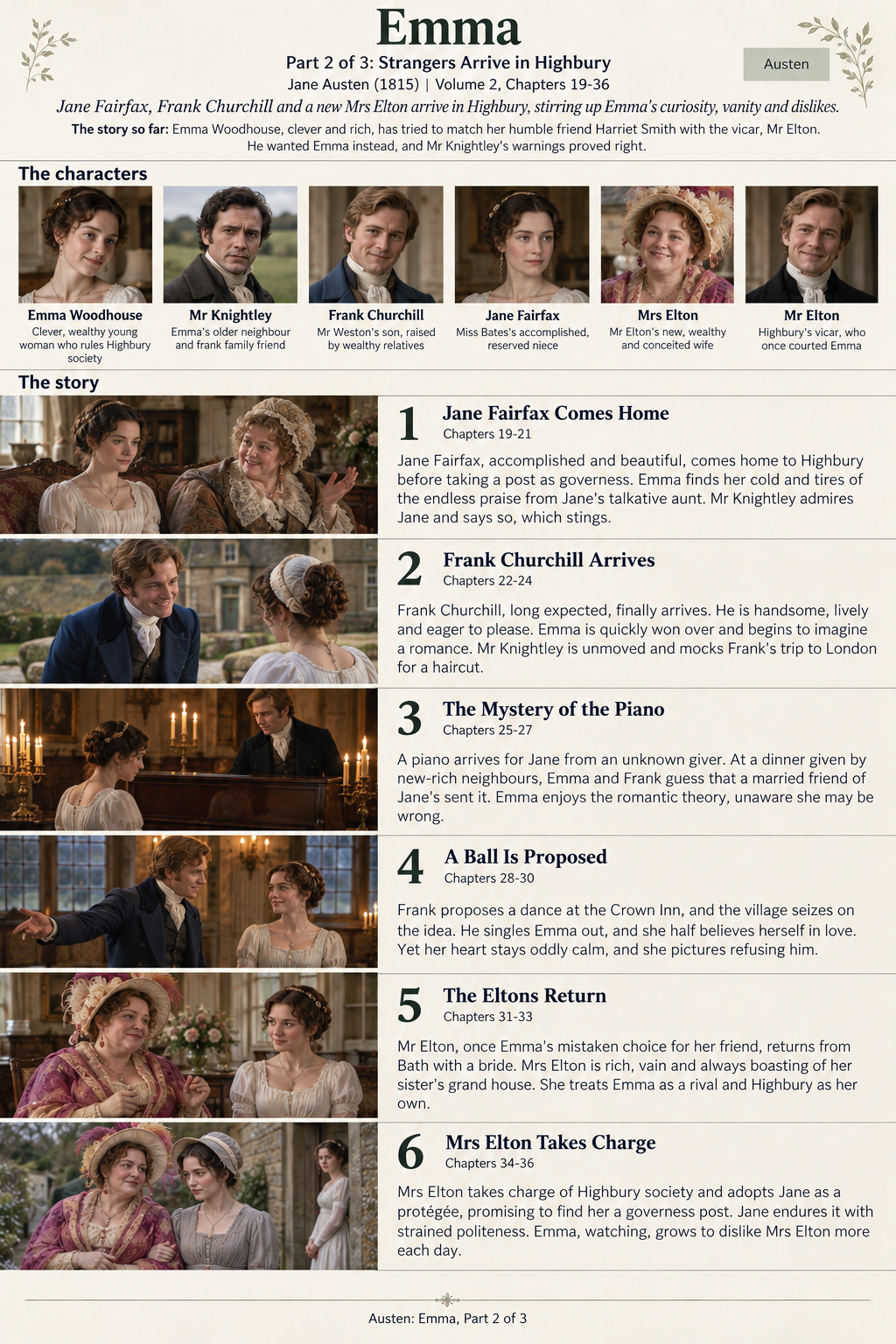
Jane Fairfax, Frank Churchill and a new Mrs Elton arrive in Highbury, stirring up Emma's curiosity, vanity and dislikes.
The story so far: Emma Woodhouse, clever and rich, has tried to match her humble friend Harriet Smith with the vicar, Mr Elton. He wanted Emma instead, and Mr Knightley's warnings proved right.
Emma Woodhouse, handsome, clever and rich, rules the Surrey village of Highbury from her father's house, Hartfield. In the first part she took up the humble Harriet Smith, steered her away from a good match with a farmer, and wrongly believed that the vicar, Mr Elton, loved Harriet when he wanted Emma herself. Mr Knightley, an old family friend, had warned her.
This part opens as Highbury awaits two arrivals. Jane Fairfax, the accomplished, beautiful niece of the talkative Miss Bates, comes home before taking a post as governess. Emma finds her reserved and has never warmed to her. Mr Knightley, by contrast, admires Jane and thinks Emma could learn from her. Then Frank Churchill, the son of Emma's friend Mr Weston, who was adopted by wealthy relatives in Yorkshire, makes the visit he has long postponed. He is handsome, easy and flattering, and Emma is delighted. Mr Knightley, hearing that Frank has gone to London for a haircut, is scathing. A piano arrives for Jane from an unknown giver, and at a dinner given by the Coles, a family risen from trade, Emma and Frank agree it must come from a married friend who secretly admires her. Frank then proposes a ball at the Crown Inn, and the village plans it eagerly. Meanwhile Mr Elton returns from Bath with a bride. Mrs Elton is rich, vain and forever praising her sister's grand home, Maple Grove. She sets herself up as Highbury's leading lady and patronises Jane, promising to find her a place.
Emma's motives are mixed. She likes to be admired, and she enjoys imagining herself in love with Frank, though her heart seems oddly calm. Her coolness toward Jane owes something to jealousy of a rival who is more accomplished, as well as to Jane's guardedness. Frank's brilliance sometimes seems to hide something. Mr Knightley is steadier and more observant, and critics differ on whether his dislike of Frank is simply sound judgment or also the first hint of feelings he has not yet named.
The part explores class and manners, as Highbury's ranks shift with the Coles' rise and Mrs Elton's pretensions. It shows how gossip and imagination can pass for knowledge, for Emma builds a whole romance out of a piano. It also contrasts easy charm with real worth, and shows how reserve can look like coldness.
Readers may take away a caution about judging others from the outside. Emma's confident guesses about Jane's private life are entertaining and unkind, and the novel suggests that silence deserves respect. Charm is not character, and honest criticism, like Mr Knightley's, is easy to resent but valuable. Mrs Elton, meanwhile, shows how easily snobbery can disguise itself as generosity.
Further reading
- Jane Austen, edited by Fiona Stafford, Emma (Penguin Classics) (2003)
- Claire Tomalin, Jane Austen: A Life (1997)
- Claudia L. Johnson, Jane Austen: Women, Politics, and the Novel (1988)